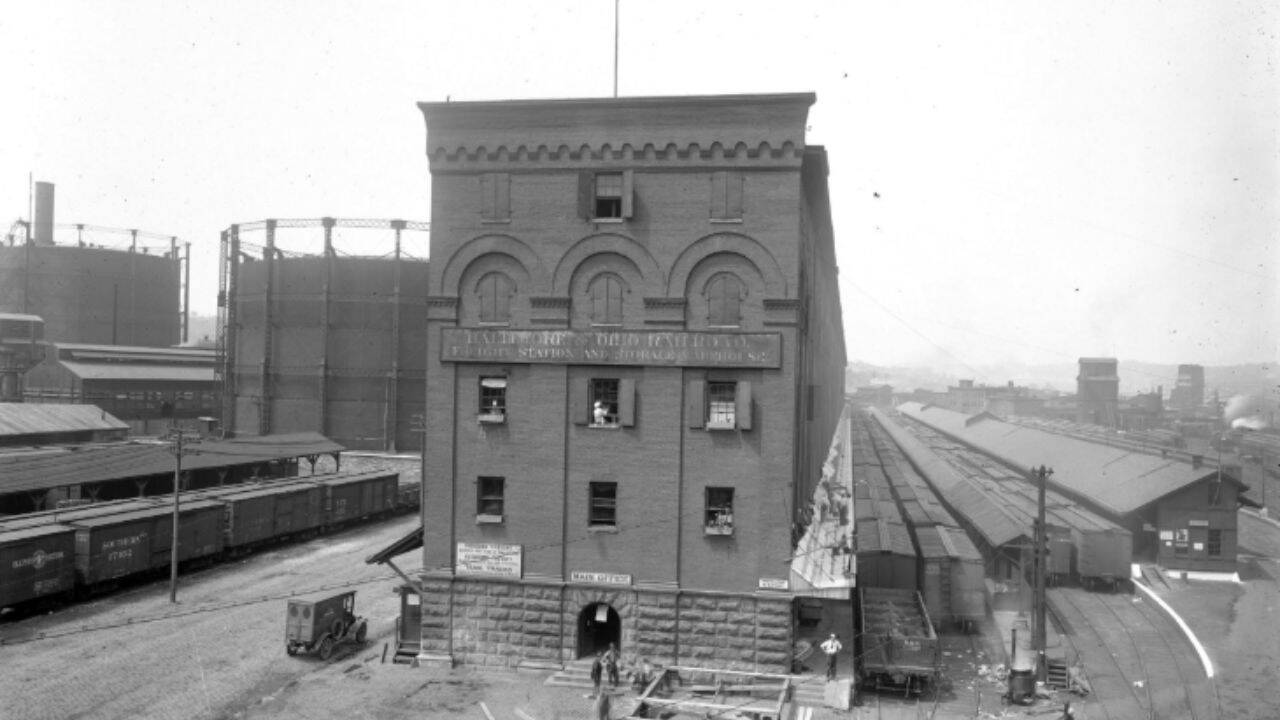
History isn't always preserved in marble monuments or grand downtown museums. Sometimes, it sits right next to railway tracks, disguised as a mundane industrial box. Standing tall on Cincinnati's landscape, the historic freight warehouse built back in 1904 tells a wild story of logistics, ambition, and eventual urban amputation.
People drive past massive old buildings every day without giving them a second glance. They assume old brick is just old brick. They're wrong. When this concrete and brick titan went up at the start of the twentieth century, it stretched an astonishing 1,227 feet in length. It wasn't just big. It dominated the local transit infrastructure. It stood proudly among the longest structures on the entire planet. Read more on a connected issue: this related article.
Today, you won't find the full 1,227 feet. Modern development happened. Part of it vanished. Exactly 210 feet of the original footprint are completely gone, chewed up by shifting transportation needs and highway expansion. If you want to understand how midwestern commerce shaped America, you have to look closely at this massive Cincinnati warehouse.
The Engineering Marvel of 1904
Railroads ruled the world at the turn of the twentieth century. Cities grew because freight moved. When companies designed massive freight depots, they didn't mess around with small footprints. They needed scale. They needed speed. Additional journalism by Vogue explores similar perspectives on the subject.
The Big Four Railroad built this specific freight house to handle mountains of goods moving through the Midwest. Think about the logistics challenge. Goods arrived by rail car. Workers unloaded boxes, crated machinery, sorted dry goods, and loaded them onto local delivery wagons. Doing that efficiently requires a straight line. Long, narrow buildings let freight operators move items from boxcars directly across platforms without wasting precious hours.
Measuring over a fifth of a mile long, the building was a masterclass in industrial utility.
- Massive sliding doors lined the loading bays.
- Heavy timber frames supported sprawling rooflines.
- Concrete foundations handled the immense weight of constant foot traffic and heavy cargo.
It was loud. It smelled of coal smoke, damp wood, and sweat. It was the beating heart of regional supply chains long before anyone uttered supply chain buzzwords.
Why 210 Feet Had to Go
Time doesn't care about historical length. Cities expand, freeways slice through neighborhoods, and industrial districts morph into office parks or empty lots. Progress has a cost.
The removal of those 210 feet wasn't a sudden disaster. It happened piece by piece as urban planners remapped Cincinnati's transit corridors. As trucks replaced rail freight for regional deliveries, massive rail-adjacent warehouses lost their original purpose. Municipalities needed right-of-ways. Interstates required clearance. The building shrank because the city around it changed its mind about how traffic should flow.
Losing nearly two football fields of industrial history stings if you love local architecture. Yet, the remaining portion still stands as a stubborn reminder of early 1900s construction durability. Modern commercial buildings get thrown up with steel studs and foam panels meant to last thirty years. This warehouse was built like a fortress. Even with the amputation, the remaining length commands attention.
Spotting Industrial History in the Wild
You shouldn't just read about architectural landmarks. Go look at them. If you find yourself exploring Cincinnati's industrial corridors, take a detour to trace the old rail lines. Look for long, low-slung brick profiles that seem to stretch endlessly down the block.
When you stand next to a structure that once measured 1,227 feet, scale hits you differently. Notice the rhythm of the brick piers. Look for the ghost signs or faded markings of old rail platforms. You start to see how nineteenth and twentieth-century engineers solved problems with sheer physical mass.
Preserving these spaces takes active work. Local preservationists fight constant battles against demolition crews who see old warehouses as vacant lots waiting for new parking structures. Support local historical societies. Pay attention to zoning fights in your own town. Old industrial architecture anchors our cities in physical reality. Don't let it disappear quietly.