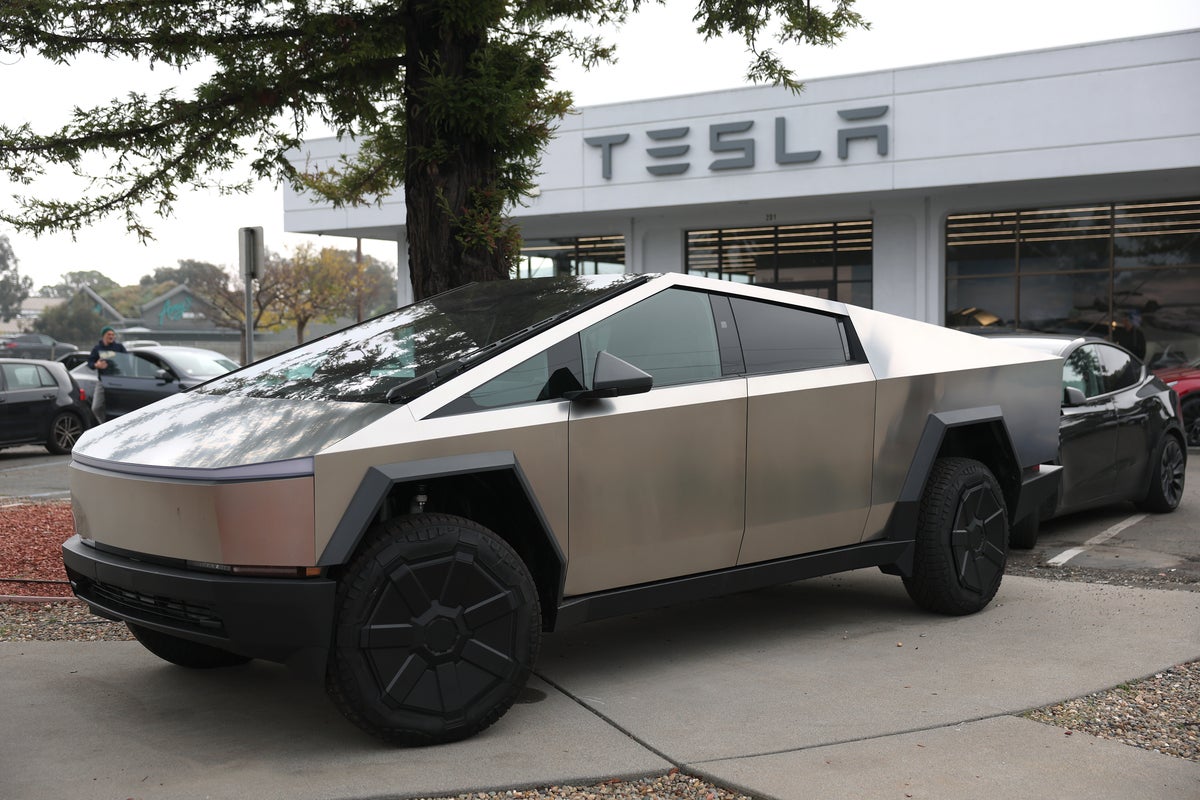
The convergence of political identity and consumer behavior has reached a point of systemic friction, exemplified by the market reaction to high-visibility liberal influencers adopting the Tesla Cybertruck. This phenomenon is not merely a social media "roast" but a documented collapse of brand-alignment logic. When a public figure whose platform is built on environmental advocacy, social equity, or anti-corporate sentiment acquires a vehicle that represents brutalist aestheticism and the idiosyncratic brand of Elon Musk, they trigger a multi-vector backlash. This backlash is fueled by three distinct structural misalignments: the Ethos-Product Gap, the Social Proof Paradox, and the Utility vs. Symbolism Contradiction.
Understanding this friction requires moving beyond the superficial "hypocrisy" narrative and examining the underlying mechanics of how objects function as identity proxies in a polarized digital economy. Meanwhile, you can find related events here: Why Tech Leaders Are Turning to Ancient Religion to Fix Ethical AI.
The Triad of Brand Friction
The visceral reaction on platforms like X (formerly Twitter) functions as a real-time audit of an influencer’s brand equity. This audit focuses on three specific variables:
- Aesthetic Conflict: The Cybertruck’s design language—characterized by cold-rolled stainless steel and sharp, angular geometry—is a deliberate departure from the "soft" sustainability cues usually associated with liberal environmentalism.
- Leadership Association: The vehicle is inseparable from the public persona of Elon Musk. For a liberal influencer, the act of purchase is mathematically interpreted by their audience as a direct capital contribution to a political adversary.
- The Luxury-Utility Disconnect: While marketed as a rugged utility vehicle, the Cybertruck functions primarily as a high-status luxury asset. When an influencer who critiques wealth inequality displays such an asset, they violate the internal logic of their own ideological framework.
The Mechanics of Social Capital Depreciation
In a digital ecosystem, an influencer’s value is a function of their perceived authenticity. This can be expressed as:
$$V = \frac{A \times C}{S}$$
Where V is Brand Value, A is Authenticity, C is Consistency, and S is Signaling Noise. To see the full picture, check out the detailed report by Gizmodo.
When an influencer purchases a Cybertruck, S (Signaling Noise) increases exponentially because the vehicle sends a signal that contradicts the influencer's established C (Consistency). This leads to a rapid depreciation of V (Brand Value). The "roasting" observed online is the market's way of correcting an overvalued brand that has failed its consistency check.
The Audience as an Algorithmic Auditor
Audiences no longer consume content in a vacuum; they act as distributed auditors. They compare an influencer's historical data points (previous tweets, videos, and sponsorships) against new acquisitions. The Cybertruck serves as a "high-contrast" data point. Its physical presence is so jarring that it makes any ideological deviation impossible to ignore. This creates a Cognitive Dissonance Loop:
- Step 1: The influencer displays the vehicle to signal "innovation" or "tech-forwardness."
- Step 2: The audience perceives "wealth display" and "support for a polarizing figure."
- Step 3: The influencer attempts to justify the purchase through environmental or technical specs.
- Step 4: The audience identifies the logical fallacies (e.g., the carbon footprint of manufacturing a 6,600-pound steel vehicle vs. smaller EVs).
The Engineering of Outrage: Why the Cybertruck is a Unique Catalyst
The Cybertruck is not a standard automobile; it is a low-poly, physical manifestation of internet culture. Unlike a Porsche or a Rivian, which carry established prestige markers, the Cybertruck is a "meme-asset."
The Materiality of Polarization
The choice of 30X cold-rolled stainless steel is more than an engineering decision; it is a rejection of the "crumple-zone" aesthetic of modern safety-first design. For critics, this represents a lack of empathy for other road users (pedestrians and smaller cars). When a liberal influencer—who likely advocates for "walkable cities" or "public safety"—drives a vehicle that is perceived as a "pedestrian-unfriendly kinetic weapon," the ideological breach is total.
The Ownership Stake as Political Endorsement
In the current attention economy, where "vote with your dollar" has moved from a slogan to a primary mode of activism, the purchase of a $100,000+ vehicle is viewed as a significant campaign contribution. The influencer is not just buying a car; they are providing liquid capital and brand validation to a CEO whose personal politics are often antithetical to the influencer's stated mission. This creates a "funding the opposition" narrative that is impossible to deconstruct through standard PR maneuvers.
Categorizing the Criticisms: A Framework of Hostility
The "roasting" of influencers follows a predictable taxonomy. By categorizing these attacks, we can see how the audience deconstructs the influencer’s strategy:
1. The Hypocrisy Tax
This is the most common form of feedback. It targets the gap between the influencer's rhetoric (e.g., "tax the rich") and their behavior (buying a high-priced status symbol). The severity of the tax is proportional to the influencer's previous level of moralizing.
2. The Aesthetic Rejection
This critique focuses on the "ugly" or "unfinished" look of the vehicle. By attacking the influencer’s taste, the audience is effectively attacking their judgment. If an influencer cannot see that a vehicle "looks like a refrigerator," how can they be trusted to interpret complex political or social issues?
3. The Technical Skepticism
A more sophisticated segment of the audience focuses on the Cybertruck’s well-documented production issues, such as panel gaps, rusting (iron contamination), and software glitches. By highlighting these, the audience frames the influencer as a "sucker" who fell for marketing hype rather than a savvy early adopter.
The Strategy of the Failed Pivot
Many influencers attempt to frame the purchase as a "technological necessity" or a "curiosity-driven experiment." This rarely succeeds because it ignores the Symbolic Weight of the object.
To successfully pivot, an influencer would need to apply a Mitigation Framework:
- Pre-emptive Transparency: Acknowledging the conflict before the audience does.
- Decoupling the Product from the Creator: Focusing strictly on technical benchmarks while distancing themselves from the manufacturer’s personal politics.
- The Utility Proof: Demonstrating a specific, non-prestige use case for the vehicle that justifies its footprint (e.g., heavy towing in a remote area for a specific project).
Most influencers fail this because they treat the Cybertruck as a standard lifestyle upgrade rather than a high-risk brand pivot. They underestimate the degree to which their audience views every purchase as a data point in a larger moral ledger.
The Economics of Reputation Damage
The long-term impact of this misalignment is a "Trust Deficit." Once an influencer is categorized as "out of touch" or "inconsistent," their ability to mobilize their audience for political or social causes diminishes. This is a quantifiable loss.
Consider the Engagement-Conversion Ratio:
An influencer with high trust can convert 5% of their audience to take action (donate, vote, or sign a petition). After a high-visibility brand misalignment like the Cybertruck purchase, that conversion rate can drop to 1-2%, even if their total follower count remains the same. The "hate-follows" increase, but the "actionable-follows" decrease.
The Feedback Loop of the "Roast"
Social media algorithms prioritize high-arousal content. A "roast" creates a feedback loop where:
- Negative comments increase.
- The algorithm sees high engagement and pushes the post to more people.
- The larger audience (beyond the influencer’s base) joins in the critique.
- The influencer becomes "viral" for all the wrong reasons, permanently tattooing the "hypocrite" label onto their digital footprint.
Structural Observations on the Future of Political Consumerism
The Cybertruck incident is a bellwether for a broader trend: the "Hardening of the Symbol." In previous decades, a car was largely just a car. In the 2020s, every major purchase is a signal in a global identity war.
For influencers, the margin for error is shrinking. The "Middle Ground" of consumption is disappearing. You either consume in total alignment with your tribe, or you face an immediate and brutal audit. The Cybertruck is particularly dangerous for this because it lacks any "neutral" ground—it was designed specifically to be a polarizing artifact.
Strategic Recommendation for High-Visibility Personal Brands
Influencers and public figures must transition from "Lifestyle Curation" to "Ideological Auditing" of their physical assets. Before any high-visibility acquisition, a brand must perform a Tri-Vector Impact Assessment:
- Founder Alignment: Does the manufacturer’s leadership hold positions that negate my core messaging?
- Aesthetic Signaling: Does the object’s design language reinforce or contradict my brand’s "vibe"? (e.g., Minimalism vs. Brutalism).
- Community Friction: What is the "Outrage Potential" of this asset on a scale of 1 to 10?
If the Outrage Potential exceeds the Functional Utility, the acquisition is a net-negative for the brand's long-term equity. In the case of the liberal influencer and the Cybertruck, the Outrage Potential was a 10, while the Functional Utility was virtually identical to less controversial EV alternatives. The result was an inevitable collapse of brand authority.
The move forward is not to apologize—which often signals weakness to the "roasting" crowd—but to lean into the technical data of the vehicle while aggressively over-indexing on the influencer's core political work to re-balance the moral ledger. However, the most efficient strategy remains avoidance: in a world of high-definition digital auditing, the most expensive purchase you can make is the one that costs you your credibility.