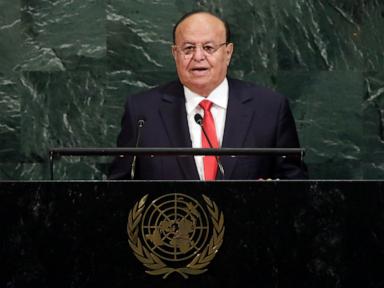
The passing of former Yemen president Abdrabbuh Mansour Hadi at age 80 marks the definitive end of an era. It's an era most observers misunderstood while it was happening. News of his death in Saudi Arabia, where he lived in exile for years, closed a chapter on a leader who held the official title of president during one of the world's most devastating humanitarian crises.
To understand the current state of Middle Eastern geopolitics, you have to look closely at Hadi's turbulent tenure. He wasn't just a bystander. He was the central figure around whom the complex Yemeni civil war revolved.
Many mainstream media outlets portray Hadi as a weak leader who simply lost control of his country. That's a massive oversimplification. The real story of his political life reveals how regional proxy wars, deep-seated tribal fractures, and well-intentioned international transition plans can collide to tear a nation apart.
The Accidental President Who Inherited an Impossible Situation
Hadi didn't claw his way to the absolute top through charismatic populism. He climbed through the ranks of the military and served as a quiet, loyal vice president to Ali Abdullah Saleh for nearly two decades. When the Arab Spring protests swept through Sanaa in 2011, the Gulf Cooperation Council brokered a transition deal. Saleh stepped down. Hadi took the reins in 2012.
He ran in a one-man election. Think about that for a second. He secured millions of votes because Yemenis desperately wanted stability, not because he possessed a roaring political mandate.
Hadi's Path to Power:
1994: Appointed Vice President by Ali Abdullah Saleh
2011: Arab Spring protests destabilize the regime
2012: Takes power as the sole candidate in a transition election
2015: Flees Sanaa after Houthi rebels seize the capital
The structural flaws of that transition plan sealed his fate from day one. The international community, backed heavily by the United Nations, treated Yemen like a standard political negotiation. They assumed a National Dialogue Conference could smooth over decades of intense regional grievances. It didn't work. Hadi found himself caught between a vengeful former president Saleh—who aligned with his old enemies, the Houthi rebels—and a population growing impatient with the lack of economic progress.
How the 2015 Crisis Rewrote Middle Eastern Alliances
By late 2014, the Houthi movement marched out of their northern stronghold in Saada and took control of Sanaa. Hadi was placed under house arrest. In early 2015, he escaped to the southern port city of Aden, rescinded his forced resignation, and declared Aden the temporary capital.
The critical turning point came when Hadi fled across the border to Saudi Arabia. He requested direct military intervention. This single move transformed a localized civil conflict into a massive regional proxy war.
A coalition led by Saudi Arabia launched Operation Decisive Storm in March 2015. They promised a quick victory to restore Hadi's legitimate government. Instead, the intervention triggered a brutal, deadlocked conflict that dragged on for years. The United Nations consistently labeled the situation in Yemen as the world's worst humanitarian crisis, with widespread famine, cholera outbreaks, and a collapsed economy.
Hadi spent the vast majority of his remaining presidency operating out of Riyadh hotels and palaces. This created a profound legitimacy crisis. It's incredibly difficult to project authority over a war-torn nation when you aren't living among the people suffering through the bombs and blockades.
The Reality Behind the Riyadh Resignation
For years, the international community clung to Hadi because he represented the sole legal mechanism of state legitimacy under UN Security Council Resolution 2216. If Hadi wasn't the president, the Saudi-led intervention lost its legal veneer.
That dynamic broke completely in April 2022. Under intense pressure from Saudi Arabia and the United Arab Emirates, Hadi sat in front of a television camera and read a statement transferring his full powers to an eight-member Presidential Leadership Council.
Political analysts knew exactly what happened behind closed doors. It was a forced exit. The coalition realized that Hadi was an insurmountable barrier to any realistic peace talks with the Houthis. The Houthis refused to negotiate with him, viewing him as a puppet of foreign powers. By removing him from the equation, Riyadh hoped to pave a smoother path toward an exit strategy from the costly conflict. After handing over power, Hadi largely vanished from public life, remaining in Riyadh until his death.
Why Analyzing This History Matters for Future Peace
Western policymakers frequently make the mistake of looking at conflicts like Yemen through a simplistic binary lens. They see good guys versus bad guys. Legitimate governments versus rebels.
Hadi's legacy proves that formal legitimacy means absolutely nothing without local enforcement capability and genuine domestic trust. You can't govern a country via decree from a neighboring capital.
The current Presidential Leadership Council still struggles with the exact same internal divisions that plagued Hadi's final years in power. The southern secessionists, northern tribes, and traditional loyalists don't share a unified vision for a future Yemen. They merely share a common adversary.
If you want to understand where the region goes next, stop looking at superficial political declarations. Focus instead on the ground realities of economic fragmentation, port control, and local tribal alliances. True political stability in the region requires building governance from the ground up, rather than imposing a top-down leader via international consensus. Anyone studying global diplomacy should view the failures of the 2012 Yemeni transition as a stark warning.