Stand on the waterfront of Hong Kong International Airport just as the evening humidity softens into a gray, coastal haze. Metal beasts roar overhead, tearing upward into the clouds with bellies full of cargo and travelers seeking futures elsewhere. For decades, this patch of reclaimed earth was understood as a place of transit. People arrived. People left. Nobody stayed.
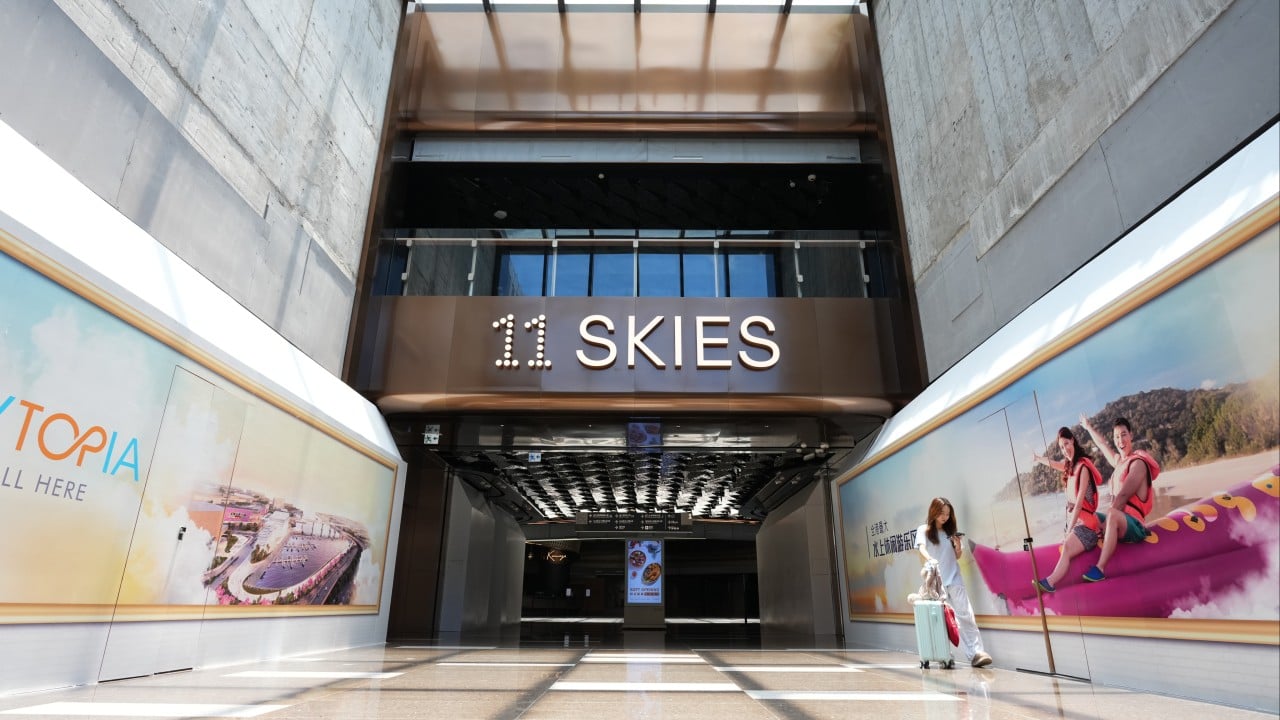
Then came the concrete skeleton of 11 Skies.
Rising near the perimeter of the passenger terminals, this multi-billion-dollar behemoth of retail, entertainment, and workspace was supposed to redefine what an airport district could be. It was conceived as a destination in its own right—a towering promise of leisure built for a world that moved constantly.
Yet, ambition often outpaces reality. Markets shift. Global travel freezes, thaws, and fractures. The sprawling commercial hub found itself navigating a complex labyrinth of economic turbulence, waiting for a guiding hand strong enough to steady its weight.
Enter the Airport Authority.
To understand why the return of the 11 Skies project to the Authority's direct oversight matters, you have to look past the spreadsheets. You have to look at how a city breathes.
The Anatomy of a Concrete Promise
Imagine stepping off a twelve-hour flight. Your legs are stiff. Your mind is foggy with jet lag. In the old days, you caught a taxi into the urban core or sat miserably in a sterile departure lounge watching the seconds tick away on a flickering monitor.
The architects of 11 Skies envisioned a different rhythm. They wanted a district where commerce and culture collided right at the border of the tarmac. Entertainment spaces, immersive experiences, and wellness hubs were stitched together by glass bridges and subterranean corridors. It was an ecosystem designed to capture the modern wanderer.
But building an ecosystem is easy. Sustaining it when the global economic tide goes out is another matter entirely.
When private entities face prolonged headwinds, grand visions risk becoming hollow monuments. The financial strain rippled through the development. Construction milestones stretched. The delicate choreography of retail leasing slowed to a crawl. The grand promise began to look less like a gateway and more like a gamble.
That is when leadership changes. Not out of luxury, but out of necessity.
The Logic of Centralized Gravity
When the Airport Authority steps in to absorb or redirect a project of this magnitude, critics often mutter about state overreach or market interference. They look at the balance sheets and see risk.
They miss the deeper pattern.
Airports are no longer just runways and baggage carousels. In the modern global economy, they are municipal hearts. They are the first impression a visitor gets of a territory and the last memory they carry away. If the immediate surroundings look tentative or incomplete, the entire economic narrative suffers.
By consolidating control over 11 Skies, the Airport Authority achieves something private operators struggling in a volatile climate simply cannot: synchronization.
Consider how an airport functions at its best. Baggage systems talk to air traffic control. Customs syncs with immigration. Ferries, high-speed rail links, and buses weave into a single, pulse-driven timetable. When the massive commercial development adjacent to the terminals operates under that same centralized gravity, friction disappears.
It becomes part of the machine.
Industry analysts point out that this consolidation will likely spur broader hub development across the region. Why? Because certainty breeds investment. When developers, airlines, and international brands see a single, authoritative entity steering the ship with ultimate accountability, the hesitation thins. They are no longer betting on a fractured venture; they are investing in the infrastructural backbone of a global financial capital.
The Human Scale of Mega-Projects
It is easy to get lost in the nomenclature of aviation logistics. We talk about "passenger throughput," "yield optimization," and "commercial square footage" as if human beings were liquid flowing through pipes.
Let us bring it down to the ground.
Meet Marcus. Marcus is a retail logistics manager who spent twenty years working out of cargo hubs across Europe before moving to East Asia. When he first walked through the cavernous atriums of the unfinished 11 Skies complex, he felt a familiar dread. The spaces were breathtakingly vast, yet eerily quiet. Workers huddled in corners, discussing delayed timelines and renegotiated contracts.
"Scale is a monster," Marcus told me over a steaming cup of milk tea near Tung Chung, watching the skyline flicker against the dusk. "If you build something big enough to hold a small city, you need a government-backed heartbeat to keep the blood pumping through it. Private capital builds the skeleton. But sometimes, only public infrastructure can carry the weight until the city catches up."
Marcus isn't an economist. He is a guy who manages inventory docks and warehouse floor plans. But his observation cuts straight to the core of the issue.
When a project like 11 Skies stumbles, the shockwaves are felt by thousands of workers, local suppliers, and regional service providers whose livelihoods depend on steady foot traffic. Bringing the project back under the strategic umbrella of the Airport Authority provides a safety net of operational continuity. It signals to workers like Marcus that the lights aren't going to flicker out. It signals that the long-term vision of an integrated Airport City is still alive.
Beyond the Tarmac
We are living through an era where physical distance shrinks daily, yet the places where we pause become more complex. The traditional airport model—drop your bags, board your plane, get out—is dead.
Today's travelers demand experiences. They want wellness clinics before red-eye flights, exhibition spaces during layovers, and high-end dining that reflects local heritage without forcing a two-hour trek into the city center.
The 11 Skies project was always meant to be the physical manifestation of this shift. By anchoring it firmly within the Airport Authority’s development strategy, Hong Kong is positioning itself not merely as a transit stop, but as a multi-dimensional hub. It creates a gravitational pull that draws business travelers, weekend tourists, and local residents alike to the edge of the sea.
The transition won't be effortless. Integrating massive commercial retail space with strict aviation operations requires a delicate administrative balancing act. Bureaucracy can easily smother creativity if the management style is too rigid. The challenge for the Authority will be maintaining the entrepreneurial spirit of the original design while applying the ironclad reliability of public infrastructure management.
If they pull it off, the implications extend far beyond the immediate district. It establishes a blueprint for how modern metropolitan airports can evolve into self-sustaining economic cities, independent of the cyclical whims of global aviation alone.
The night settles fully over the harbor. The neon lights of the terminal facades stretch across the dark water, reflecting in the ripples kicked up by passing ferries.
Inside the terminal, thousands of footsteps echo against the polished stone floors. Somewhere out there, beyond the glass, the massive structures of 11 Skies stand ready for their next chapter—quietly shifting from an uncertain speculation into a cornerstone of a reinvented horizon.
The planes keep landing. The world keeps moving. And the concrete remembers where it stands.