A block of cheap, gray construction aggregate sat in the corner of a nondescript garage in the Czech Republic. It looked like junk. To any passing eye, it was just the debris of a DIY project gone wrong or the leftover waste of a suburban renovation. It was heavy, rough-hewn, and utterly silent.
But bone was hiding inside.
For two weeks, a team of specialized police officers and forensic experts stared at this block, knowing that a single reckless stroke of a hammer could pulverize eight centuries of history. They weren’t looking for contraband or a murder victim from the criminal underworld. They were hunting for Saint Corona. Specifically, they were trying to liberate her skull, which had been stolen, encased in modern concrete, and hidden away like a piece of stolen plumbing.
History is usually preserved in velvet-lined display cases, protected by climate-controlled glass and silent museum guards. We expect our relics to look revered. When they are treated with brutal, utilitarian disrespect, it shocks the system. It forces us to ask what happens when the sacred is treated as mere currency, and how a piece of a medieval martyr ended up trapped in a substance invented for highways and high-rises.
The Heist at the Highway Chapel
To understand how a saint ends up in a garage, you have to understand the geography of devotion in Central Europe. The landscape is dotted with small, isolated shrines. Some sit on the edges of pine forests; others overlook winding rural roads. They are vulnerable.
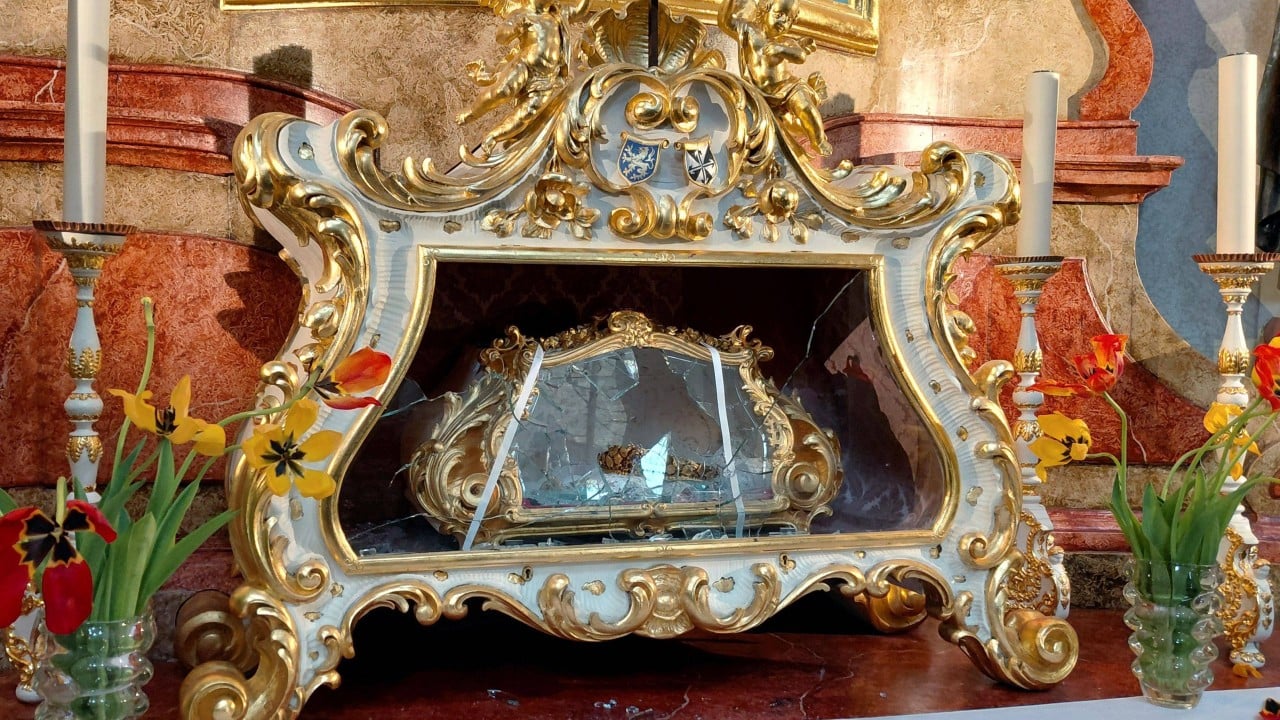
Two years ago, a thief walked into one of these quiet sanctuaries—the Pilgrimage Church of the Nativity of the Virgin Mary in the town of Chlumek. The target wasn’t the collection box or the silver candlesticks. It was a highly specific, deeply revered relic: the skull of Saint Corona, a second-century martyr whose remains had been kept by the church for generations.
Imagine the mindset of that thief. You aren't just stealing gold; you are stealing an identity. You are stealing the physical anchor of a community’s faith. For centuries, locals had looked to this relic during times of plague, financial ruin, and war. It survived the Hussite Wars, the Thirty Years' War, and decades of communist suppression. Then, on a random Tuesday, a padlock is snipped, and it vanishes into the back of a hatchback.
Black market antiquities trading is an invisible ecosystem. It thrives on anonymity. But a saint’s skull is an incredibly difficult item to flip. You cannot list it on an online auction site. You cannot take it to a local pawn shop. The thief quickly realized that having the relic was a liability. The police were watching. The public was outraged.
So, the pressure mounted. The thief panicked.
Fear does strange things to human ingenuity. Instead of destroying the evidence, the thief decided to preserve it in the most brutal way possible. They mixed a bucket of standard construction concrete, placed the ancient, fragile skull into a mold, and poured the wet sludge over it.
The logic was simple yet terrifyingly effective. If the police raided the property, they wouldn't look twice at a chunk of broken masonry. It was the perfect camouflage. It was also a potential death sentence for an 800-year-old artifact.
The Delicate Art of Forensics and Faith
When the Czech police finally cracked the case and located the suspect's garage, they found the block. The triumph of the discovery was instantly replaced by an overwhelming sense of dread.
They had found it. But how were they going to get it out?
Concrete cures by an exothermic reaction. As it hardens, it creates heat. It shrinks. It binds tightly to whatever surface it touches. A medieval skull is not stone; it is aged, brittle organic matter. It is porous. The wet cement would have seeped into the orbital sockets, filled the nasal cavities, and clung to the fragile bone structure.
The recovery operation became a slow-motion thriller. This wasn't work for heavy machinery or sledgehammers. It required the patience of an archaeologist and the precision of a neurosurgeon.
Consider the tools of the modern detective in this scenario. They didn't start with chisels. They started with technology. The block was subjected to X-rays and CT scans to map the exact orientation of the skull within the mass. The police needed to know where the bone ended and the aggregate began. They had to plot a path through the gray stone.
Day after day, using micro-chisels, dental drills, and chemical solvents that could soften the concrete without dissolving the calcium of the bone, the team chipped away. Every vibration of the drill risked fracturing the cranium. The air in the lab must have been thick with the smell of pulverized lime and old dust.
It was a battle against a mistake made in a panic. The thief had sought to erase the relic's form, to turn a symbol of spiritual eternity into a temporary block of industrial waste. The restoration crew was doing the exact opposite, fighting to restore form to the formless.
Why an Old Skull Still Matters
It is easy to look at this story with a sense of modern detachment. We live in an era of digital data, cloud storage, and synthetic materials. Why do we care so much about a fragment of bone from a teenager who died in Syria nearly two millennia ago?
The answer lies in our desperate need for tangible connection.
We are a species obsessed with proof. We want to touch the past. A relic is a bridge across time. When a believer stands before a shrine, or when a historian examines an ancient artifact, the centuries compress. The distance between the year 1200 and the present day collapses into nothingness.
When you encase that history in concrete, you aren't just hiding an object. You are cutting the cord that connects a modern community to its ancestors. You are telling the people who built their lives around that church that their history can be overwritten by a trip to the hardware store.
The Czech Republic is often cited as one of the most atheistic countries in Europe, a byproduct of its complex twentieth-century history. Yet, the intensity of the police investigation and the collective sigh of relief that followed the successful extraction of the skull suggest something deeper. Even in a highly secular society, there is a profound respect for the sacredness of heritage. There is an understanding that some things are non-negotiable. Some things cannot be bought, sold, or buried in cement.
The Return to the Light
The skull is free now.
It bears the scars of its ordeal—traces of gray dust that may never fully leave the crevices of the bone, tiny imperfections where the modern world collided violently with the medieval. But it is intact. The jawless cranium, which once looked out at generations of pilgrims, survived its two-week burial in a suburban garage.
The suspect is facing charges, the legal system will grind onward, and the paperwork will be filed away in police archives. The dry news reports will summarize the weight of the concrete and the statutes violated.
But the real story isn't found in the police ledger. It is found in the contrast between the materials. Concrete is the defining material of our current age—cheap, temporary, easily demolished, and quickly replaced. The skull is the exact opposite. It is irreplaceable, fragile, and enduring.
For a brief moment, the worst of the modern world tried to swallow a piece of the ancient past. The past won. The relic will eventually return to its place, resting behind glass once more, while the broken shards of the concrete block that tried to steal its identity sit in a trash bin somewhere, entirely forgotten.