The numbers are terrifying. Ebola is now killing a person every thirty minutes in the Democratic Republic of Congo.
If you think this is just another distant health scare, look closer. With 2,325 deaths and nearly 5,000 confirmed cases, this is officially the deadliest Ebola outbreak in the country's recorded history. It has officially surpassed the grim milestones of the 2018 to 2020 crisis.
United Nations humanitarian chief Tom Fletcher put it bluntly: "Ebola is winning."
When a disease outpaces the medical response in real time, we need to ask why. Why is this particular wave breaking previous records with such brutal speed? Let's break down what is actually happening on the ground and why conventional response frameworks are failing.
The Brutal Math Behind the Numbers
The scale of this epidemic defies normal expectations. Back in May, when health authorities declared the outbreak, few predicted it would double roughly every 20 days.
To put that speed into perspective, consider past emergencies. During the massive 2014 to 2016 epidemic in West Africa, it took nearly five months to reach 1,000 deaths. In Congo right now? The death toll blew past 2,000 victims in less than three months.
The case fatality ratio tells an equally grim story. Early in June, about 20 percent of confirmed patients died. Today, that number sits at a staggering 46 percent. Nearly one out of every two infected people is dying.
Public health specialists point to a profound breakdown in early detection. Patients are showing up at treatment centers far too late. Many are only diagnosed after they have already passed away within their communities, instantly resetting contact tracing efforts and fueling fresh chains of transmission.
Why This Strain Is Different
We are dealing with a unique enemy this time. This outbreak stems from the Bundibugyo species of the virus.
Unlike other strains that benefit from well-established stockpiles of approved vaccines or targeted therapeutics, Bundibugyo has no approved vaccines or specific treatments ready to deploy off the shelf. While clinical evaluations and trials for experimental therapies are moving forward, frontline workers are fighting a semi-blind battle. They are relying almost entirely on supportive care, isolation, and rapid barrier nursing rather than a magic-bullet cure.
Without approved vaccines for this specific strain, containment depends entirely on human mechanics: tracking every contact, isolating the sick, and executing safe burials. When those human mechanics break down, the virus wins.
The Collateral Damage on Fragile Infrastructure
You cannot fight a hyper-fast pathogen in a vacuum. Congo's health infrastructure was already cracking under years of regional conflict, mass displacement, and chronic funding shortages.
Now, the system is near total collapse. Dedicated beds for suspected Ebola cases in North Kivu are completely full. Hospitals lacking proper transit centers are forced to isolate patients in ordinary wards, risking wider contamination.
Health workers bear the heaviest burden. By mid-August, the World Health Organization reported that at least 155 health workers had contracted Ebola, with 45 dying from the disease. When doctors and nurses become patients, entire clinics shut down.
Meanwhile, other fatal emergencies are being starved of resources. Measles, cholera, and malaria continue to ravage the population. Medical groups report tens of thousands of suspected measles and cholera cases. Because communities are terrified of catching Ebola at local clinics, sick individuals avoid seeking help altogether. They stay home, letting treatable conditions turn fatal.
What Needs to Change Immediately
Throwing money at the problem isn't working by itself. The UN recently injected an extra $30.5 million from its Central Emergency Response Fund, supplementing millions already spent. But cash sitting in a bank account doesn't stop a virus.
Experts on the ground agree that containment requires radical operational scaling:
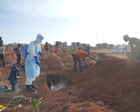
- Double Safe Burials: Teams must scale up safe burial operations to immediately cut off transmission cycles at funerals, which remain high-risk exposure points.
- Triple Treatment Capacity: Medical infrastructure must expand rapidly to isolate active cases before patients deteriorate at home.
- Deploy Experienced Leadership: Ground logistics require seasoned emergency managers who know how to navigate community distrust and security vacuums.
- Fix Surveillance Gaps: Contact tracing must transition from reactive guessing to aggressive, community-level tracking.
If global partners and local authorities fail to match the sheer speed of this epidemic, the human cost will climb far beyond historical records. Stop viewing this as an isolated regional tragedy. When a virus doubles every twenty days in an interconnected world, containment is a global test.