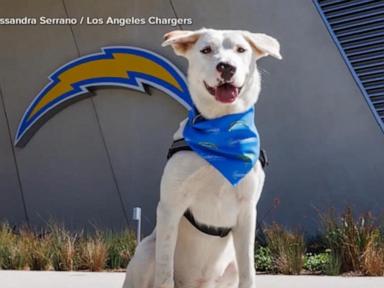
Professional sports franchises operate as high-yield attention engines. When the Los Angeles Chargers deploy their brand equity toward the service dog sector—specifically through the "Chargers Pup" initiative—the operation extends far beyond traditional corporate social responsibility. It represents a structured application of cross-industry resource allocation, converting a team's cultural capital into tangible operational support for the non-profit supply chain.
The traditional media narrative captures the emotional resonance of a canine mascot. However, a rigorous structural analysis reveals a complex multi-party ecosystem that optimizes training costs, utilizes non-traditional labor pools, and minimizes customer acquisition friction for animal rescue organizations. For an alternative perspective, read: this related article.
The Specialized Animal Allocation Framework
The service animal infrastructure suffers from severe structural bottlenecks. The cost to breed, raise, socialize, and professionally train a single service dog capable of supporting an individual with physical disabilities or post-traumatic stress disorder (PTSD) ranges between $20,000 and $50,000. This capital intensity is compounded by a high attrition rate; approximately 50% to 60% of canine candidates fail to graduate due to medical or behavioral constraints.
The Chargers' operational model optimizes this framework by splitting the lifecycle of the animal into distinct phases managed by separate entities: Further analysis on the subject has been published by Forbes.
- Sponsorship and Capital Injection: Corporate partners like Lazy Dog Restaurants mitigate the raw financial liability of care, food, and initial veterinary medical expenses.
- Sourced Public Socialization: The franchise uses its high-density environments—such as training camps, media events, and games at SoFi Stadium—as a stress-testing lab for public access skills. This eliminates the artificial simulation costs typically required to socialize high-tier assistance animals.
- Alternative Labor Integration: By partnering with organizations like Paws for Life K9 Rescue and utilizing specialized programs within California correctional institutions, such as the California Medical Facility, the model integrates a low-cost, high-time-availability labor framework. Incarcerated trainers provide round-the-clock behavioral modification and basic task training, lowering the variable cost per canine hour.
The Tri-Party Value Realization Matrix
[Corporate Sponsor] ---> (Capital & Underwriting) ---> [Non-Profit Rescue / Training Program]
                                                                    |
                                                     (Canine Socialization & Public Access)
                                                                    v
[Sports Franchise] <------------------------------------ [Service Dog Candidate]
(High-Density Media Exposure)
The operational efficacy of this initiative rests on a mutual exchange of assets between three primary nodes: the sports franchise, the corporate underwriter, and the specialized non-profit organization.
1. The Franchise Media Engine
A major challenge for service dog non-profits is the high cost of organic audience acquisition. By adopting dogs like Bolt, Brisket, or River into the official roster, the franchise embeds the non-profit's operational mission directly into its primary content stream. The animal acts as a permanent, high-engagement brand asset across social media, broadcast assets, and live events. This integration shifts the cost of consumer impression from paid marketing channels to natural editorial coverage.
2. Specialized Asset Diversification
The trajectory of the animals demonstrates an efficient distribution of specialized outputs based on individual canine competencies. If a canine shows high environmental resilience but lower task-specific utility, it is routed to a facility dog pathway (e.g., Brisket's placement with the Glendale Police Department). If the animal displays high sensitivity and task compliance, it is directed to targeted single-handler veteran care (e.g., River or Storm's transition to military veterans with PTSD via the Wounded Warrior Project). This flexible routing minimizes total system waste by ensuring that even "career change" dogs yield an operational return on investment.
3. Enterprise Value De-risking
For corporate underwriters, sponsoring the canine lifecycle removes the standard risks associated with direct philanthropic giving. The association with a professional sports team guarantees a baseline level of media impressions, converting a traditional charitable donation into a highly measurable marketing expenditure with quantifiable top-of-funnel customer reach.
Operational Bottlenecks and Structural Limitations
While highly efficient at producing media exposure, the model faces clear structural constraints. Scalability is strictly limited by the human capital required to manage individual animals within a corporate sports environment. A sports franchise cannot scale this program linearly; adding ten dogs simultaneously would disrupt the core operational focus of a football staff and media team.
The model remains vulnerable to behavioral unpredictable factors. A service dog candidate represents a biological asset with volatile performance metrics. If a featured animal develops a sudden stress response to pyrotechnics or stadium crowd volumes, the public-facing campaign faces an immediate halt, requiring a rapid pivot in narrative structure and asset deployment.
Franchises looking to duplicate this strategic blueprint must treat the animal not as a passive mascot, but as an active operational asset. Success requires binding the program to structured milestones: utilizing prison-based training programs to handle the labor-intensive foundational phase, using corporate sponsorships to achieve neutral cash-flow operations, and aligning public appearances strictly with the dog's ongoing behavioral evaluation. The integration of high-density sports environments with specialized canine training models provides a predictable blueprint for maximizing the real-world output of corporate charity initiatives.


