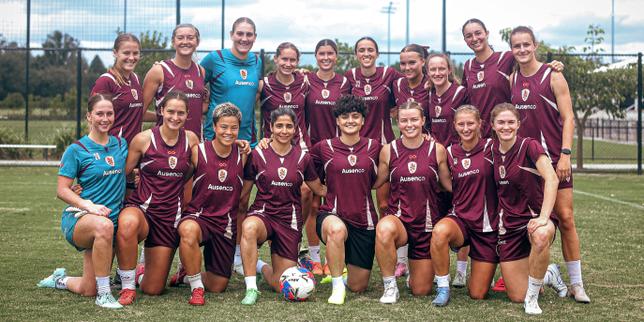
Two former members of Iran's women's national football team, Fatemeh Pasandideh and Atefeh Ramezanisadeh, received Australian citizenship certificates in Brisbane, marking the permanent end of their journey as state-represented athletes and the beginning of a complex life in exile. Months prior during the AFC Women's Asian Cup, these players stood on an international pitch and collectively refused to sing the Islamic Republic's national anthem. That silent protest transformed into a high-stakes geopolitical narrative, drawing statements from international leaders, intense pressure from state intelligence handlers, and a split within the squad itself. While superficial coverage treats citizenship ceremonies as neat, happy endings, the underlying mechanics of athletic defection reveal a brutal personal toll that standard sports reporting consistently ignores.
Athletes operating under authoritarian regimes carry a unique burden. They are simultaneously utilized as soft-power ambassadors and held hostage by the political survival of the state they represent. When a player breaks protocol on a global stage, the calculation shifts instantaneously from athletic performance to survival management. Expanding on this idea, you can find more in: The Structural Failure of FIFA Governance A Quantitative Deconstruction of Infantino and the World Cup Sell Off.
The Anatomy of a Silent Protest
The refusal to sing a national anthem looks simple on television. In reality, it represents an irreversible crossing of a legal and political Rubicon.
During the tournament in March, the Iranian delegation found itself under intense surveillance. State minders traveled with the squad, monitoring communications, media interactions, and room assignments. Choosing to remain silent while the state anthem played was not a spur-of-the-moment emotional outburst. It was a calculated, shared risk executed by women who had witnessed domestic crackdowns against civilians back home and recognized that their platform was the only shield they possessed. Analysts at ESPN have shared their thoughts on this situation.
The immediate domestic fallout was predictable. State media apparatuses labeled the players traitors, opening legal vulnerabilities under penal codes where political dissent can be categorized as corruption on earth or enmity against God.
The Diverging Paths of Coercion
The aftermath of the protest exposed how modern authoritarian states manage defections abroad. Initially, a group of seven players sought humanitarian protection through Australian authorities.
Then reality intervened. State security apparatuses reached out across borders, targeting the families left behind in Iran. Relatives received explicit warnings and threats of imprisonment or professional ruin. The pressure campaign worked on five members of the original group, who reversed their decisions, withdrew their applications, and boarded flights back to Tehran under heavy observation. Upon arrival, state media paraded them through controlled environments to project an image of state unity and deterrence.
Pasandideh and Ramezanisadeh chose the harder path. They refused to board that bus.
By staying, they traded their homeland, their families, and their cultural identity for physical safety. Home Affairs Minister Tony Burke oversaw their formal citizenship ceremony, cementing a legal status that took months of institutional vetting. Shortly after, local club Brisbane Roar welcomed them to train, offering a semblance of athletic normalcy in a foreign city.
Yet, athletic integration is not cultural assimilation. Playing soccer on a Queensland training pitch does not erase the trauma of abandoning one's family to state retaliation.
The Geopolitical Exploitation of Dissent
High-profile defections inevitably attract opportunistic political theater. When players seek asylum, their personal safety becomes secondary to diplomatic posturing. Statements from figures like United States President Donald Trump demanding immediate protection amplified the spotlight, raising the stakes for Australian immigration officials while simultaneously increasing the danger for relatives still inside Iran.
This dynamic creates an uncomfortable truth about international asylum processes. Celebrated athletes receive expedited media attention and high-level ministerial oversight, while ordinary refugees facing identical or worse dangers remain trapped in bureaucratic purgatory. The system responds to cameras and national jerseys, not necessarily to the depth of persecution.
The Iranian state views these events through the lens of betrayal and ideological contamination. Parliamentary speakers and state commentators framing the returning players as children of the homeland saved from anti-Iran deception demonstrate the regime's desperate need to control the narrative. Conversely, those who remain abroad live with permanent estrangement.
Citizenship papers issued in Brisbane provide legal protection, but they do not quiet the phone calls that no longer come from home. The transition from national hero to stateless exile requires rebuilding an entire existence from zero, where the applause of a stadium crowd is a poor substitute for the family left behind in the shadow of the state.