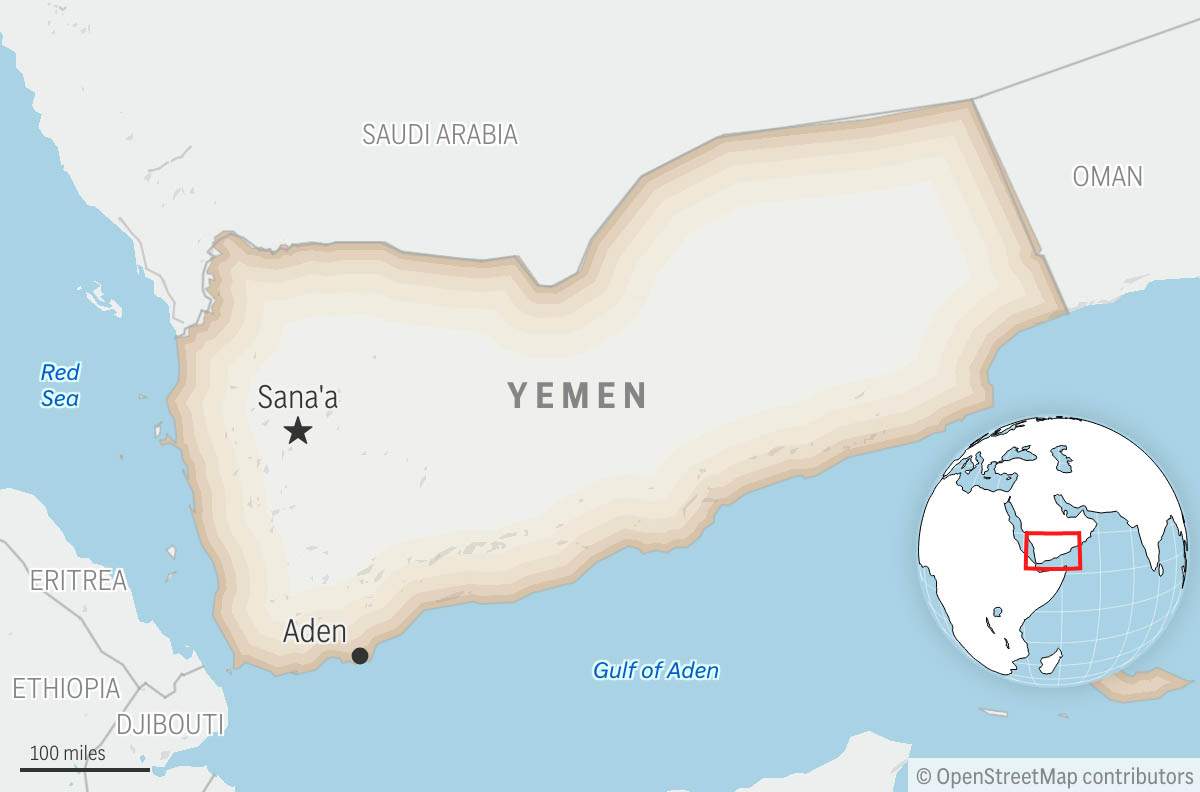
Twenty-five dead near Sanaa. Another headline. Another official statement from a Houthi spokesperson. Another wire report dutifully parroted across global news feeds without a single ounce of strategic context.
If you consume mainstream foreign policy coverage, you have seen this exact template play out hundreds of times since 2015. A strike lands outside Yemen's capital. Local authorities release a casualty figure. Western outlets slap "Houthi official says" onto the end of a headline to cover their journalistic liability, publish four hundred words of dry summary, and move on to the next news cycle.
That lazy consensus treats an asymmetric geopolitical stranglehold like a simple scoreboard. It frames a complex, multi-theater attrition war as a series of isolated kinetic incidents, blinding readers to what is actually happening on the ground in Sanaa, in the Red Sea, and inside the war rooms of Washington, Riyadh, and Tehran.
Counting bodies after an airstrike does not tell you who is winning. In asymmetric warfare, the scoreboard is rigged from the start.
The Wire Service Trap and the Illusion of Precision
Mainstream reporting on Yemen suffers from a fatal structural flaw: stenography disguised as objectivity.
Because independent international journalists rarely have unrestricted access to Houthi-controlled northern Yemen, newsrooms rely on two primary sources for immediate breaking news. The first is the Houthi Ministry of Health or military media apparatus, which has an obvious incentive to frame every strike as an indiscriminate attack on civilian infrastructure. The second is U.S. Central Command or coalition press releases, which sanitize kinetic operations into bloodless descriptions of "degrading degraded capabilities" and "targeting command-and-control nodes."
When a wire service publishes a headline claiming twenty-five people were killed in an airstrike near Yemen's capital, it presents a binary narrative. Either a military operation went horribly wrong, or a terrorist group is fabricating numbers. Both interpretations miss the operational reality of how airpower functions—and fails—in the rugged highlands surrounding Sanaa.
I have spent years analyzing post-strike battle damage assessments and tracking procurement networks across the Arabian Peninsula. The single biggest mistake analysts make is assuming that tactical destruction equals strategic deterrence. You can drop a two-thousand-pound Joint Direct Attack Munition on a warehouse in the Bani Matar district outside Sanaa, kill twenty-five operatives, and achieve precisely zero reduction in the enemy's capacity to launch anti-ship ballistic missiles the following morning.
Why? Because the Houthis—formally known as Ansar Allah—do not operate a conventional military. They operate a decentralized, subterranean, and deeply embedded insurgency that spent nearly a decade absorbing tens of thousands of Saudi-led coalition airstrikes.
Why Airpower Against the Houthis Is a Sunk-Cost Fallacy
To understand why headlines about casualty counts near Sanaa are fundamentally misleading, you have to understand the asymmetry of cost and resilience.
Consider the mechanics of a standard strike package operating against targets in northern Yemen:
- The Munition Cost: A single Tomahawk cruise missile costs roughly $2 million. An F/A-18 sortie launched from a carrier strike group in the Red Sea burns tens of thousands of dollars per hour in fuel, maintenance, and logistics before a single bomb leaves the pylon.
- The Target Reality: The infrastructure surrounding Sanaa is built into volcanic rock and subterranean cave networks excavated over decades, dating back to the Cold War and the Saleh regime. When an airstrike hits a surface structure, it rarely destroys the irreplaceable technical expertise or the dispersed component stockpiles buried fifty feet underground.
- The Recruitment Dividend: Every high-casualty strike near the capital hands Ansar Allah an immediate domestic propaganda victory. In a country devastated by years of economic collapse and blockades, external bombardment does not fracture the population's loyalty to the ruling de facto authority. It consolidates it.
Military strategists from Giulio Douhet to John Warden theorized that precision airpower could paralyze an adversary's center of gravity, breaking their will or capacity to fight from the sky. Those theories work remarkably well against centralized, industrialized nation-states with exposed power grids, conventional armored divisions, and vulnerable logistics hubs.
They fail catastrophically against decentralized militias operating in mountainous terrain.
When a headline focuses exclusively on a death toll near Sanaa, it reinforces the delusion that we are witnessing a decisive military campaign. We are not. We are witnessing expensive kinetic signaling.
What Everyone Gets Wrong About Houthi Casualty Claims
When readers see "Houthi official says" in a headline, the immediate reaction splits along predictable ideological lines. One camp dismisses the number entirely as pure fabrication. The other accepts it uncritically as proof of war crimes.
Both reactions ignore how information warfare actually operates in Yemen.
Ansar Allah's media apparatus—led by outlets like Al Masirah—is not amateurish. It is a sophisticated, disciplined communications machine modeled closely on Hezbollah's Al-Manar. They understand that Western newsrooms operate on razor-thin margins and tight deadlines. By releasing rapid, specific casualty numbers immediately following a strike, Houthi spokespeople anchor the global narrative before satellite imagery analysts or independent monitors can verify what was actually hit.
However, dismissing those numbers out of hand is equally foolish. Strikes around Sanaa frequently hit dual-use facilities: workshops tucked inside densely populated neighborhoods, fuel depots adjacent to commercial markets, or barracks situated next to residential compounds. When a secondary explosion tears through a concealed munitions cache, the resulting blast wave does not distinguish between a Houthi drone technician and a neighboring shopkeeper.
The nuance the wire reports miss is that both things are true simultaneously. The strikes are hitting legitimate military logistics, and they are killing people in areas where the line between combatant and civilian has been deliberately erased by how the Houthis embed their forces.
The Geography of Sanaa Makes Clean Warfare Impossible
If you have never looked at a topographical map of Sanaa, you cannot understand why airstrikes near the capital always generate controversial casualty reports.
Sanaa sits in a high-altitude basin at roughly 7,200 feet above sea level, ringed by steep, rocky mountains like Jabal Nuqum to the east and Jabal An-Nabi Shu'ayb to the west. Over the last twenty years, rapid urbanization pushed residential districts right up against legacy military bases, presidential guard compounds, and underground tunnel entrances carved into the surrounding hills.
Imagine a scenario where a logistics hub storing solid-fuel rocket motors is hidden inside a former textile warehouse on the outskirts of a growing suburb. Intelligence identifies the facility through signals intercepts and drone surveillance. A strike is ordered at 2:00 AM to minimize collateral damage. The munition penetrates the roof, detonates the stored propellants, and triggers a secondary blast three times larger than the bomb itself. Windows shatter two miles away. Twenty-five people—a mix of night-shift guards, technicians, and nearby residents—are killed.
By dawn, the local health ministry issues a press release. By noon, a Western wire service runs a three-paragraph blurb quoting a Houthi official. Nowhere in that report does the reader learn about the secondary explosions, the dual-use geography of the Sanaa basin, or the strategic futility of hitting a replaceable warehouse.
Redefining the Real Question
When people read about another deadly airstrike in Yemen, they usually ask two questions: Are these strikes stopping the Houthis? and Who is telling the truth about the casualties?
Those are the wrong questions.
If you want to understand what is actually happening in Yemen, stop asking how many people died in last night's raid and start asking these three questions instead:
- Where are the supply lines? Airstrikes near Sanaa treat the symptoms while ignoring the disease. Every advanced guidance system, gyroscope, and micro-turbojet engine used by Houthi forces arrives via smuggling networks running across the Arabian Sea, through Oman, or via dhow transfers off the coast of Somalia and Djibouti. Until maritime interdiction chokes off the flow of components from Iran, bombing assembly sheds in Sanaa is like mopping the floor while the faucet is wide open.
- Who controls the financial plumbing? Wars run on liquidity, not headlines. While international attention fixates on kinetic strikes, the real battle for Yemen is fought over central bank sovereignty, currency manipulation between the old rial in Sanaa and the new rial in Aden, and tax collection at the port of Hodeidah. Airstrikes do not touch the financial networks funding Ansar Allah's war economy.
- What is the endgame for deterrence? Deterrence requires convincing an adversary that the cost of continuing an action outweighs the benefit. For a movement whose core ideological slogan literally glorifies death in battle and whose domestic political legitimacy skyrockets every time it trades blows with a superpower, tactical casualty counts are not a deterrent. They are a recruiting poster.
The Uncomfortable Truth About Kinetic Containment
Let us be brutally honest about the limitations of the contrarian view here. Critics of airstrikes often argue for immediate de-escalation and diplomatic engagement, pretending that simply halting kinetic operations will bring stability to the region.
That is equally naive.
Leaving Houthi missile and drone infrastructure completely uncontested hands a non-state actor a permanent veto over global maritime trade through the Bab el-Mandeb Strait. Allowing unchallenged strikes on commercial shipping sets a catastrophic precedent that every hostile actor from the Strait of Hormuz to the Taiwan Strait will immediately copy. Doing nothing is not a strategy; it is capitulation.
The tragedy of the current approach is not that military force is being used—it is that military force is being used without a coherent political or economic strategy attached to it. Tactical strikes are being treated as a substitute for policy. Politicians get to point to footage of explosions outside Sanaa to prove they are "taking decisive action," while the underlying strategic balance remains completely unchanged.
How to Actually Read News Out of Yemen
If you want to cut through the noise the next time a wire report flashes across your screen about casualties near Sanaa, apply a simple analytical filter before drawing any conclusions:
- Ignore the initial 24-hour casualty count. Initial numbers from active conflict zones are almost always wrong—either inflated for political effect or underestimated due to collapsed infrastructure and unrecovered bodies. Wait seventy-two hours for open-source intelligence analysts, satellite imagery providers like Planet Labs or Maxar, and independent verification groups to map the exact blast radius.
- Look for secondary explosions in the footage. Amateur cell phone videos posted to Telegram within minutes of a strike tell you far more than official press releases. A single bright flash followed by silence indicates a conventional strike on a static structure. Continuous popping, cooking-off ammunition, or massive fireball plumes indicate an active munitions or fuel storage site.
- Track the operational tempo, not the body count. The only metric that matters in an air campaign is whether the adversary's launch rate drops over a sustained ninety-day window. If strikes near Sanaa kill dozens of fighters on Tuesday, and Houthi forces launch three anti-ship ballistic missiles on Thursday, the Tuesday strike achieved nothing of strategic value.
- Follow the diplomatic track in Riyadh and Muscat. Kinetic flares around Sanaa frequently coincide with deadlocked backchannel negotiations in Oman or Saudi Arabia. Violence in Yemen is routinely used as leverage at the bargaining table to extract economic concessions, prisoner swaps, or port access.
Mainstream journalism loves a clean, tragic number because numbers fit neatly into headlines and require zero explanation of asymmetric warfare, subterranean logistics, or failed deterrence theory. Readers walk away feeling informed because they know that twenty-five people died near a capital city they could not find on a map.
They do not know why those people died. They do not know why the strikes will continue next week. And they do not understand that as long as global powers rely on expensive bombs to solve a structural geopolitical insurgency, the only thing those casualty counts actually measure is how fast we are burning money to stand still.


