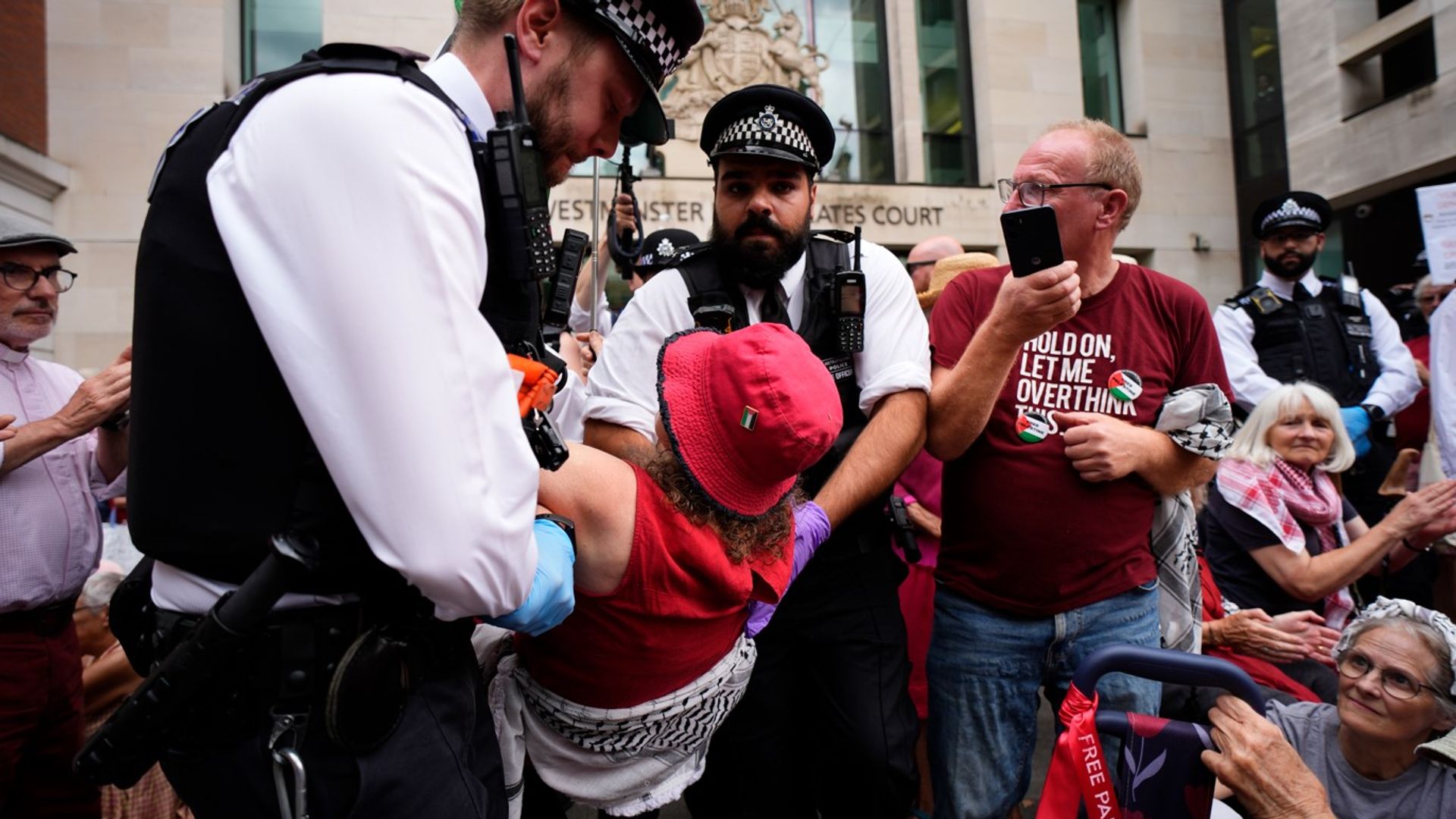
Every time a state tries to legally choke out radical direct action, it achieves the exact opposite of what the establishment wants. The lazy consensus dominating current headlines treats the impending Supreme Court battle over Palestine Action and the surge of recent arrests as a straightforward legal victory for public order.
That view is dangerously naive.
I have watched compliance officers, state prosecutors, and corporate boards miscalculate public disruption for decades. They treat civil disobedience like a localized plumbing leak. Slap a heavy enough clamp on the pipe, pass a stringent piece of legislation, and the water stops flowing.
History shows the opposite happens. When you strip away the middle ground of moderate protest through blanket bans and mass arrests, you do not pacify a movement. You radicalize its logistics, decentralize its network, and gift it a permanent martyrdom narrative that resonates far beyond the original grievance.
The Flawed Mechanics of State Suppression
Let us look at how the state currently frames the issue. The mainstream narrative relies on a comfortable fiction: that policing dissent restores equilibrium. Arrest the activists, slap them with conspiracy charges, elevate the threshold to terrorism designations, and the social body heals.
This ignores the structural hydraulics of political friction.
When groups like Palestine Action target supply chains—specifically aerospace manufacturers and defense contractors tied to foreign military campaigns—they are not operating on standard street-march logic. They are engaged in economic disruption. Traditional protest asks permission from the state to annoy the state. Direct action bypasses the permit office entirely. It calculates that the economic cost of a shuttered factory floor outweighs the legal penalty of a trespass charge.
By attempting to elevate these actions to the level of terrorism, the judiciary and the Home Office are committing a category error. Terrorism relies on terrorizing populations for political leverage. Direct action against corporate property relies on physical intervention to halt a specific industrial process. Conflating the two might satisfy short-term political posturing, but it wrecks the legal system's credibility.
If spray-painting a facility or locking oneself to a gate is legally equated with violent extremism, the state dilutes the term until it loses all deterrent value. When everything is terrorism, nothing is.
The Martyrdom Dividend
Imagine a scenario where a government successfully brands a decentralized network of activists as a proscribed terrorist entity. To the desk-bound bureaucrat, this looks like a clean sweep. Bank accounts freeze. Affiliation becomes a felony.
On the ground, the math changes instantly.
A banned entity loses its public face, yes. But it also sheds the administrative overhead of open organizing. It stops holding meetings that can be infiltrated. It fragments into autonomous cells that require no central command, no public treasury, and no formal membership roster. You cannot dismantle a network that no longer has a formal shape.
Furthermore, every high-profile Supreme Court challenge involving draconian speech or assembly laws acts as an involuntary recruitment engine. Young people who might have ignored a leaflet on a university campus suddenly pay attention when they see the full weight of the state apparatus mobilized against demonstrators. The state becomes the primary public relations agent for the cause it seeks to suppress.
I have seen corporate risk analysts run simulations on civil disobedience where they factor in police crackdowns as a positive variable for the activists. Every time a protester is dragged away by riot police on live television, sympathy ticks upward. Every time a court rules to restrict assembly further, institutional trust erodes a fraction more.
Dismantling the Legal Sleight of Hand
The legal battle heading to the Supreme Court centers on definitions of conspiracy, public nuisance, and the threshold for proscription. The establishment argument leans heavily on the protection of critical national infrastructure.
Fair enough. A functioning society requires supply chains, transport networks, and manufacturing centers. But let us look at the unspoken hypocrisy embedded in this legal defense.
When a multinational corporation inflicts systemic harm through supply chains that evade regulatory oversight, the legal remedies available to citizens are functionally zero. Regulatory bodies are underfunded, civil suits take decades and millions of dollars, and corporate lobbying ensures that the legal framework protects the balance sheet above all else.
Direct action emerges precisely where legal recourse dies. It is an emergency brake pulled by citizens who have concluded that institutional channels are rigged.
When the courts rush to protect the flow of capital while criminalizing those who physically obstruct it, they expose the state not as a neutral arbiter, but as an active participant in corporate operations. That realization spreads faster than any protest pamphlet.
Unconventional Realities of Modern Enforcement
The state thinks it is fighting a 20th-century labor dispute. It is actually dealing with 21st-century network effects.
Traditional policing relies on deterrence through punishment. But when activists are motivated by moral urgency rather than career prospects, traditional deterrence collapses. If you are willing to face prison time for a cause, a heavier prison sentence changes very little about your calculus. It simply selects for a more dedicated, hardened core of participants.
The authorities are treating the symptom while accelerating the disease. By forcing activists underground through terror bans, they ensure that future actions will be harder to predict, harder to police, and harder to mitigate through dialogue.
You cannot litigate away political discontent with a heavier gavel. You only ensure that the next iteration of the conflict takes place entirely outside the rules you wrote.