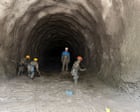
The mountain does not care about your schedules. It does not bargain with engineers, nor does it check its watch when the shift changes. It is a slow, crushing archive of time, indifferent to the fragile lungfuls of air trapped inside its ribs.
Somewhere deep beneath the jagged ridges of Nepal, trapped inside a subterranean labyrinth carved by steel and ambition, men are breathing. Or they were. Or they might still be, suspended in that terrible, narrow margin between yesterday and never. Meanwhile, you can explore similar developments here: Deconstructing The Ceuta Border Breach Why State Intent Analysis Fails Without Operational Metrics.
We talk about infrastructure as if it were abstract. We look at glossy presentations of hydropower tunnels, metrics of wattage, charts of economic output. We forget the dust. We forget the damp, slick dark where a man’s world shrinks to the beam of a dying headlamp. When the earth shifts and the concrete teeth snap shut, the spreadsheet ends and the silence begins.
Consider what happens when a tunnel collapses. It is rarely a clean break. It is a slow, violent regurgitation of rock and slurry, a sudden punctuation mark that erases exits. Suddenly, kilometers of darkness separate a human being from the sky. To see the bigger picture, we recommend the recent article by The Guardian.
Official reports from the site trickled out with the agonizingly slow cadence of bureaucratic caution. Dozens of workers cut off. Hydropower projects meant to bring light to cities plunging the very people who built them into shadow. The updates are clinical. Rescue teams are mobilized. Equipment is being hauled up winding mountain roads. Calculations of oxygen levels are scribbled on whiteboards in sterile site offices miles away.
Math cannot save you when a boulder the size of a house pins your shin.
To understand what is happening inside that mountain, you have to abandon the perspective of the map and step into the sensory reality of the interior. Imagine—and here we use a hypothetical reconstruction based on the structural geometry of Himalayan tunneling projects—a pocket formed by fallen slabs of granite. It is a void, perhaps no larger than the interior of a compact car.
Inside that pocket, the air is thick with pulverized stone and hydraulic fluid. The temperature is stifling, spiked by the geothermal heat of the earth pressing in from all sides. A man sits in the dark. His phone is useless, its screen a dead rectangle reflecting nothing. He listens.
Every minute stretches into an hour. The human mind, starved of sensory input, begins to play tricks. The drip of water sounds like footsteps. The settling of the debris overhead sounds like voices calling out a name. But it is just the mountain, shifting its weight, settling back into its ancient slumber.
Yet, hope persists. It is an irrational, stubborn thing.
Rescue officials hinted at a vital detail that separates this tragedy from a monument to grief: air pockets. In subterranean engineering, cave-ins rarely seal every single pipe, vent, or structural cavity airtight. Pockets exist. Voids form where structural steel acts as a temporary shield against the falling roof.
It is why experienced rescue coordinators refuse to write the final chapter too quickly. In similar disasters across the globe—from the trapped miners of Chile to workers in deep-shaft civil projects—survival has stretched far beyond initial prognostications. The human body is remarkably fragile, yet fiercely resilient when fueled by the sheer refusal to die. Water can be gathered from condensation on cold steel walls. Breath can be conserved by stillness. Panic is the ultimate predator, far more lethal than thirst, and the hardest thing to fight when the walls are closing in.
Outside, families gather. Their faces are the true topography of this disaster. They wait near the perimeter fence, watching heavy machinery move with agonizing deliberation. They do not care about megawatts or grid capacity. They care about a lunchbox left on a table, a pair of boots by a door, a voice that promised to be home for dinner.
This is the hidden cost of our insatiable hunger for energy. We draw lines on maps, route rivers through turbines, and bore through the roots of the world to keep our cities blazing with light. We externalize the danger. The cost is paid in sweat and, sometimes, in the terrifying lottery of a cave-in.
The rescue operation is a race against time, physics, and the unpredictable geology of a fragile mountain range. Every meter of debris cleared is a gamble. Dig too fast, and you trigger another slide. Dig too slow, and you run out of the only currency that matters.
As the search continues beneath the unyielding stone, the entire region holds its breath. The numbers on the official updates are just statistics until you realize each digit represents a father, a son, a brother, a human story cut short mid-sentence.
The mountain remains silent. But deep inside its dark corridors, somewhere beneath the weight of an indifferent earth, a pulse might still be tapping against the stone, asking if anyone is listening.