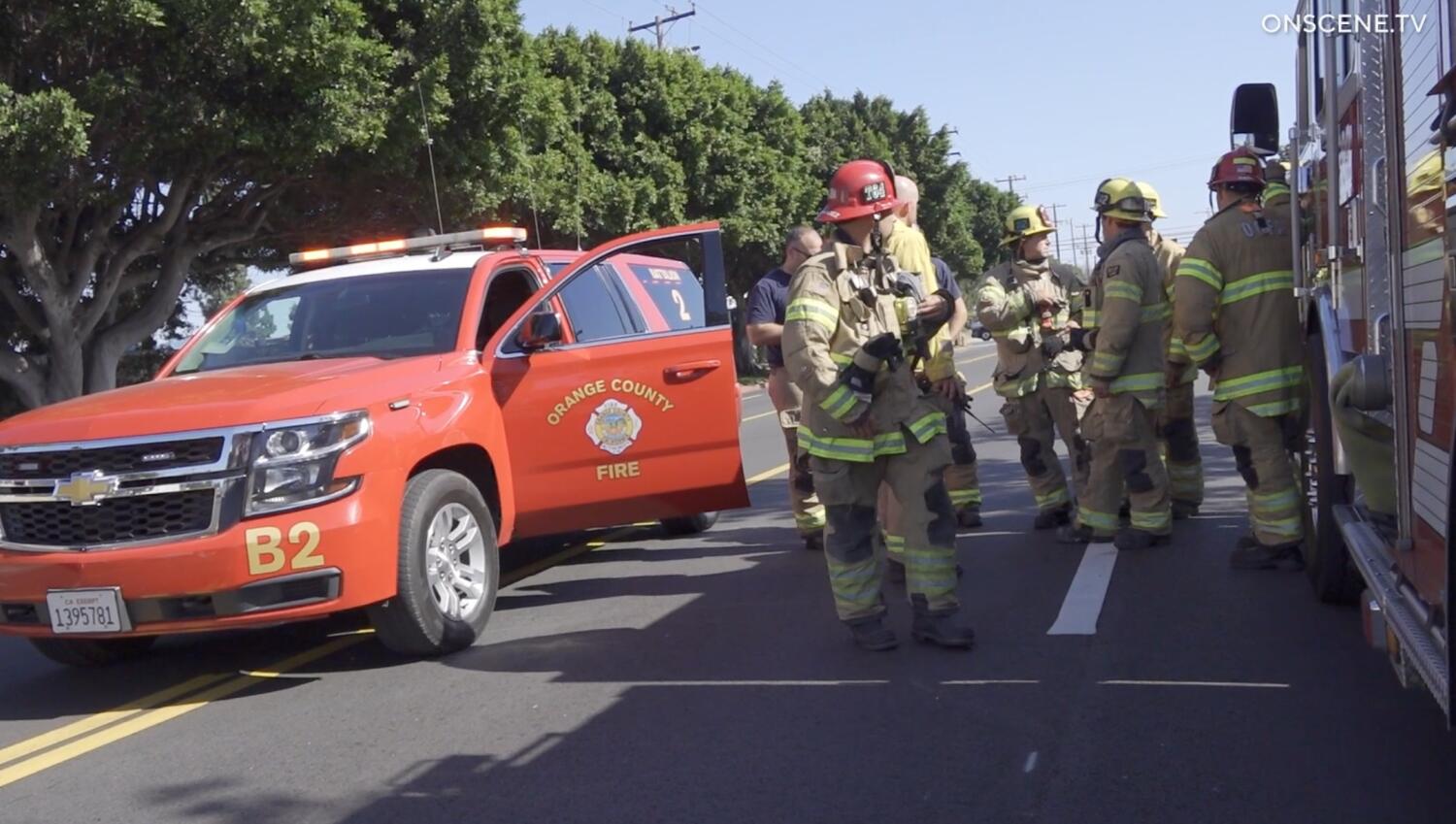
The sirens in Garden Grove didn’t start with a bang. They began as a low, irritating hum, the kind of background noise you mistake for a neighbor’s lawnmower or a distant delivery truck.
It was mid-afternoon. The sun was cutting through the usual Southern California haze, casting long, lazy shadows across manicured lawns and strip mall parking lots. For thousands of people going about their Tuesday, the world was perfectly, beautifully mundane. A mother was fighting with a stubborn car seat. A mechanic was wiping grease from his knuckles. A barista was foaming milk for a vanilla latte.
Then came the smell.
It wasn't the familiar scent of exhaust or smog. This was sharp. Chemical. It tasted like pennies on the back of the tongue and felt like a sudden, cold slap to the back of the throat. Within minutes, that ordinary Tuesday evaporated, replaced by a chaotic scramble for survival as a massive hazardous chemical leak turned a thriving suburb into an active containment zone.
We live our lives under the assumption that the ground beneath our feet and the air in our lungs are stable constants. We trust the infrastructure. We trust the zoning laws. But emergencies have a way of ripping back the curtain, forcing us to confront a terrifying reality: safety is a fragile illusion, maintained by a thin line of valves, gaskets, and luck. When that line breaks, the transformation from normalcy to nightmare happens in a heartbeat.
The Invisible Threat Down the Street
To understand what happened in Garden Grove, you have to understand the geography of the modern American suburb. We don’t build factories in the middle of nowhere anymore. We build communities around them. Industrial parks blend into commercial districts, which bleed directly into residential cul-de-sacs.
When the leak began at a commercial facility near the intersection of local shipping arteries, the chemicals didn't stay contained by property lines. They drifted.
Consider a hypothetical resident named Elena. She isn't a statistic; she is the manifestation of everyone who lived through that afternoon. Elena was sitting in her living room, working from home, when her eyes began to water. At first, she thought it was seasonal allergies. Then her dog, a golden retriever sensitive to the slightest change in the environment, began to whine and pace by the front door.
When Elena opened her door to check the street, she was met by a wall of acrid air that made her gasp.
Outside, the neighborhood was already fracturing. Police cruisers were blocking intersections, their red and blue lights flashing violently against the stucco houses. Megaphones barked orders that were swallowed by the wind. Evacuate immediately. Move north. Do not roll down your windows.
The facility had experienced a catastrophic failure involving a highly volatile hazardous compound. While official reports later detailed the exact chemical makeup and parts-per-million concentrations, the immediate reality for the people on the ground was much simpler: the air had become toxic.
When hazardous materials enter the atmosphere, they don't behave like smoke from a campfire. They are heavy. They hug the ground, creeping into basement windows, creeping through air conditioning vents, and settling into the low-lying areas where children play.
The Anatomy of a Panic
What happens when you are told you have ten minutes to leave your life behind?
You don't think about your birth certificate or your insurance policies. You grab the wrong things. You grab a half-empty water bottle. You grab a favorite sweater, even if it’s eighty degrees outside. You grab the cat, who fights you because she senses the terror radiating from your palms.
The streets of Garden Grove quickly choked with vehicles. Bumper-to-bumper traffic paralyzed the evacuation routes as hundreds of families tried to flee simultaneously. The local authorities acted with remarkable speed, shutting down major thoroughfares to create a perimeter, but that perimeter became a wall for those trapped inside it.
+-------------------------------------------------------+
|                 THE ZONE OF EXCLUSION                 |
+-------------------------------------------------------+
|                                                       |
|   [ Hot Zone: Chemical Source ]                       |
|         |                                             |
|         v                                             |
|   [ Warm Zone: Immediate Evacuation / Air Toxic ]     |
|         |                                             |
|         v                                             |
|   [ Cold Zone: Road Closures / Shelter-in-Place ]     |
|                                                       |
+-------------------------------------------------------+
For those caught in the gridlock, the car cabins became tiny, suffocating pressure cookers. If you turned on the air conditioning, you risked drawing the toxic outside air directly into your lungs. If you left it off, the heat became unbearable. People sat in their cars, watching the emergency vehicles tear past them in the opposite direction, heading straight toward the source of the poison.
The emergency response was a massive, multi-agency choreography. Hazmat teams dressed in heavy, surreal yellow suits looked like astronauts walking through a suburban wasteland. They carried monitoring equipment, testing the air quality foot by foot, trying to map an invisible enemy that changed direction with every shift of the breeze.
For the first few hours, no one knew how far the plume would travel. Nearby schools were placed on lockdown, children moved to interior hallways while teachers taped wet towels under the doors. Businesses snapped their window shades shut and flipped their signs to 'Closed,' leaving half-eaten lunches on tables and registers open.
The Sanctuary of Strangers
By dinner time, the evacuation zone had expanded, and the local high school gym had been converted into an emergency shelter.
Shelters are strange, heartbreaking places. They are monuments to human vulnerability. Rows of grey cots lined the polished hardwood of the basketball court. The smell of industrial disinfectant mixed with the scent of stale coffee and fear. Volunteers from the Red Cross moved through the crowds, handing out blankets and bottles of water, their voices deliberately calm, a counterweight to the ambient anxiety.
In the corner of one gym, elderly residents from a nearby assisted living facility sat in wheelchairs, looking dazed. They had been rolled out of their home with nothing but the clothes on their backs. Nearby, young parents tried to turn a disaster into a camping adventure for their toddlers, using cardboard boxes to build makeshift forts on the gym floor, hiding their own tears whenever their children looked up.
The questions circulating through the shelter were always the same, whispered from cot to cot.
When can we go back?
Is the cat going to be okay?
What happens if it gets into the water supply?
The truth is, even the experts didn't have immediate answers. Environmental remediation after a chemical spill is a slow, methodical process. You cannot rush science. You cannot scrub the air clean with a broom. You have to wait for the chemical to dissipate, or you have to neutralize it at the source, a terrifyingly precise operation when dealing with compounds that can ignite or vaporize at the slightest miscalculation.
The Lingering Vapor
By the time the sun dipped below the horizon, the facility managers announced they had capped the leak. The immediate danger had passed. The air quality indices began to drop back into the green zones. The evacuation orders were slowly lifted, neighborhood by neighborhood, street by street.
People returned to their homes in the dark. They opened their doors cautiously, sniffing the air, looking for any leftover trace of the metallic tang that had driven them out hours earlier. The streets were quiet again, save for the occasional rumble of a lingering police cruiser patrolling the area.
On paper, the incident was closed. The statistics will show zero fatalities, a handful of hospitalizations for respiratory irritation, and a successful containment timeline. The regulators will issue fines. The lawyers will file briefs. The local news will move on to the next traffic jam or political scandal.
But the real impact of an event like the Garden Grove leak isn't measured in parts per million or economic damage. It is measured in the quiet moments after the lights go back out.
It is measured in the way Elena now looks at the industrial park on her drive to work, no longer seeing a boring collection of concrete warehouses, but a sleeping giant. It is measured in the way a parent pauses when they hear a distant siren, their heart skipping a beat as they wonder if they need to grab the shoes and the kids again.
The chemical plume has washed away into the upper atmosphere, diluted by the Pacific breeze until it is completely unmeasurable. The air in Garden Grove is clean again. But the innocence of the neighborhood is gone, replaced by the heavy, permanent knowledge of just how quickly the air we breathe can turn against us.


