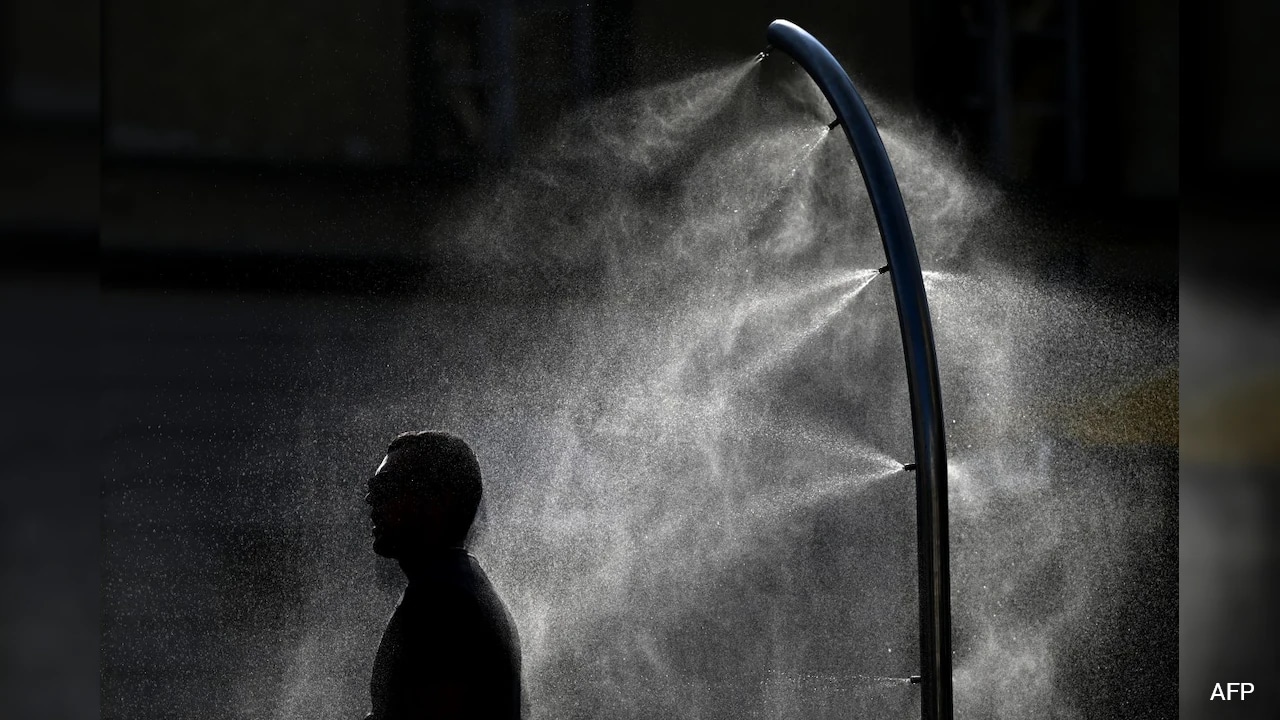
The air didn't just feel hot. It felt heavy, like a wet wool blanket pulled tight over the face of the city.
Marcus stood on the platform of a south London tram station, wiping a line of stinging sweat from his eyes. It was only 10:00 AM. Under normal circumstances, the morning commute is a mindless routine of swiping transit cards and staring blankly at smartphones. Today was different. The air smelled strongly of hot tar and cooked metal. Underfoot, the ground felt subtly wrong, less like solid earth and more like shifting sand.
Then came the announcement over the crackling loudspeaker: all services suspended.
A collective groan rippled through the crowd, but nobody was truly surprised. We had all seen the warnings. We just didn't want to believe them. For decades, Europe treated extreme heat as a luxury—a reason to flock to Mediterranean beaches or drink cold beer in shaded plazas. Now, the heat was no longer a visitor. It was an occupier.
When Infrastructure Forgets Its Purpose
We build our world on a foundational lie: that the environment is a fixed variable.
Engineers design roads, railways, and bridges based on historical averages. They look at the last fifty years of weather data, calculate the highest probable temperature, and add a small safety margin. In northern and western Europe, that safety margin was never designed to handle weeks of unrelenting, forty-degree weather.
Consider what happens to steel when the sun beats down on it for twelve hours straight. Steel tracks absorb heat far more efficiently than the surrounding air. If the ambient temperature is 38°C (100.4°F), the internal temperature of a rail can easily soar past 50°C (122°F).
Science tells us that heat causes molecules to vibrate frantically, pushing away from one another. The metal expands. But a train track is locked in place, bolted firmly to wooden or concrete ties. With nowhere to go, the expanding rail builds up immense internal pressure.
Eventually, something has to give.
With a sound like a gunshot, the steel snaps or bends violently out of alignment. Engineers call it sun kink, or track buckling. To the average commuter, it looks like a roller coaster track designed by a madman. A train hitting that bend at seventy miles per hour will derail. Suddenly, the cancellation of Marcus’s morning commute wasn't an inconvenience; it was a safety protocol preventing catastrophe.
The Bleeding Earth
A few miles away from Marcus’s stranded tram, truck drivers on a major arterial highway were experiencing a different kind of architectural rebellion. The road was bleeding.
Black, glossy pools of liquid asphalt were bubbling up through the aggregate surface. To understand why this happens, you have to realize that asphalt isn't a single solid block. It is a mixture of crushed rock bound together by crude bitumen—a thick, sticky petroleum product. Bitumen behaves like honey. When it is cold, it is rigid and brittle. When it is warm, it flows.
In countries like Spain or Italy, roads are mixed with hard, high-viscosity binders designed to withstand intense solar radiation. In contrast, roads in the UK, France, and Germany were laid down using softer binders to prevent cracking during freezing winters. They were built for damp chill, not a subtropical assault.
When the soft bitumen reaches its melting point, it separates from the stone. Heavy freight trucks rolling over this softened surface push the rocks aside, creating deep ruts and ridges. The road loses its grip. Driving on it feels less like piloting a vehicle on solid ground and more like sliding across a frying pan slicked with oil.
In some regions, emergency crews scrambled to spray white dust or sand over the highways. It was a desperate, visual metaphor: trying to powder the nose of a sweating giant. The white dust reflects a fraction of the sunlight, buying the road a few precious degrees of coolness, but it is a temporary bandage on a systemic fracture.
The Invisible Stakes of a Sweating Continent
It is easy to look at a video of a buckled track or a melting highway and see it as an isolated engineering failure. That is a mistake. These melting arteries are symptoms of a much larger, systemic vulnerability.
Modern society relies on a web of invisible dependencies. If the roads melt, trucks cannot deliver groceries to supermarkets or medicine to hospitals. If the trains stop, workers cannot reach power plants, water treatment facilities, or air-conditioned offices. The supply chain doesn't just slow down; it chokes.
Think about the energy required to keep a collapsing system alive. As millions of people crank their air conditioning units to maximum capacity, the electrical grid groans under the demand. At the exact moment the grid needs more cooling, the power lines themselves begin to sag from the heat, reducing their efficiency. It is a feedback loop of vulnerability.
We are discovering, in real-time, that our collective threshold for chaos is remarkably low.
The Shift in the Dirt
By mid-afternoon, the city had slowed to a crawl. Marcus walked back toward his apartment, his shoes sticking slightly to the soft pavement with every step. A low hiss rose from the ground as a passing delivery van left deep, permanent scars in the street.
The real challenge moving forward isn't just fixing the broken tracks or repaving the ruined highways. It is the realization that we can no longer build for the world we used to have. Every piece of stone, steel, and concrete we lay down from this moment onward must be engineered for an unpredictable, volatile future.
We have to rewrite the rules of architecture, logistics, and daily life. Until then, we are at the mercy of the thermostat.
Marcus reached his front door, his shirt clinging to his back, and looked back down the empty street. The horizon danced in the heat waves rising off the dark tarmac. The road looked fluid, wavy, and uncertain, like a mirage of a city that was slowly losing its grip on solid ground.