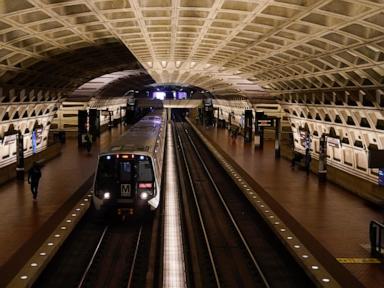
Eleven people went to the hospital because two yellow machines met on a track where only one should have been. The news cycle does what it always does: it counts the stretchers, quotes the National Transportation Safety Board (NTSB) spokesperson, and bemoans "another lapse in safety." They treat the crash between a Washington Metro work train and a stationary passenger train as an isolated failure of a specific protocol. They are wrong.
This isn't a "lapse." This is the logical, inevitable conclusion of a transit philosophy that prioritizes human-in-the-loop "oversight" over hard-coded engineering reality. If you are surprised that a maintenance vehicle slammed into the back of a train at 1 a.m. near the Potomac Avenue station, you haven't been paying attention to how the Washington Metropolitan Area Transit Authority (WMATA) actually functions.
We don't have a safety problem. We have an autonomy problem.
The Myth of the "Work Zone" Safety Protocol
The standard reporting focuses on the "failure to communicate." They want to know if the radio was on or if the flagger was in position. This is the wrong question. In a system as complex as the DC Metro, if the safety of eleven human beings depends on a radio call, the system has already failed.
Modern heavy rail is essentially a series of high-mass projectiles moving through a closed loop. The moment we introduced "work zones" that require manual overrides of the Automatic Train Protection (ATP) systems, we signed a contract with chaos. Most outsiders don't realize that when maintenance vehicles enter the mix, the very tech designed to prevent collisions is often bypassed or "shunted" to allow these vehicles to move through sections of track that the system thinks are occupied.
I have watched transit agencies across the country dump tens of millions into "safety cultures" and "sensitivity training" for operators. It is a waste of capital. You cannot train the "human" out of a human. You can, however, engineer the human out of the loop. The "lazy consensus" says we need better-trained operators. The brutal truth is we need fewer operators and more rigid, unbypassable logic gates.
Stop Blaming the Infrastructure and Start Blaming the Logic
Critics point to the age of the 7000-series cars or the crumbling tunnels. That’s a distraction. This wasn't a structural failure. This was a logic failure.
The industry likes to use the term "fail-safe." It’s a comforting lie. A true fail-safe means that if a component breaks, the system defaults to a state that cannot cause harm. In the case of the Potomac Avenue collision, the system defaulted to "trust the operator." That is a fail-dangerous state.
We operate under the delusion that "human oversight" adds a layer of protection. In reality, it adds a layer of noise. When you have an automated system that is 99% reliable, the human operator becomes bored, distracted, and eventually, incapable of reacting during that 1% edge case. This is "automation bias," and it kills people in cockpits, Teslas, and subway tunnels.
If the Metro was truly a modern system, the work vehicle would have been physically incapable of entering a block occupied by another transponder. No "override" button. No "central command" permission. Just hard physics dictated by software.
The Cost of the "Safety" Theater
Every time an accident like this happens, the NTSB issues a report, WMATA holds a press conference, and we get more "slow zones." Slow zones are the ultimate admission of defeat. They are a tax on the commuter's time because the agency cannot trust its own signaling.
We spend billions on the "appearance" of safety. We hire more inspectors, more auditors, and more middle managers to sign off on clipboards. Meanwhile, the actual technology—the "moving block" signaling and the fully automated operation (ATO) that Metro was built to use—remains sidelined or hobbled because of a lack of institutional courage.
Let's be clear about the stakes:
- The Status Quo: We keep humans in the driver’s seat, continue to have "miscommunications," and accept a baseline of collision risk because it's politically easier than firing the human element.
- The Contrarian Reality: We move to a "Dark Rail" model. Minimal human intervention. Complete digital interlocking. No manual overrides for work crews unless the entire line is de-energized.
It sounds harsh. It sounds like it lacks "flexibility." Good. Flexibility is what gets eleven people hospitalized on a Tuesday night.
The High Price of Institutional Cowardice
I’ve seen transit boards blow through five-year budgets on PR campaigns to "restore public trust" after a crash. You don't restore trust with ads or apologies. You restore trust by making the system boring.
The DC Metro is too exciting. Every ride is a gamble on whether the signaling system is actually working or if "Central" has told the driver to proceed under manual control. We are using 2026 tax dollars to run a system with 1970s risk management.
If you want to fix the Metro, you don't look at the tracks. You look at the code. You look at the hierarchy that allows a human to say "yes" when the computer says "no." Until we reach a point where the machine has the final veto power over the human, these "accidents" aren't accidents at all. They are scheduled events.
Stop asking who was on the radio. Start asking why the radio was necessary in the first place.
Build a system that doesn't care if the operator is tired. Build a system that doesn't care if the maintenance crew is running late. Take the keys away from the humans before they hit something else.