Silence.
When a phone rings in an empty room, the sound carries an edge of desperation, a sharp mechanical plea that hangs in the heavy air long after the ringing stops.
In the high-stakes theater of nuclear diplomacy, that unanswered ring is not merely a snub. It is a calculated, terrifyingly deliberate vacuum where miscalculation breeds in the dark.
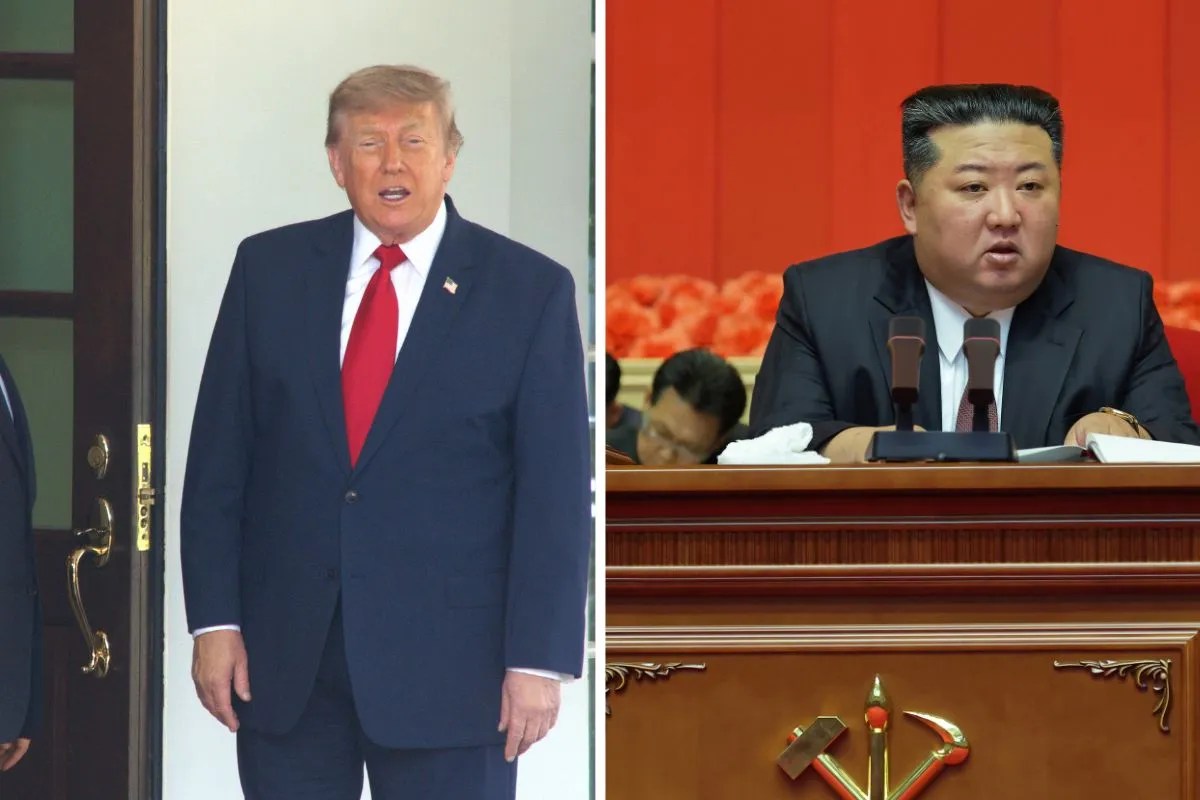
Reports circulating through international diplomatic channels and defense assessments describe a stark reality between Washington and Pyongyang. Kim Jong Un is reportedly refusing to take Donald Trump’s phone calls, leaving formal letters unopened on ornate desks while North Korea accelerates its capacity to strike the American mainland. To read those facts in a standard news brief is to absorb cold statistics about missile ranges, solid-fuel propellants, and stalled summits. To understand what they actually mean requires stepping away from the podiums and looking at the human machinery trapped inside the standoff.
The Architecture of an Unopened Envelope
Consider a hypothetical scenario inside a secure communications room in Washington. Picture a mid-level diplomatic courier—let us call him David—whose entire professional existence revolves around protocols, backchannels, and the precise weight of cream-colored stationery. For years, David watched the theatrical intimacy of personal diplomacy unfold across three high-profile meetings in Singapore, Hanoi, and the Korean Demilitarized Zone. Back then, the letters flowed both ways, celebrated publicly as "beautiful" correspondence that seemed to bypass decades of institutional gridlock.
Now, picture David watching a dispatch vanish into the bureaucratic void of the Swiss or Swedish diplomatic channels that serve as protecting powers in Pyongyang. The envelope is pristine. The seal remains intact. Nobody on the other end is picking up the receiver.
Why would a leader who once walked across the concrete slab at Panmunjom suddenly treat the world’s most powerful office like an unwanted telemarketer?
The answer lies in the brutal arithmetic of leverage. When two leaders meet without a safety net of lower-level agreements, the personal bond becomes the entire bridge. If that bridge fails to deliver the one thing Pyongyang demands above all else—the lifting of crippling economic sanctions without surrendering its nuclear deterrent—then the personal channel loses its currency. Picking up the phone when you hold a weaker economic hand looks like supplication. Leaving the letter unopened, however, projects absolute control.
The Invisible Stakes in the Quiet
While the diplomatic lines sit dead, the factories do not stop humming.
Defense analysts and intelligence assessments from the Pentagon and independent nuclear monitors point to a steady, methodical expansion of North Korea’s strategic arsenal. This is not the clumsy, liquid-fueled rocketry of a decade ago, which required hours of exposed fueling on a launchpad—giving American satellites ample time to spot the preparations and calculate a response.
Think of the difference between an old-fashioned kerosene lantern and a modern flare gun. The lantern requires you to pour the fuel, trim the wick, and strike a match while standing in plain sight. The flare gun is already loaded, sitting in a coat pocket, ready to fire the instant a finger pulls the trigger.
That is the shift represented by North Korea’s investment in solid-fuel intercontinental ballistic missiles, such as the Hwasong-18 and its successors, alongside multiple independently targetable reentry vehicles. By mastering solid propellants and mobile transporter-erector-launchers hidden inside mountain tunnels, Pyongyang has compressed the warning window from hours into minutes.
I remember sitting in a cramped briefing room in Seoul years ago, listening to the civil defense sirens wail during a routine drill while office workers outside barely looked up from their iced coffees. That numbness is a survival mechanism. When a threat lasts for seventy years, people stop flinching at headlines. Yet beneath that calm surface, every strategic planner in Washington, Tokyo, and Seoul knows that faster launch times mean shorter decision windows. And shorter decision windows mean human beings under unimaginable stress have less time to verify whether a radar blip is a flock of geese, a sensor glitch, or an incoming warhead.
Ghosts of Hanoi and the Trap of Personal Diplomacy
To understand why the letters remain sealed today, you have to look back at February 2019 in Hanoi.
For forty-eight hours, the world watched two men sit across from each other in the Metropole Hotel, convinced that sheer force of personality could untangle a seventy-year-old knot. North Korea offered to dismantle its aging nuclear complex at Yongbyon in exchange for the removal of the most punishing United Nations sanctions. Washington, recognizing that Pyongyang possessed covert uranium enrichment facilities elsewhere, demanded everything in exchange for nothing upfront.
They walked away without a lunch, without a joint statement, and without a face-saving exit.
In authoritarian systems built on the myth of infallible leadership, public humiliation is toxic. When Kim Jong Un boarded his armored green train for the sixty-hour journey back through China, the failure of Hanoi dictated the next decade of North Korean military doctrine. The lesson drawn by Pyongyang’s inner circle was brutally simple: diplomatic charm does not buy security; only an undeniable, survivable second-strike capability forces Washington to negotiate on equal terms.
Since that train pulled out of Vietnam, North Korea has enshrined its nuclear status into its constitution, declared South Korea a permanent hostile state rather than a partner for reunification, and deepened its military alignment with Moscow. Artillery shells and ballistic missiles flowing from North Korean stockpiles to Russian battlefields have brought hard currency, food, and potential technical expertise back into Pyongyang. When you have a powerful neighbor buying your munitions and shielding you at the United Nations Security Council, you no longer need to answer calls from Washington.
The Human Cost Inside the Fortress
It is easy to talk about geopolitical chessboards and deterrence theory until you remember that entire populations live underneath the board.
Inside North Korea, the pursuit of intercontinental reach is paid for in calories and electricity. Every ton of specialized steel, every guidance gyroscope, and every batch of composite propellant consumes scarce resources in a country where chronic food insecurity and crumbling healthcare infrastructure remain daily realities for ordinary families outside the Pyongyang elite.
Meanwhile, across the Pacific, an ordinary resident in Seattle, Los Angeles, or Chicago wakes up, makes toast, and drives to work without ever thinking about orbital trajectories over the North Pole. That obliviousness is the ultimate luxury of superpower status. Yet the quiet expansion of North Korea’s missile capabilities is specifically designed to puncture that insulation—to force an American president to ask whether defending Seoul or Tokyo is worth risking an American city.
I confess there is a deep, unsettling confusion in watching this cycle repeat. Experts write thousands of pages debating whether Pyongyang’s weapons are defensive insurance policies or tools of regional coercion. The honest truth, admitted quietly by seasoned diplomats in private conversations, is that nobody outside a tiny circle in Pyongyang knows for certain where deterrence ends and compulsion begins. We are reading intentions through satellite photographs of concrete pads and exhaust plumes, trying to psychoanalyze silence.
The Illusion of the Easy Reset
In American political discourse, there is a persistent temptation to believe that foreign policy deadlocks are merely failures of personal chemistry—that if the right leader simply picks up the phone, flashes a signature smile, or sends a flattering note, decades of structural hostility will evaporate.
History suggests otherwise.
A phone call cannot erase the technical reality of a solid-fuel missile rolling out of a tunnel. A personal letter cannot resolve the fundamental contradiction between an American demand for complete denuclearization and a North Korean conviction that giving up nuclear weapons is political and physical suicide.
When a diplomat sends a letter that goes unopened, the silence is delivering a message far clearer than any summit communique. It says that the price of admission to the negotiating table has permanently changed. Pyongyang is no longer asking to be recognized as a state willing to trade away its arsenal for economic relief; it is demanding to be accepted as a permanent nuclear power, with all the terrifying parity that status implies.
Out in the cold waters of the Sea of Japan, a fishing boat bobs in the pre-dawn swell, its crew watching the horizon under a sky still dark with stars, waiting to see if the morning brings only the sun or another streak of fire climbing toward the stratosphere.


