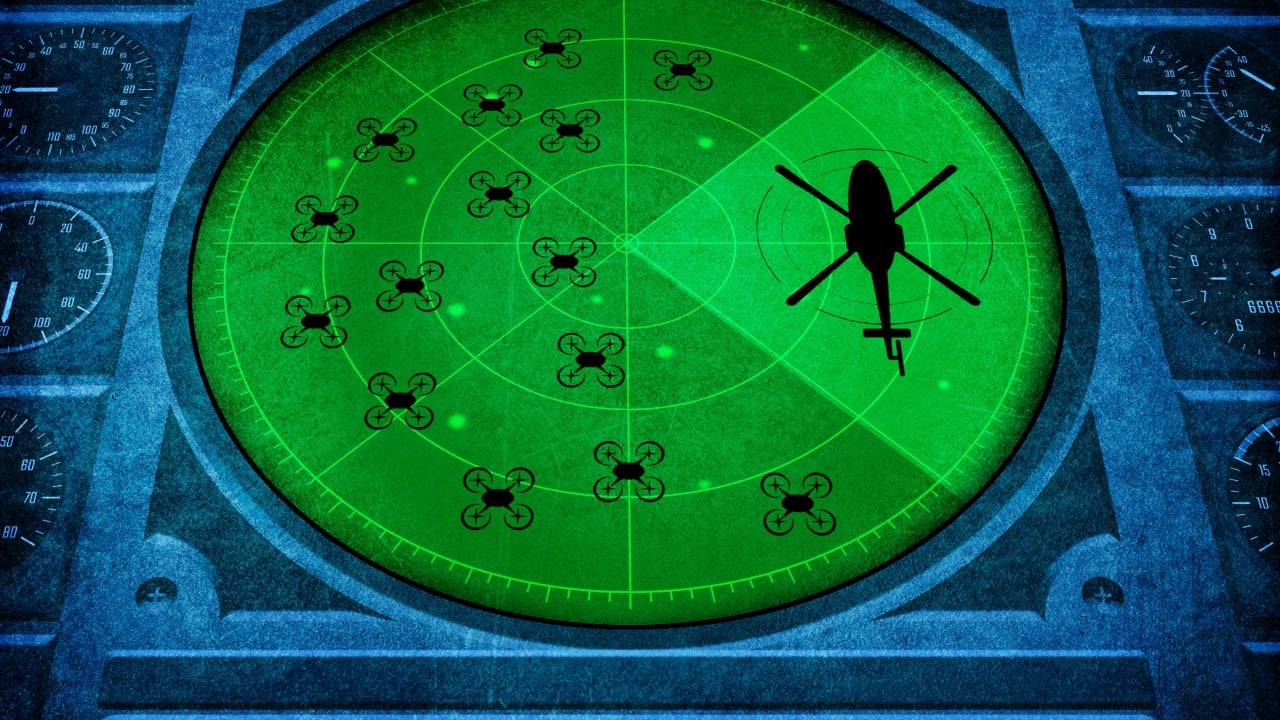
The traditional attack helicopter is currently facing an existential reckoning that no amount of armor plating or electronic countermeasures can fully mask. For decades, the doctrine of "nap-of-the-earth" flying—hugging the terrain to stay below radar—provided a reliable shield against conventional threats. That shield has shattered. In modern theaters, the sky is no longer just a space for aircraft; it is a saturated environment of loitering munitions, first-person view (FPV) drones, and cheap MANPADS that can be distributed to every infantry squad on the front line. To survive, the military helicopter is undergoing a radical technical overhaul that shifts its role from a primary brawler to a high-altitude digital quarterback.
The fundamental problem is one of economics and physics. A modern attack helicopter, such as the AH-64E Apache, costs roughly $35 million to $50 million depending on the configuration. A swarm of ten FPV drones, capable of taking it down or forcing it out of the airspace, costs less than a used sedan. This lopsided math has forced military planners to realize that the helicopter can no longer be the tip of the spear in high-intensity conflict. Instead, it must become a standoff platform, launching its own autonomous systems while remaining safely outside the "kill web" of enemy short-range air defenses.
The Shift to Air Launched Effects
The most significant change in helicopter design isn't the airframe itself, but what it carries in its belly and on its pylons. We are seeing the rise of Air Launched Effects (ALE). These are essentially drones launched from the helicopter while it is still miles away from the target. Rather than flying into a valley to hunt tanks, the pilot stays behind a mountain range and releases a "wolf pack" of small, disposable UAVs.
These drones do the dirty work. They scout the terrain, jam enemy communications, and, if necessary, dive into targets. The helicopter acts as a mobile command center, processing the data stream from these expendable scouts. This creates a buffer of safety. If a drone is shot down, the pilot loses a sensor, not their life. This transition effectively turns the helicopter into a "mother ship," a concept that was once science fiction but is now a mandatory requirement for programs like the U.S. Army’s Future Vertical Lift.
Speed as the New Survival Metric
In the past, maneuverability was the gold standard for survival. If you could out-turn a missile or duck behind a tree line, you lived. Today’s optical and thermal sensors make hiding nearly impossible. Defense contractors are now betting on raw speed and range to outpace the threat.
The traditional helicopter design is limited by the physics of the main rotor. When a helicopter moves forward, the "advancing" blade moves faster than the "retreating" blade. At high speeds, the retreating blade eventually loses lift, a phenomenon known as retreating blade stall. To break this speed ceiling, the industry is moving toward compound designs and tilt-rotors.
The Bell V-280 Valor, for instance, uses tilt-rotor technology to achieve speeds nearly double those of the Black Hawk it is intended to replace. By flying faster and higher, these aircraft can bypass the "low-altitude trap" where small drones and heavy machine guns dominate. However, this shift comes with a massive trade-off in mechanical complexity. Maintaining a tilt-rotor in a muddy, forward-deployed base is a logistical nightmare compared to the rugged simplicity of 20th-century designs.
Digital Camouflage and the Electronic War
If you can be seen, you can be hit. But in the current era, "seeing" is done through the electromagnetic spectrum. Military helicopters are being outfitted with a new generation of Directed Energy Infrared Countermeasures (DIRCM). These systems use high-powered lasers to blind the seekers of incoming heat-seeking missiles.
Beyond physical defenses, the focus has shifted to Low Probability of Intercept (LPI) communications. Modern helicopters must transmit massive amounts of data to ground troops and other aircraft without screaming their location to enemy signals intelligence. This requires advanced beam-forming antennas that "whisper" data in a narrow direction rather than broadcasting it in a circle. The moment a helicopter turns on its radar or radio, it becomes a beacon. Survival now depends on being electronically "dark" while remaining digitally connected.
The Burden of Manned-Unmanned Teaming
The mental load on a modern pilot is reaching a breaking point. Operating a complex aircraft while simultaneously managing a swarm of four or five drones is more than a human brain can handle in the heat of combat. This has led to the integration of Cognitive Decision Aids, which are essentially onboard computers that filter out 90% of the "noise" and only present the pilot with actionable threats or targets.
This isn't about the aircraft flying itself; it’s about the aircraft knowing what the pilot needs to see. If a drone in the swarm detects a surface-to-air missile site, the helicopter’s computer doesn't just show a blip; it calculates the best escape route and readies the jamming pods automatically. This level of integration is expensive and fragile. A single software bug can be as lethal as a rocket-propelled grenade.
The Vulnerability of the Tail Rotor
If you want to see where helicopter design is going, look at what is disappearing: the tail rotor. Long the "Achilles' heel" of the helicopter, the tail rotor is vulnerable to small arms fire and is a major source of acoustic noise. New designs are favoring coaxial rotors (two sets of main blades spinning in opposite directions) or NOTAR (No Tail Rotor) systems.
By removing the tail rotor, engineers reduce the aircraft's noise signature and eliminate a single point of failure that has claimed countless lives in "brown-out" landings or urban combat. The Sikorsky X2 technology, which uses stacked rotors and a rear pusher prop, allows for high-speed flight and incredible stability at a hover. But even these advances don't solve the fundamental problem that a large, hot, metal object in the sky is an easy target for a $500 drone with a shaped-charge warhead.
Is the Attack Helicopter Already Obsolete?
There is a brewing argument in defense circles that the attack helicopter is the new battleship—a majestic, powerful machine that is simply too expensive and vulnerable to use in a real fight. Critics point to the heavy losses of Ka-52 Alligators in Ukraine as proof that even the most advanced armored gunships struggle against a motivated infantry equipped with modern sensors.
The counter-argument is that drones cannot yet provide the immediate, heavy "weight of metal" that a helicopter can. A drone might carry one or two missiles; an Apache carries sixteen Hellfires and a 30mm chain gun. There is a psychological impact to the presence of a manned gunship that a small drone cannot replicate. However, the mission is changing from "search and destroy" to "coordinate and survive."
The Infrastructure Challenge
Modernizing a fleet isn't just about the aircraft; it's about the "tail." These high-tech helicopters require specialized fuel, clean rooms for sensor repair, and a constant stream of software patches. In a protracted conflict where supply lines are targeted by long-range missiles, the ability to maintain a fleet of tilt-rotors becomes a strategic liability. The military is struggling to balance the need for "high-tech" with the reality of "rugged."
The Pivot to Modular Open Systems
To avoid being locked into 40-year-old technology, the newest generation of helicopters is built on a Modular Open Systems Approach (MOSA). This means the hardware and software are "plug and play." If a new type of drone-detection sensor is invented tomorrow, it can be integrated into the helicopter's cockpit in weeks rather than years. This flexibility is the only way to keep pace with the rapid evolution of drone warfare, where new threats emerge on a monthly basis.
The goal is to move away from the "black box" proprietary systems of the past. By using standardized interfaces, the military can swap out components from different manufacturers, driving down costs and speeding up the deployment of counter-drone technologies. This is a quiet revolution in bureaucracy that is just as important as any new engine or rotor blade.
The Reality of the Future Battlefield
The helicopter of 2030 will look more like a high-speed transport for sensors than a flying tank. It will sit far back from the front lines, acting as the hub of a vast, autonomous network. The pilots will be "system managers" as much as they are "stick and rudder" flyers. The era of the lone-wolf helicopter pilot charging into a valley is over.
The survival of the platform depends entirely on its ability to integrate with the very drones that currently threaten its existence. If the helicopter cannot control the swarm, it will be consumed by it. The engineering is largely solved; the real challenge now is the doctrine—learning how to fight in a world where the most dangerous thing in the sky is also the cheapest.
Map the electromagnetic footprint of your operational area before committing manned assets to the hover.