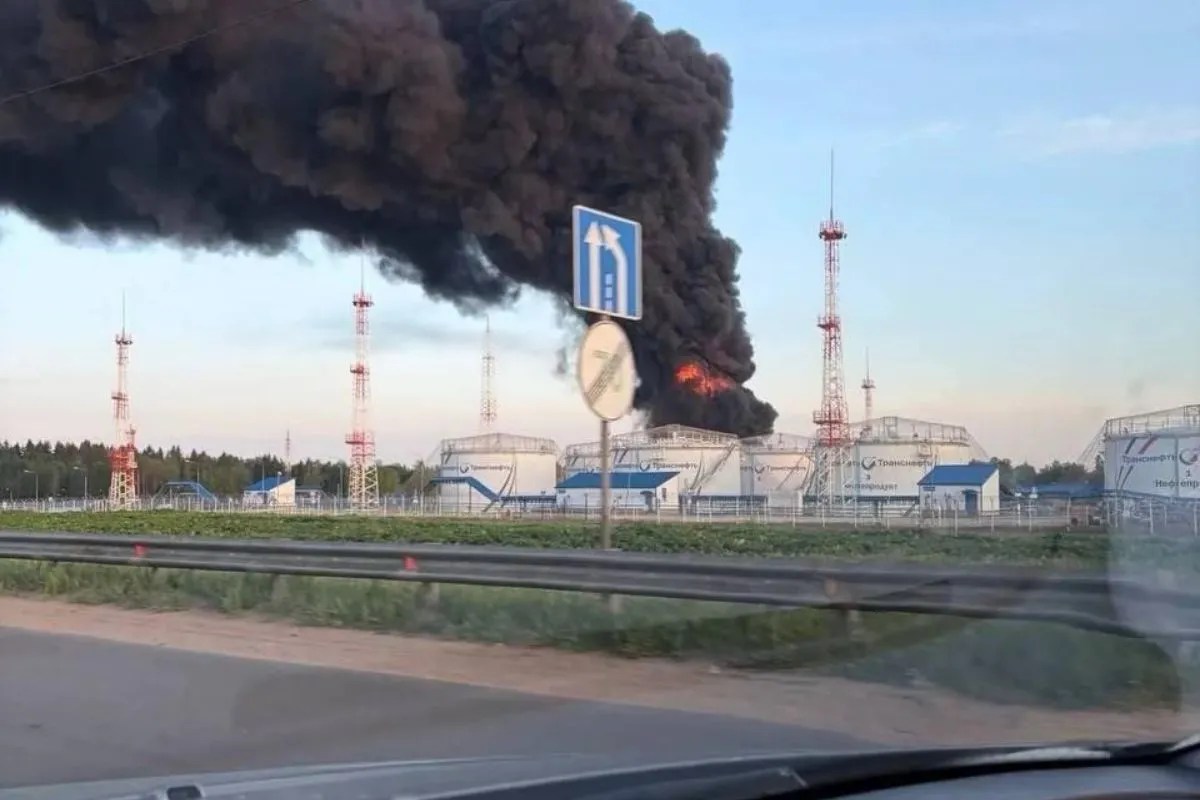
Ukraine has fundamentally altered the geography of modern warfare by striking Russia’s Tyumen refinery, using a long-range drone to hit a target situated over 2,000 kilometers from the border. This specific operation shatters the traditional assumption that Russia’s vast interior provides an automatic geographic shield for its critical infrastructure. By bypassing dense layers of front-line air defenses to hit a facility deep within Western Siberia, Kyiv has signaled that every single oil and gas asset in European Russia is now vulnerable. This paradigm shift forces Moscow to make an agonizing choice between protecting its frontline troops or guarding the economic engine that funds its war machine.
The logistics of the Tyumen strike reveal a massive intelligence and engineering failure on the part of the Russian state, while exposing the structural fragility of its energy supply chain. You might also find this related coverage insightful: The Ghost at the Negotiating Table.
Breaking the Geography of Deterrence
For generations, Russian military doctrine relied on the tyranny of distance. The country's strategic depth was its ultimate defense, a lesson learned by invading armies throughout history. That defense has collapsed. A drone traveling 2,000 kilometers does not just fly; it navigates a complex, multi-hour flight path requiring sophisticated guidance systems, low-altitude terrain masking, and highly precise intelligence on blind spots within Russian radar coverage.
To understand how a localized conflict transformed into a deep-theater air campaign, one must look at the technical composition of these long-range assets. These are not the off-the-shelf commercial quadcopters seen on the front lines in the Donbas. These are essentially uncrewed, low-cost cruise missiles built with composite materials that minimize radar cross-sections. They utilize pre-programmed waypoint navigation combined with optical scene matching for terminal guidance, allowing them to strike specific distillation columns with pinpoint accuracy even in environments heavily compromised by electronic warfare. As extensively documented in recent articles by NBC News, the implications are significant.
The vulnerability of the Tyumen facility highlights a structural flaw in Russia's domestic defense posture. Air defense systems like the S-400 and Pantsir-S1 are highly capable, but they are finite resources. Russia cannot protect every square kilometer of its airspace. When forced to choose between deploying these systems to protect active military logistics hubs near Ukraine or securing refining infrastructure deep in the rear, Moscow consistently prioritizes the front lines. Ukraine exploited this gap, turning Russia’s geographic vastness into a liability by forcing Russian air defense to search for a needle in a continent-sized haystack.
The Economic Chokepoint in the Siberian Interior
Targeting a refinery in Tyumen is a calculated economic maneuver designed to inflict maximum systemic friction on the Russian economy. Refineries are not simple warehouses; they are highly complex chemical plants that operate under immense pressure and temperature. The most critical components of these facilities are the primary distillation towers, known as AVT units. These units separate crude oil into its primary fractions, such as gasoline, diesel, and jet fuel.
Replacing an AVT unit is a monumental task under normal economic conditions. Under global sanctions, it becomes a logistical nightmare.
- Sanctions Constraints: Much of the sophisticated automation, control valves, and specialized catalytic cracking components inside Russian refineries were supplied by Western engineering firms before the escalation of the conflict.
- Supply Chain Bottlenecks: While Russia can attempt to source replacement parts from alternative markets or reverse-engineer components domestically, doing so introduces significant delays and lowers overall operational efficiency.
- Production Halts: A successful strike on a single distillation column can take an entire refinery offline for months, forcing the operator to either flare crude oil or shut down production wells upstream.
The financial ripple effects extend far beyond the immediate cost of repairing steel and concrete. When a refinery deep in the interior stops producing, local supply chains break down. Siberia is the heart of Russia’s resource extraction, and the heavy machinery, transport trucks, and regional rail networks that keep the economy moving rely entirely on locally refined diesel. Depriving the region of this fuel forces Moscow to redirect refined products from other parts of the country, clogging an already stressed railway network and driving up domestic fuel prices.
The Shell Game of Strategic Air Defense
The Tyumen strike forces a radical reallocation of Russian military hardware. Western analysts have noted that Russia has been forced to pull mobile air defense units away from secondary military installations and even from its borders with NATO countries to create localized defense rings around major industrial centers. This creates a highly exploitable patchwork of coverage.
The Dilemma of Point Defense
Protecting a sprawling industrial complex like the Tyumen refinery requires point-defense systems capable of intercepting low-flying, slow-moving targets. Systems like the Pantsir are designed for this exact role, but they are required in massive numbers to provide 360-degree, multi-layered protection against coordinated swarm attacks. Every Pantsir battery stationed outside a Siberian refinery is one less battery available to protect a fuel depot in Crimea, a command post in Zaporizhzhia, or a military airfield in Voronezh.
The Intelligence Blindspot
A drone does not fly 2,000 kilometers through Russian airspace without inside help or profound intelligence gaps. The success of these missions points to a highly sophisticated reconnaissance apparatus. Ukraine has successfully leveraged satellite imagery, signals intelligence, and potentially human intelligence networks on the ground inside Russia to map out the active radars of Russia’s early warning network. By charting a course through the valleys and radar shadows of the Russian landmass, these drones exploit the fundamental truth that it is impossible to maintain continuous, low-altitude radar coverage across eleven time zones.
The Flawed Logic of Western Escalation Fears
For months, international observers debated the wisdom of allowing or enabling deep strikes inside Russian territory, citing the risk of uncontrollable escalation. The Tyumen operation demonstrates that this debate was largely disconnected from the realities on the ground. Ukraine developed its own indigenous long-range strike capabilities precisely to bypass external political restrictions, signaling a new phase of self-reliance in strategic warfare.
This domestic development changes the diplomatic calculus. Washington and European capitals can no longer dictate the operational boundaries of the conflict by withholding specific weapon systems. Kyiv has demonstrated that it possesses the engineering capability to manufacture long-range kinetic tools independently, using commercial components, domestic funding, and localized production facilities hidden from Russian missile strikes.
The escalatory response that many feared has instead manifested as a desperate defensive scramble within Russia. Moscow's options for asymmetric retaliation are shrinking. Its strategic bomber fleet is already heavily utilized, its missile stockpiles are subject to production bottlenecks, and its economy is dealing with chronic inflation and labor shortages. The narrative of an untouchable Russian hinterland has evaporated, replaced by the reality of a protracted, symmetrical war of attrition that reaches deep into the Russian heartland.
The Vulnerability of Global Energy Architecture
The implications of the Tyumen raid stretch far beyond the borders of Russia and Ukraine, offering a grim preview of the future of global conflict. The modern global economy relies on a highly concentrated, hyper-efficient network of energy infrastructure. Pipelines, refineries, and maritime terminals were built for economic efficiency, not tactical resilience.
What happened in Tyumen can be replicated anywhere. The proliferation of cheap, long-range uncrewed systems means that non-state actors, regional powers, and smaller nations now possess strategic strike capabilities that were once the exclusive domain of global superpowers. A billion-dollar energy facility can be crippled by a drone that costs less than a luxury SUV.
This asymmetry redefines the cost-benefit analysis of modern industrial defense. Governments and multinational corporations must now accept that physical distance is no longer a viable form of security. The vulnerability is permanent, and the technology required to exploit it is only becoming cheaper, more accurate, and harder to detect.