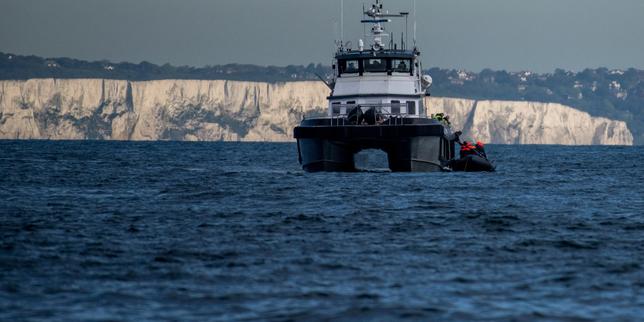
Brussels just blinked. By sending European border agency assets into the icy waters of the English Channel to help France manage small-boat crossings, the European Union has committed to a theatrical exercise in maritime band-aids. The lazy consensus says that adding more grey hulls to a crowded waterway solves a crisis. It does not. It merely subsidizes the symptom while ignoring the structural mechanics driving every inflatable dinghy off the beaches of northern France.
Let us look at the architecture of this deployment without the political spin. The official line from the European Border and Coast Guard Agency frames this as a vital reinforcement for search and rescue operations. Spanish patrol vessels like the Duque de Ahumada and later Lithuanian units are rotating into the zone under French operational control.
Here is what the press releases omit. Under international maritime law and French standard operating procedure, pulling people out of the water does not equal stopping them from trying again. Rescued individuals return to French soil legally unrestricted, free to procure another cheap rubber boat and launch into the dark the following week. Adding European ships to a rescue loop that feeds right back into the departure cycle is like bailing out a sinking ship with a perforated bucket while leaving the garden hose wide open.
This is a failure of logic born from political panic. Governments treat migration as a logistics problem to be bullied into submission with hardware. If you buy enough patrol boats, thermal cameras, and helicopters, the human element supposedly vanishes.
History shows the opposite. Border enforcement without destination-market accountability acts as an unintended tax paid in human lives and administrative exhaustion. When land and near-shore routes tighten, smugglers simply upgrade their risk models. They pack more bodies into flimsier vessels, knowing that European and French coast guards are legally obligated under maritime law to fish them out of the water.
Imagine a scenario where a private logistics company tried to optimize a supply chain by investing heavily in emergency crash response while refusing to fix the faulty steering mechanism on their trucks. They would bleed capital while the wreck rate climbed. That is precisely what Paris and Brussels are doing. They are scaling up rescue infrastructure in the Channel while pretending that the pull factors across the Dover Strait do not exist.
The economic profile of the smuggling networks running out of Calais and Dunkirk is remarkably resilient. These syndicates operate on low fixed costs. Inflatable rafts bought in bulk from overseas manufacturers cost a fraction of what a single crossing fetches in cash per boatload. A patrol vessel from Frontex operating in the North Sea or the Channel burns through tens of thousands of euros a day in fuel, maintenance, and personnel costs. The asymmetry is staggering. State actors deploy billion-dollar institutional apparatuses to chase low-cost, decentralized criminal enterprises that adapt their launch sites within hours of a police sweep.
To understand why this deployment changes nothing, look at the legal constraints governing the mission itself. Frontex assets are there explicitly to support search and rescue and coast guard functions, not to push boats back or engage in extraterritorial interdiction. France refuses to intercept boats actively heading out to sea because towing or stopping them while underway creates immediate, catastrophic capsizing hazards that liability-conscious democracies refuse to shoulder.
Therefore, the operational reality on the water remains identical to what it was before the first European vessel arrived. The boats launch, they founder or enter distress, and state vessels pick them up. The flag painted on the side of the rescue ship changes from French to Spanish or Lithuanian, but the trajectory of the human beings on board does not shift by a single degree.
If policymakers were serious about breaking the model, they would stop pretending that the problem lives exclusively in the water between Calais and Dover. The maritime boundary is the final, most expensive point of failure in a long chain of policy breakdowns.
Real disruption requires dismantling the shadow economy on land before the rubber ever touches the sand. That means treating human smuggling networks with the same financial surveillance tools used to dismantle international narcotics syndicates. It means targeting the anonymous supply chains that funnel commercial engines and cheap polymers into northern French storage sheds.
More importantly, it requires confronting the asynchronous labor markets and asylum procedures across the Channel that make the perilous journey a rational economic gamble for desperate people. Until those deep structural drivers are addressed, deploying European navies to the Channel is nothing more than expensive theater. It provides a convenient optical illusion for politicians needing to look decisive on television, while the underlying machinery of the crossing hums along undisturbed.
Stop funding the symptoms. Shut down the black-market supply lines on dry land or accept that every grey hull you park in the Channel is just an expensive taxi service for a broken system.