The panic starts about a week before totality. People swarm hardware stores, raid pharmacy counters, and pay thirty times markup on flimsy cardboard frames fitted with dark polymer sheets. They treat a celestial alignment like an impending zombie apocalypse, convinced that walking outside without certified ISO 12312-2 filters will instantly turn their retinas into charcoal.
It is mass hysteria wrapped in bad optics. Don't forget to check out our earlier article on this related article.
The lazy consensus from every mainstream lifestyle blog and recycled science column is simple: buy the glasses or stay indoors behind locked blinds. If you miss the plastic-frame memo, you are supposedly doomed to blindness.
That advice is lazy, scientifically sloppy, and misses the entire physics of how we interact with light. Stop hunting for pieces of cardboard stamped with international standards. You do not need specialized solar glasses to experience an eclipse safely, because looking directly at a partial solar phase is a bad idea whether you have cheap paper specs or not. To read more about the background here, The Spruce provides an informative summary.
The Physics They Refuse To Explain
Let us clear up the core misconception immediately. Solar glasses do not protect your eyes because they are magical pieces of high-tech gear. They protect your eyes because they block roughly 99.999% of visible light, alongside virtually all ultraviolet and infrared radiation. They act as a massive neutral density filter.
When you slip them on, you see a crisp, orange-white crescent of the sun floating in a pitch-black void. It is clean. It is clinical. It is also entirely unnecessary if you change your methodology.
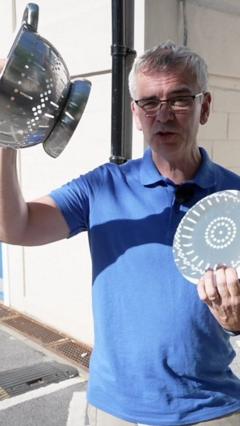
The mainstream narrative treats direct observation as the only valid way to witness the event. That is a failure of imagination. Long before mass-produced polymer films existed, astronomers and curious observers projected the sun. They used pinholes. They used tree leaves. They used kitchen colanders.
When light passes through a small aperture, it forms an image of the light source on the surface behind it. Every single leafy tree during a partial eclipse acts as a multi-lens projector, casting hundreds of dancing crescent suns onto the sidewalk. You do not need to stare up into the sky to watch the show. Look down.
Dismantling The Pinhole Phobia
Type "how to view an eclipse without glasses" into any search engine, and you will find endless articles treating the pinhole projector like a craft project for third-graders. They patronize you with instructions involving two index cards and a pushpin, making it sound like an amateurish backup plan you only use when you fail to secure the real gear.
That perspective turns reality upside down.
Indirect projection is superior for spatial comprehension. Staring directly into a pinprick of light through tiny filter lenses gives you tunnel vision. You see a sliver of the sun, but you miss the environmental drop in temperature, the strange twilight shadows, the behavioral shift in wildlife, and the sweeping geometry of the sky.
If you build a simple projection box—a basic shoebox with aluminum foil and a pinhole—you get a clear, scaled projection of the solar disk on a back panel. You can stand comfortably with your back to the sun, chatting with friends, watching the crescent shrink and grow without squinting, sweating, or worrying about a gust of wind tearing cheap cardboard off your face.
The downside? It takes two minutes of actual effort to set up instead of clicking "buy now" on an overpriced marketplace listing.
The Real Danger Is Not The Eclipse
Let us talk about why the panic industry thrives around eclipses. People are terrified of the sun because they fundamentally misunderstand how the human body processes light.
On a random Tuesday in July, you can walk outside, stare directly at the blazing noon sun, and permanently damage your vision. Nobody issues a nationwide news alert about Tuesday afternoons. Yet, when an eclipse rolls around, otherwise rational adults treat the sun like a loaded gun pointed directly at their foreheads.
The danger during an eclipse is not that the sun becomes more harmful. The danger is that your pupils dilate because the ambient light drops, leading people to stare longer and harder at a concentrated sliver of blinding radiation without immediate pain receptors screaming at them to look away. Photokeratitis, or solar retinopathy, burns the retinal tissue without pain.
That is the actual risk. It has nothing to do with special eclipse magic. It has everything to do with human stubbornness and bad behavior.
If you use cheap, counterfeit glasses purchased from a sketchy third-party seller online—a massive problem during every major celestial event—you are trusting your eyesight to a piece of printed cardboard that might have microscopic pinhole tears or lack proper optical density. The market is flooded with fake safety gear. Relying on a piece of cardboard from an unverified vendor is far riskier than using indirect, physics-backed projection methods that cost zero dollars.
The Totality Exception
There is one massive caveat that the media routinely mangs, and it creates profound confusion.
If you are inside the path of totality—the narrow corridor where the moon completely blocks the face of the sun—you do not need solar glasses for a brief, magical window of time. In fact, if you keep your glasses on during totality, you will see precisely nothing, because totality is as dark as a clear night sky with bright stars and planets emerging.
During those precious minutes of totality, you can and should take your eye protection off entirely. Look at the corona. Look at the solar prominences licking the edge of the black lunar disk. It is safe because the scorching photosphere of the sun is entirely occluded.
The second the first bead of direct sunlight reappears—the diamond ring effect—the protection must go back on instantly.
This nuance is where casual observers mess up. They either stay too terrified to take their glasses off during totality, robbing themselves of the defining visual experience of a lifetime, or they take them off too early during the partial phase and burn their retinas.
If you want to avoid this confusion entirely, master projection. Let a simple pinhole track the partial phases while you keep your eyes planted firmly on the horizon and your environment. When totality hits, drop the box, look up at the black sun with your naked eyes, and experience the universe without a plastic filter standing between you and reality.
Stop treating astronomy like an equipment-buying contest. Step away from the checkout cart. Grab a colander from your kitchen, walk out into your driveway, and watch the ground light up with crescents.