The Fetishization of a Mudflat
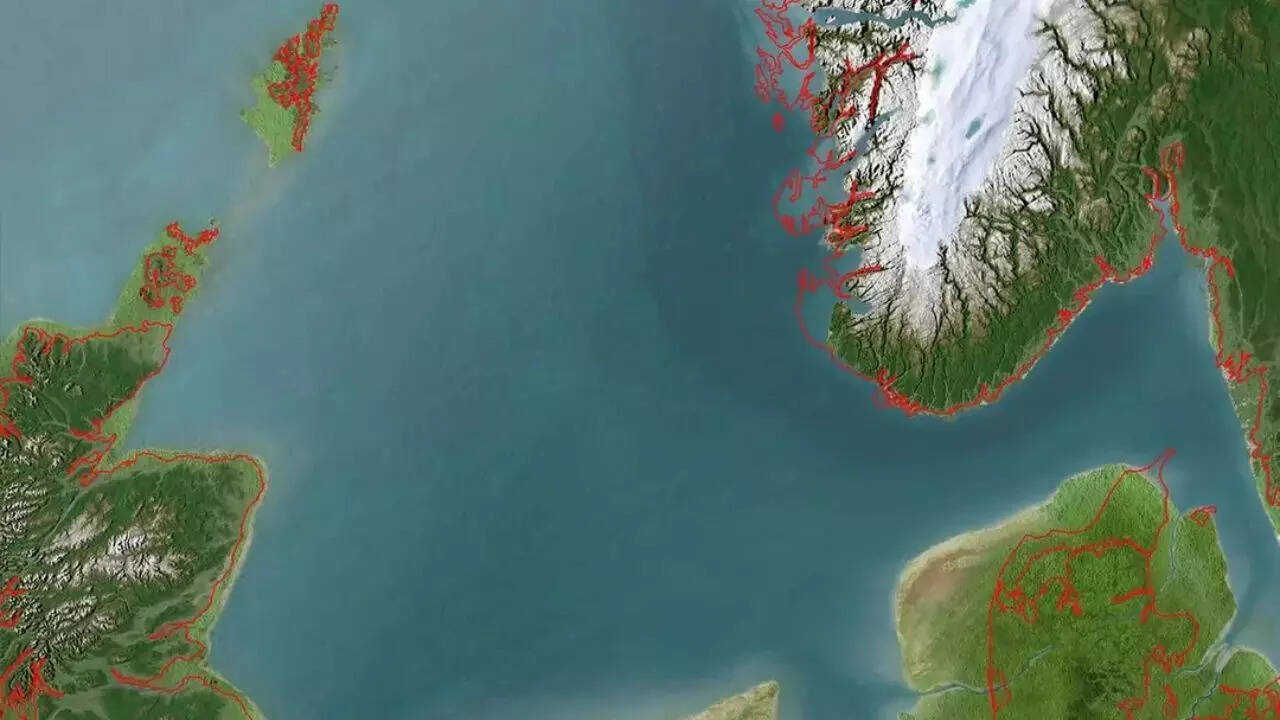
Most archaeology reads like a funeral dirge for a place nobody remembers. You’ve seen the maps. They show a vast, sprawling landmass connecting the UK to the Netherlands and Denmark, painted in a lush, prehistoric green. The narrative is always the same: a "lost world" swallowed by the rising tides, a cautionary tale for our own climate-threatened coastline.
It’s a lazy take. It’s romanticized environmentalism masquerading as history. If you liked this piece, you should check out: this related article.
Doggerland wasn't a paradise lost. It was a brutal, shifting, sodden mess of marshland that was inevitably doomed by the very geography that created it. To view its submergence as a catastrophe is to fundamentally misunderstand how human migration and ecological succession actually function. We need to stop treating the English Channel like a crime scene and start seeing it for what it is: a necessary filter that defined the modern European identity.
The Myth of the Sunken Eden
Pick up any standard text on the Mesolithic and you’ll find the same trope. They call it the "Garden of Eden" of the North Sea. They point to the "Brown Bank" finds—mammoth teeth, flint tools, and human remains dredged up by Dutch fishing trawlers—as evidence of a flourishing civilization. For another angle on this development, refer to the recent coverage from Smithsonian Magazine.
Let’s get real about the topography.
For the majority of its existence, Doggerland was a drainage basin. Imagine the Thames, the Rhine, and the Elbe all dumping their silt and runoff into one massive, low-lying plain. This wasn't a rolling countryside; it was a swamp. During the Preboreal and Boreal periods, roughly 10,000 to 8,000 years ago, the region was a maze of braided river channels and stagnant lagoons.
If you lived there, you weren't "thriving" in a lush meadow. You were fighting off biting insects, navigating treacherous bogs, and moving your camp every time a seasonal flood surged three inches higher than the year before. The sediment data confirms it. We’re looking at peat, clay, and fine sands.
The "lost world" wasn't a country. It was a giant sponge.
The Storegga Slide is a Red Herring
The favorite "villain" in the Doggerland story is the Storegga Slide. About 8,200 years ago, a massive underwater landslide off the coast of Norway triggered a tsunami that supposedly wiped out the remaining inhabitants of the Dogger Archipelago in one fell swoop.
Sensationalist? Yes. Accurate? Hardly.
While the Storegga tsunami was undoubtedly a terrifying event, it didn't "sink" Doggerland. The land was already a goner. Global sea levels were rising at a rate of nearly two meters per century during the early Holocene. The math is simple:
$$\Delta H = \int_{t_1}^{t_2} R(t) dt$$
Where $\Delta H$ is the change in sea level and $ R(t) $ is the rate of eustatic rise. By the time the tsunami hit, the "land" was already a series of disconnected, low-lying islands. The tsunami was the coup de grâce, not the cause of death.
Archaeologists like Vincent Gaffney have done incredible work using seismic data to map the paleolandscape, but the public interpretation of that data has become warped. We’ve turned a slow, predictable inundation into a sudden, cinematic disaster. This distorts our understanding of Mesolithic resilience. These people weren't surprised. They had been retreating for generations. They were the original masters of the tactical withdrawal.
The Continental Divorce was a Strategic Win
We are told that the separation of Britain from the continent was a tragedy of isolation. That’s a fundamentally flawed, Eurocentric perspective.
The flooding of the Dover Strait and the final submergence of the Dogger Bank created the most effective defensive moat in human history. Without the "loss" of Doggerland, British history—and by extension, the geopolitical structure of the Western world—is unrecognizable.
The North Sea became a highway, not a barrier. But it was a highway with a toll. It required technology. It required seafaring. The transition from the Mesolithic to the Neolithic in the British Isles was slowed by this water barrier, allowing for a unique cultural synthesis that wouldn't have happened if you could simply walk from Calais to Dover.
The isolation forced a specific type of evolutionary pressure on the populations that remained. It created a maritime culture by necessity. If Doggerland still existed today, London would just be another inland city on a muddy river, likely a provincial outpost of a sprawling, indistinguishable North European plain.
The Data the Romantics Ignore
When you look at the isotope analysis of human remains found in the North Sea basin, a clear pattern emerges. These weren't settled "nations." They were highly mobile opportunistic foragers.
- Diet: Heavy reliance on aquatic resources, which are naturally more resilient to climate shifts than terrestrial ones.
- Mobility: Tool kits found in the North Sea indicate a "curated" technology—meaning they carried light, high-quality stone and bone because they knew they wouldn't be staying long.
- Population Density: It was incredibly low. The idea of a "lost civilization" implies a structure that simply didn't exist.
The loss of land didn't mean a loss of life on a scale that impacted the human trajectory. It was a reorganization. The people moved to the high ground. They moved to the Dogger Hills (now the Dogger Bank fishing grounds) and eventually to the coastlines of Yorkshire and Denmark.
We see this in the Star Carr site in North Yorkshire. It’s often cited as a "sister site" to the Doggerland cultures. What does Star Carr show us? People who were perfectly comfortable living on the edge of a changing water world. They weren't mourning the loss of the plains; they were busy hunting red deer and making headdresses from antlers.
Stop Using Doggerland as a Climate Prop
The most egregious use of Doggerland is as a "canary in the coal mine" for modern sea-level rise. It’s a false equivalence.
The sea-level rise at the end of the last ice age was driven by the collapse of the Laurentide and Fennoscandian ice sheets. It was a natural, orbital-cycle-driven transition from a glacial to an interglacial period. The rates of change, while fast in geological terms, occurred over millennia.
Using Doggerland to scare people about 21st-century climate change is intellectually dishonest for two reasons:
- Infrastructure: Mesolithic humans didn't have nuclear power plants, fiber-optic cables, or multi-billion dollar coastal cities. They had tents. They picked up their belongings and walked five miles inland over the course of a decade. For them, "rising seas" meant their favorite fishing spot moved slightly.
- Topography: Most of Doggerland was less than five meters above sea level. It was the lowest-hanging fruit for an encroaching ocean. Comparing the loss of a prehistoric marsh to the potential flooding of Manhattan or Miami—cities built on significantly more complex and stable geological foundations—is apples and oranges.
The Real Value of the Sunken North Sea
If we want to actually respect the history of Doggerland, we need to stop treating it as a lost continent and start treating it as a laboratory.
The North Sea is currently being colonized by wind farms. This is the ultimate irony. We are building the energy infrastructure of the future on the graveyard of a world drowned by previous climate shifts. Developers are forced to conduct "Pre-construction Archaeological Assessments."
I have seen the reports. They are fascinating. We are finding more about our ancestors through industrial development than we ever did through pure academic research. The "lost land" is finally paying its rent.
We are finding that the Mesolithic occupants of the Doggerland plains were far more adaptable than we give them credit for. They didn't just survive; they exploited the shifting margins. They lived in the "liminal space" between land and sea—a concept modern urban planners are only just beginning to grasp.
Forget the Elegy
We don't need another documentary about the "Atlantis of the North." We don't need more CGI recreations of a hunter-gatherer looking sadly at a rising tide.
Doggerland was a transient feature of a volatile planet. Its disappearance was the catalyst for the Britain we know. It was the filter that pushed people into the rugged highlands of Scotland and the fertile valleys of southern England.
It wasn't a tragedy. It was a clearing of the deck.
The North Sea isn't a tomb; it’s a biological and historical engine that is still running. The mammoths are gone, the marshes are under sixty meters of salt water, and the world is better for it.
Go to the coast of Norfolk. Look out at the grey, churning water. Don't feel sad for what was lost. Feel grateful for the barrier that was built. The ocean didn't "swallow" Doggerland; it reclaimed a workspace that was no longer fit for purpose.
Stop looking for a lost world and start looking at the one it paved the way for.