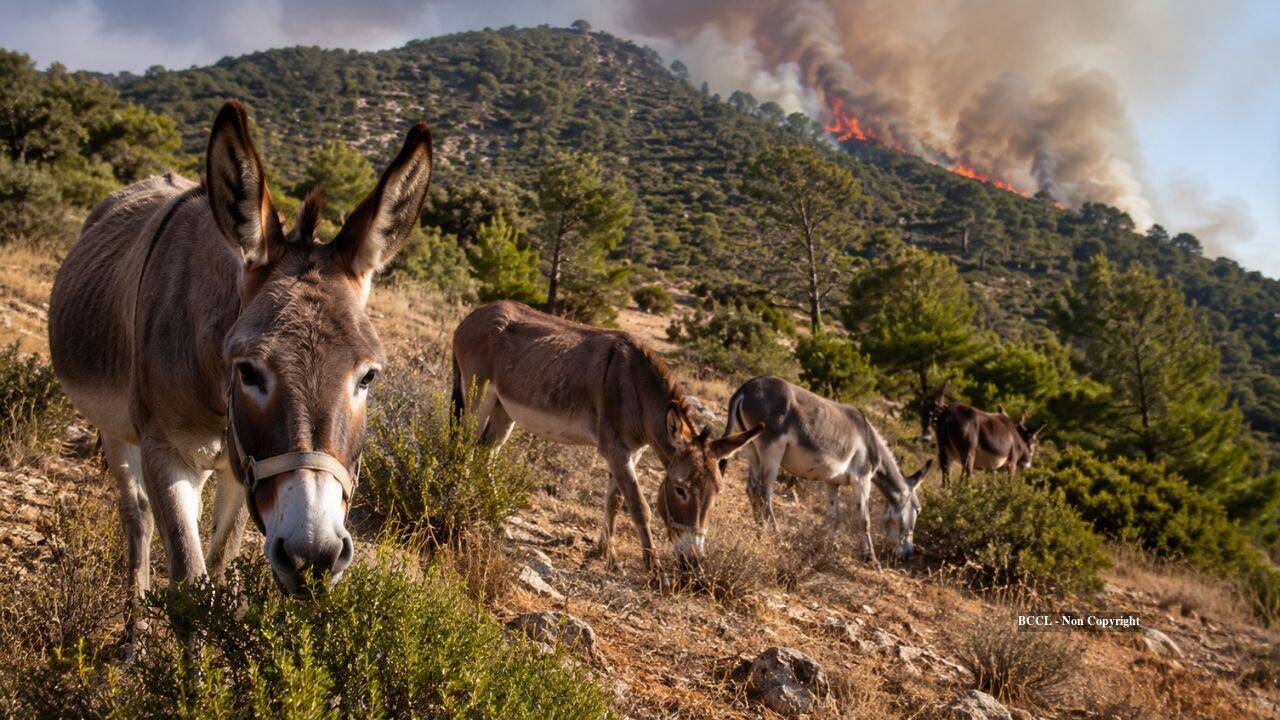
Wildfire mitigation operates on a strict energetic deficit. Mechanical clearing relies on fossil fuels, heavy machinery, and high labor overhead, while controlled burns demand precise meteorological windows that rarely materialize. When a Spanish practitioner trained a cohort of rescued equines to clear high-density Mediterranean underbrush, the intervention bypassed traditional machinery constraints.
Understanding this model requires examining the intersection of biological consumption rates, terrain accessibility, and municipal cost functions. Equine browsing converts high-flammability dry biomass into localized nutrient cycling, altering the fuel load profile of rugged topography without carbon-heavy mechanical intervention.
The Mechanics of Biomass Reduction
Vegetation management centers on the removal of fine fuels, which include grasses, shrubs, and low-hanging canopy branches measuring less than six millimeters in diameter. These materials dictate the rate of spread and flame length during ignition events. Traditional strategies deploy crews with chainsaws or heavy mulchers. Both options fail in steep, rocky Mediterranean terrain where transport costs for heavy equipment exceed operational value.
Resected equines alter this dynamic through targeted browsing patterns. Unlike ruminants such as sheep or goats that strip bark and kill mature timber through ring-barking, equines select coarse grasses, gorse, brambles, and low brush. Their digestive tracts process high-lignin, low-nutrient flora that other domestic livestock reject.
Browsing Efficiency Variables
- Ingestion Rate: An adult animal consumes roughly two percent of its body weight in dry matter daily, converting standing fuel loads directly into biological waste.
- Locomotion Dynamics: Equine hoof action breaks up the organic duff layer, aerating soil and crushing seed casings while trampling surface litter into contact with soil moisture, accelerating decomposition.
- Topographical Range: Low center of gravity and sure-footedness allow access to slopes exceeding thirty degrees, zones where wheeled or tracked mulchers cannot operate safely.
The operational footprint scales directly with herd size and movement pacing. By maintaining high-density grazing pressure on targeted ridge lines, managers create linear fuel breaks that interrupt fire runs without disturbing deep-rooted canopy trees.
The Economic Cost Function
Public land management agencies evaluate wildfire prevention through a standard cost-efficiency formula. The variable cost of manual labor includes wages, transport, gear, and safety compliance. Mechanical clearing adds capital expenditure for machinery acquisition, fuel consumption, and hydraulic maintenance.
$$\text{Total Cost}{\text{Mechanical}} = \text{CapEx}{\text{Equipment}} + \text{OpEx}{\text{Fuel}} + \text{Labor}{\text{Crews}}$$
Integrating rescued stock shifts the balance of the expenditure ledger.
$$\text{Total Cost}_{\text{Equine}} = \text{Feed/Vet Baseline} + \text{Handler Labor} + \text{Containment Infrastructure}$$
Rescue animals introduce a negligible acquisition cost compared to heavy equipment. However, the labor model changes from machinery operators to animal handlers. One handler manages a cohort of eighteen animals, covering an area equivalent to a multi-man mechanical crew at a fraction of the hourly burn rate for diesel equipment.
The hidden variable lies in municipal waste management subsidies. Rescued animals often arrive from shelter environments with ongoing maintenance costs funded by donations or municipal animal control budgets. Redirecting these assets toward ecological services transforms a liability asset into a functional municipal utility.
Behavioral Conditioning and Herd Dynamics
Unmanaged equines avoid unfamiliar terrain and panic under erratic environmental stimuli such as smoke or sudden noise. Deploying rescue animals for fuel reduction requires systematic desensitization protocols to ensure operational safety and efficacy in zones prone to environmental stress.
The training framework relies on operant conditioning combined with herd leadership hierarchies. A primary alpha animal is conditioned to respond to directional cues from the handler. Because donkeys maintain strong herd cohesion, the remaining seventeen animals follow the lead individual through dense thickets and over broken terrain.
- Acoustic Desensitization: Exposure to chainsaw noise, vehicle engines, and sudden alarms ensures the animals remain calm during adjacent municipal operations.
- Obstacle Navigation: Training includes crossing rocky outcroppings, navigating loose scree, and moving through dense thorn scrub without panic responses.
- Handler Trust Calibration: Establishing spatial boundaries prevents animals from over-grazing sensitive riparian zones while driving them relentlessly into target scrub patches.
This behavioral programming bridges the gap between domestic rescue management and aggressive land stewardship. The animals transition from rehabilitation wards to active environmental units.
Operational Limitations and Risk Profiles
No mitigation strategy offers universal efficacy. Equine-driven fuel reduction presents distinct biological and logistical bottlenecks that prevent it from serving as a standalone solution for regional fire safety.
Dietary selectivity creates uneven clearing patterns. While animals consume aggressive invasive species and dry brush, they avoid toxic flora such as oleander or specific nightshades. If left in an overgrazed sector too long, selective browsing leaves behind unpalatable species that may exhibit high flammability characteristics.
Veterinary overhead scales unpredictably. Hoof rot, dental degradation, and parasite management require specialized veterinary oversight. If an animal sustains a limb injury on rocky terrain, the entire unit's productivity drops while handlers manage the rehabilitation process.
Water access in remote Mediterranean ridgelines introduces a heavy supply chain requirement. Eighteen large mammals consume substantial volumes of water daily. Hauling potable water to high-altitude deployment zones requires secondary vehicle support, undercutting the zero-emission premise of the operational model.
Scaling the Intervention Model
Replicating this framework across wider geographical regions requires shifting away from ad-hoc rescue projects toward standardized municipal contracting. Land management agencies must codify animal-based fuel reduction into regional wildfire defense plans, treating herds as mobile biological assets rather than experimental novelties.
Municipalities should establish regional grazing banks where rescue organizations supply trained herds, and local forestry departments supply temporary fencing, water distribution nodes, and logistical oversight. This public-private alignment turns animal welfare infrastructure into a scalable weapon against escalating seasonal fire threats.
Deploy mobile holding pens along high-risk wildland-urban interfaces during the early spring growth phase, forcing concentrated browsing before seasonal temperatures cure the vegetation into explosive tinder.