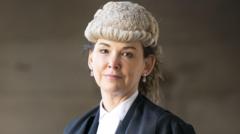
The British press pack is running its standard playbook on the resignation of Scotland's Lord Advocate. According to the mainstream media consensus, Dorothy Bain KC is stepping down because the "dual role" of Scotland’s top law officer is fundamentally broken. They paint a picture of a system collapsed under the weight of an irreconcilable conflict of interest: serving as the Scottish Government’s chief legal adviser while simultaneously acting as the country’s independent head of prosecution.
They point to the Peter Murrell embezzlement case, the frantic pre-briefings given to First Minister John Swinney, and the subsequent parliamentary fury as proof that the office has been hopelessly politicized.
They have the story completely backward.
Bain’s departure following the May 2026 Holyrood election does not expose a structural failure. It demonstrates structural success. The Lord Advocate is supposed to be politically exposed. The role is designed to take the heat so the wider justice system does not have to. Pretending that separating the prosecutor from the politician will magically purify Scottish justice is a comforting fiction. In reality, it would create an unaccountable, untouchable legal fiefdom that answers to absolutely no one.
The Myth of the Neutral Prosecutor
I have watched governments across the UK spend decades tinkering with constitutional architecture, always chasing the same phantom: a perfectly sanitized, completely apolitical legal officer. It does not exist.
The core argument of the reform lobby is simple, seductive, and wrong. They claim that because the Lord Advocate sits in the Scottish Cabinet, their prosecutorial independence is compromised. Critics screamed bias when Bain informed John Swinney about the criminal charges facing the former SNP chief executive ten months before the public found out.
But let us dismantle the premise of that outrage.
Was the prosecution halted? No. Was the investigation suppressed? Clearly not. The Crown Office proceeded exactly as it would have with any other high-profile white-collar crime investigation. What the pre-briefing actually achieved was the prevention of a catastrophic state crisis. Imagine a scenario where a sitting First Minister is blind-sided on live television by the arrest and charging of a major political figure linked inextricably to his own party. The institutional panic would paralyze the civil service.
A chief legal adviser's job is to ensure the machinery of state does not throw a rod. Giving the head of government a tactical heads-up about an impending judicial earthquake is not political corruption; it is basic administrative competence.
The Danger of an Untouchable Crown Office
If you strip the political advisory element from the Lord Advocate, what are you left with? You get an independent public prosecutor with an unprecedented concentration of power, answerable to no electorate, completely insulated from parliamentary scrutiny.
Consider the massive policy shifts overseen during Bain's tenure:
- The Drug Deaths Crisis: Class A drug possession was effectively diverted away from prosecution, favoring medical intervention over criminal records.
- Supervised Consumption Centers: The opening of the Glasgow consumption facility in 2025 required explicit legal tolerance from the Crown Office.
- Sexual Offence Prosecutions: Stripping back historic evidentiary norms to increase conviction rates.
These are not purely legal choices. They are massive, highly contentious social policy decisions. Under the current framework, because the Lord Advocate sits in Parliament and Cabinet, they can be dragged before MSPs to defend these choices. They can be forced to resign when the political pressure becomes unbearable.
If you decouple the office from the executive, you hand these massive societal levers over to a permanent committee of unelected lawyers. If the public detests a new prosecution policy, who do they vote out? Nobody. You have built a system where the public prosecutor can dictate social policy by deciding what laws they feel like enforcing, with zero democratic accountability.
The Absolute Certainty of the Westminster Veto
Let us look at the other stick used to beat Bain: her 2022 advice to Nicola Sturgeon that a unilateral independence referendum would likely be unlawful without a Section 30 order.
The nationalist fringe called her a unionist stooge. The unionist opposition called her an SNP enabler for even letting the case reach the Supreme Court. The lazy analysis says she was caught between two political masters.
The hard legal reality is that she saved Holyrood from a humiliating, chaotic wildcat referendum that would have ruined Scotland's international legal standing. She looked at the Scotland Act 1998, recognized the strict limits of devolved power, and told her boss the brutal truth. That is exactly what a high-caliber legal advisor is paid to do.
The fact that she was roundly abused by partisans on both sides of the constitutional divide is the definitive proof that she maintained absolute professional objectivity. If both sides think you are biased against them, you are likely sitting dead center.
The Real Reason Bain is Leaving
Dorothy Bain is not leaving because she was broken by the Murrell memo scandal. She is leaving because her political patron is gone, a new parliamentary session has begun, and the shelf-life of a modern Lord Advocate is inherently tied to the electoral cycle. This is exactly how the system is designed to regenerate.
A new government requires a new legal vanguard. The incoming administration needs a Lord Advocate whose authority has not been ground down by five years of relentless, bad-faith partisan bickering.
The current system forces Scotland's top lawyer to walk a tightrope over a pit of political broken glass. It is brutal, exhausting, and guarantees a short career tenure. James Wolffe broke under it; Dorothy Bain has reached her natural limit. But the fact that the person in the job changes does not mean the office is broken. It means the safety valve is working.
Stop trying to fix the dual role. The messy, compromised, highly scrutinized intersection of law and politics is not a bug in the Scottish constitution. It is the feature that keeps the whole system accountable.