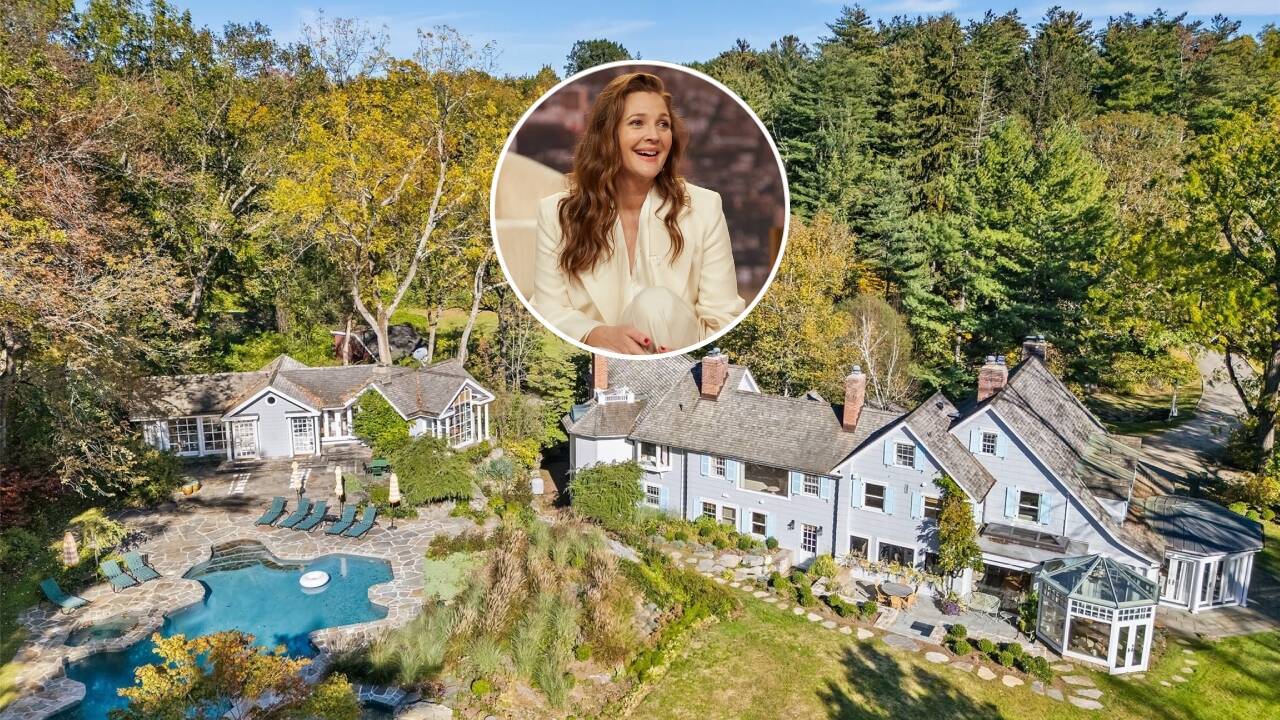
Drew Barrymore sold her historic 1740s Colonial estate in Harrison, New York, for $4.5 million, closing a chapter on a property she held for less than two years after purchasing it for roughly $4.9 million in late 2022. On the surface, a $400,000 paper loss looks like a standard celebrity real estate misstep. Look closer at the Westchester County market, the brutal economics of pre-Revolutionary War architecture, and the logistics of a daily daytime television grind, and a very different picture emerges. This was not a distressed liquidation. It was a calculated retreat from a lifestyle experiment that collided head-on with financial and operational reality.
Celebrity property transactions are rarely about brick and mortar alone. They are barometers of shifting personal priorities, tax exposure, and the hidden friction of ultra-high-net-worth maintenance. When a star of Barrymore’s caliber takes a haircut on a trophy asset in an affluent suburb just thirty miles north of Midtown Manhattan, industry insiders immediately look past the listing photos. The real story sits in the carrying costs, the commute math, and the quiet behavioral shift among New York media personalities who bought into the suburban dream at the tail end of the pandemic boom.
The Anatomy of a $400,000 Paper Loss
Most casual observers read a sale price below the purchase price and assume failure. In luxury real estate, that reading is amateurish. When you factor in closing costs, transfer taxes, broker commissions, and capital improvements, Barrymore’s actual exit cost on the Harrison property likely exceeded $750,000.
New York State imposes a mansion tax on residential purchases over $1 million, scaling upward on properties near the $5 million threshold. Buying at $4.9 million meant writing a substantial check to Albany before a single piece of furniture crossed the threshold. Selling at $4.5 million triggered another round of state transfer taxes alongside standard brokerage fees, which typically hover around 5 to 6 percent in Westchester County unless negotiated down on high-value listings.
Why accept that kind of loss so quickly? Because holding the wrong asset bleeds cash faster than selling it at a discount.
A 280-year-old estate sitting on multi-acre grounds in lower Westchester carries relentless fixed overhead. Property taxes in Harrison are notoriously steep, easily eclipsing $60,000 to $80,000 annually for estates in that valuation bracket. Add specialized historic home insurance, year-round groundskeeping, tree management, snow removal, and climate-control utility bills for a structure built decades before the Declaration of Independence, and the baseline burn rate reaches five figures every single month before a single repair is commissioned.
Smart capital cuts losses early. Rather than letting an underutilized estate drain liquidity over five or ten years while hoping for appreciation that high interest rates had already capped, Barrymore absorbed the upfront friction and moved on.
The Brutal Reality of 1740s Architecture
Buying a home built in the 1740s is an act of romanticism. Owning one is an act of endurance.
Marketing copy loves words like provenance, original wide-plank flooring, and hand-hewn beams. Contractors use different words. They talk about knob-and-tube remnants, settling fieldstone foundations, non-standard framing dimensions, and thermal inefficiency that makes winter heating bills look like commercial utility invoices. Even when a historic Colonial has been extensively modernized by previous owners, the underlying skeleton dictates every subsequent modification.
You do not simply knock down a wall in an 18th-century structure. You consult structural engineers, navigate local historic preservation guidelines, and pay a steep premium for craftsmen who understand lime mortar and antique joinery rather than modern drywall and standard lumber.
For a busy executive and television host, a historic property quickly transforms from a sanctuary into a second full-time job. Every storm brings anxiety about century-old oaks near power lines or slate roofs. Every plumbing or electrical upgrade becomes an archaeological dig. Celebrities who buy modern new-construction homes in the Hamptons or Beverly Hills buy turnkey predictability. Those who buy 18th-century New England or Hudson Valley estates buy stewardship. Stewardship requires time, and time is the one commodity a daily talk show host does not have in surplus.
The Commute Math and the CBS Broadcast Grind
Geography killed the romance faster than property taxes ever could.
The Drew Barrymore Show tapes at the CBS Broadcast Center on West 57th Street in Manhattan. On a map, Harrison sits roughly 25 to 30 miles northeast of Midtown. In the real world of the Hutchinson River Parkway, Interstate 95, and the FDR Drive, thirty miles is an unpredictable gauntlet.
During off-peak hours, a chauffeured SUV can make that run in forty minutes. During morning call times or evening rush hour, that same stretch routinely balloons to ninety minutes or more. For a host whose schedule demands early hair and makeup calls, script rehearsals, guest briefings, and promotional tapings—all while raising two school-age daughters—losing two to three hours a day inside a vehicle is unsustainable.
Consider the alternative. Living in Manhattan, whether on the Upper East Side or downtown, compresses that transit window to fifteen minutes. It restores hours of sleep, eliminates weather-related transit anxiety during Northeast winters, and keeps family logistics tight.
Many high-profile buyers who fled New York City between 2020 and 2022 miscalculated how completely their professional lives would snap back to physical studio footprints. When remote work faded and live studio audiences returned, the suburban buffer zone lost its primary appeal. What once felt like a peaceful retreat began to feel like an anchor.
Westchester Luxury Market Dynamics
To understand why the property closed at $4.5 million rather than holding out for a profit, look at the broader Westchester luxury tier between 2022 and 2024.
When Barrymore purchased the estate in late 2022, the market was still digesting the tail end of pandemic-era migration out of New York City. Inventory in prime lower Westchester enclaves—Harrison, Rye, Scarsdale, and Bronxville—was severely constrained. Cash buyers and high-income earners routinely bid over asking price to secure acreage and privacy within commuting distance of the city.
By the time she brought the home back to market, the macro environment had shifted fundamentally. Mortgage rates had climbed past 7 percent, choking off the upper-middle-tier buyers who stretch to reach the $4 million to $5 million bracket. Even all-cash buyers became selective, scrutinizing price-per-square-foot metrics and refusing to bail out sellers who bought at the peak.
How Buyers Value Historic Estates Versus New Builds
In the current Westchester market, buyers spending $4.5 million split into two distinct camps, and neither camp generously rewards recent sellers of antique homes.
| Buyer Priority | 1740s Colonial Estate | Modern New Construction |
|---|---|---|
| Primary Appeal | Architectural character, mature trees, privacy | Open floor plans, smart tech, warranty coverage |
| Maintenance Profile | High, specialized, unpredictable | Low, standardized, predictable |
| Energy Efficiency | Poor without massive retrofitting | High, code-compliant insulation and HVAC |
| Resale Liquidity | Niche buyer pool | Broad executive buyer pool |
Modern luxury buyers overwhelmingly favor turnkey transitional colonials built within the last decade. They want ten-foot ceilings, massive mudrooms, radiant heated floors, and integrated home automation without having to manage a renovation crew. A 1740s Colonial appeals to a much narrower slice of the market—purists who specifically want period details and are willing to accept lower ceilings, smaller closets, and compartmentalized rooms.
When you sell to a niche buyer pool in a high-rate environment, pricing power evaporates. You either meet the market where it stands, or you sit on the listing for eighteen months while paying taxes on an empty house. Barrymore chose liquidity over ego.
The Quiet Pivot in Celebrity Real Estate Strategy
Barrymore’s exit mirrors a broader recalibration across entertainment and media circles. For decades, accumulating sprawling suburban compounds was the default status symbol for successful stars. Today, the smartest operators treat real estate as operational infrastructure rather than a trophy cabinet.
Look at how veteran media figures structure their living arrangements in New York now. The dominant playbook favors a hyper-central primary residence in Manhattan—often a full-service condominium or discreet townhouse that minimizes external maintenance—paired with a single, easily accessible weekend escape, or simply high-end hospitality rentals when time off actually occurs.
Owning multiple complex properties across the tri-state area creates operational drag. Even with a personal assistant or household manager, someone has to approve vendor invoices, oversee security systems, manage seasonal openings and closings, and deal with municipal inspections. Barrymore has built a modern media brand around radical honesty, relatability, and shedding unnecessary complexity in her personal life. Offloading a high-maintenance suburban estate aligns completely with that ethos.
Privacy also plays a quiet role in these decisions. Once a celebrity’s home address circulates in real estate blogs and local gossip columns, the sanctuary effect degrades. Suburban acreage offers distance from the street, yet it lacks the perimeter security and doorman anonymity of a premier Manhattan building. Reclaiming anonymity often requires resetting the board entirely.
What Sophisticated Buyers Take Away From This Sale
You do not need a $4.5 million budget to apply the underlying lessons of this transaction. The mechanics scale down to every tier of residential real estate.
First, holding period dictates strategy. Buying any residential property with a horizon shorter than five years exposes you to massive transaction friction. Between transfer taxes, title insurance, legal fees, and broker commissions, the round-trip cost of buying and selling real estate routinely consumes 8 to 10 percent of the asset’s value. Unless you are executing a targeted value-add renovation in a rising market, short-term ownership almost guarantees a net loss.
Second, never underestimate carrying costs on aging inventory. Buyers routinely stretch their budgets to cover the acquisition price of an older home while underbudgeting for the ongoing capital expenditures required to keep it functional. Roofs, septic systems, foundations, and outdated electrical panels do not care about your renovation timeline. Always model the five-year total cost of ownership, not just the monthly mortgage payment.
Third, commute friction compounds daily. Overpaying slightly to shave forty-five minutes off a daily round-trip commute yields one of the highest returns on investment available in personal finance. Time cannot be refinanced.
Drew Barrymore did not lose $400,000 in Harrison. She paid a calculated exit fee to buy back her mornings, eliminate an operational headache, and realign her living situation with the actual demands of her life. In high-stakes real estate, knowing when to walk away from a bad fit is worth far more than waiting around to break even.