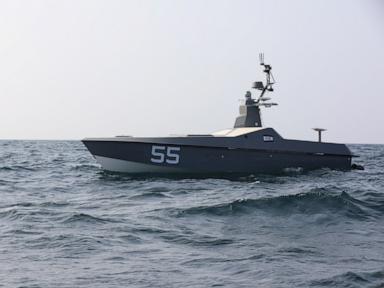
The media is swooning over a recent incident where an unmanned surface vessel—a drone boat—fished two downed US helicopter crew members out of the water after an Iranian intercept. The consensus machine immediately fired up its favorite narrative. They are calling it a triumph of automation, a definitive proof of concept for the "Ghost Fleet," and the moment that manned search-and-rescue became obsolete.
They are dead wrong.
Celebrating this rescue as a victory for autonomous warfare completely misses the terrifying tactical reality of what actually happened. The mainstream defense press is treating a lucky, highly localized coincidence as a scalable strategy. If the Pentagon buys into this lazy narrative, it will cost American lives in the next high-intensity conflict.
The Mirage of the Autonomous Rescue
Here is the sanitized version of the story you are being fed: a helicopter goes down in a contested choke point, a nearby autonomous vessel swiftly reroutes, plucks the aviators from the drink, and slips away without risking a single additional human life. It sounds like a perfect sales pitch for a defense contractor's quarterly earnings call.
But look closer at the mechanics of maritime extraction.
In any real-world naval conflict, search and rescue (SAR) is not a simple pickup service. It is a violent, high-stakes race against enemy capture, environmental degradation, and secondary attacks. The drone boat in question succeeded because it happened to be operating in an environment with absolute air superiority, benign sea states, and an adversary that chose not to engage the rescue craft itself.
I have spent years analyzing naval doctrine and watching billions of dollars vanish into autonomous system research and development. The harshest lesson of modern naval warfare is simple: uncrewed systems do not project authority; they project an absence.
When a manned MH-60S Seahawk or a combat rubber raiding craft arrives at a crash site, it brings a crew capable of dynamic triage, suppressive fire, tactical communication adjustments, and physical handling of injured personnel. A drone boat brings a camera feed and a hope that the wounded sailors have the strength to haul themselves over a rigid hull. If an aviator is unconscious, severely burned, or entangled in parachute shrouds, an unmanned vessel is nothing more than a floating witness to their drowning.
Why the Tech Elite Underestimates the Littoral Zone
Silicon Valley and the newer breed of defense-tech startups love to view the ocean as a giant, flat grid where algorithms can optimize routing. They view the littoral zone—the areas close to shore where these geopolitical frictions actually occur—as a software problem waiting to be solved.
It is an arrogant assumption. The littoral environment is chaos. It is a mess of radar clutter, civilian shipping traffic, electronic warfare jamming, and unpredictable thermal layers.
When you strip the human crew out of a small vessel to save weight and cost, you also strip away the ultimate redundant system: human adaptability. If a drone boat’s primary satellite uplink is jammed by an Iranian electronic warfare unit on Qeshm Island, that boat becomes an expensive piece of drifting fiberglass. It cannot troubleshoot a fried circuit board. It cannot switch to manual steering based on a paper chart. It cannot spot a low-tech sea mine bobbing in its path that its computer vision model mistook for sea foam.
Worse, relying on these uncrewed platforms creates a false sense of security for commanders. It lowers the political threshold for putting assets in harm's way, under the assumption that a loss carries no human cost. But when that asset is tasked with saving human lives, the failure modes multiply exponentially.
Dismantling the Cost-Effective Defense Argument
The most common defense of the mass-produced drone fleet is purely financial. Proponents argue that you can build one hundred autonomous surface vessels for the price of a single Arleigh Burke-class destroyer. They say it democratizes naval power and overwhelms the adversary through sheer numbers.
Let us run the numbers on that illusion.
- The Maintenance Debt: Unmanned does not mean unmaintained. Small autonomous boats operating in saltwater environments suffer brutal mechanical degradation. Without a crew on board to perform routine preventive maintenance—clearing fuel filters, fixing seals, scraping barnacles—the operational readiness rate of these fleets plummets within days of deployment.
- The Logistics Tail: To keep a squadron of drone boats operational in a theater like the Persian Gulf or the South China Sea, you need a massive, highly vulnerable manned mother ship or a heavily fortified shore facility. You have not eliminated the human footprint; you have just pushed it somewhere else and made it a fatter target.
- The Payload Limitation: A small drone boat cannot carry the defensive weaponry required to survive a contested airspace. It lacks the power generation for advanced electronic warfare suites or close-in weapon systems. It is, by definition, a soft target.
If we look at recent engagements in the Black Sea, we see drone boats used effectively as asymmetric, one-way kamikaze weapons against stationary or poorly defended targets. That is a valid, destructive role. But transforming a cheap offensive weapon into a reliable, defensive, life-saving platform is a structural contradiction. You cannot build a rescue asset out of disposable parts.
The Flawed Premise of "Risk-Free" Operations
People often ask: Isn't it always better to risk a machine instead of a crew?
The question itself is flawed because it assumes the machine can achieve the same mission success rate. In a combat search and rescue scenario, a 50% success rate from a drone is a 50% fatality rate for the crew waiting in the water.
Consider a scenario where the downed aviators are drifting toward an enemy-controlled shoreline. A manned rescue crew can make the immediate, gut-wrenching decision to violate rules of engagement, push their engines past their thermal limits, and exchange fire with shore batteries to pull their comrades out.
An autonomous system operates within strict boundaries defined by a software architecture written months prior in an office building in Virginia or California. If the algorithm determines that the risk threshold to the platform exceeds its programmed parameters, or if the communication link drops for a predetermined number of seconds, the drone boat will execute its fail-safe protocol. It will turn around. It will preserve itself and abandon the humans.
That is not a theoretical flaw; it is a feature of autonomous design. Machine logic prioritizes system integrity over existential human value.
The Downside of the Counter-Perspective
To be absolutely fair, manned rescues are becoming terrifyingly difficult. The proliferation of cheap, shoulder-fired anti-aircraft missiles (MANPADS), anti-ship cruise missiles, and loitering munitions means that sending a $35 million helicopter and a highly trained crew into a hot zone is increasingly a suicide mission. There is a legitimate argument to be made that in certain high-threat bubbles, a manned rescue attempt is statistically unviable.
But the solution is not to pretend that a defenseless autonomous boat is a magic bullet. The solution is a brutal reappraisal of our tactical vulnerabilities. If we cannot protect the rescue assets, we cannot protect the strike assets.
The Hard Reality for the Next Conflict
We need to stop treating tech-sector press releases as naval doctrine. The rescue of those two crew members was an anomaly, a alignment of fortunate variables that will not exist in a real shooting war against a peer adversary.
If the Navy continues to underfund traditional, ruggedized, high-endurance search and rescue capabilities in favor of cheap, autonomous gimmicks, we are setting ourselves up for a catastrophic failure. Drone boats are excellent for surveillance. They are lethal as guided torpedoes. But they are entirely unsuited to hold the line when human lives are hanging in the balance.
Stop celebrating the exception. Prepare for the rule.


