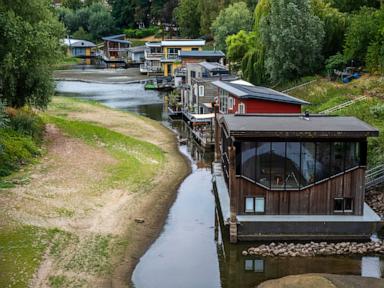
The headlines scream about cracked clay, stranded barges, and impending economic doom across the Rhine and the Dutch river systems. Every single summer, the mainstream media rolls out the same tired narrative. Dry heat hits Europe, water levels drop, and panicking commentators claim our infrastructure is crumbling under the weight of climate pressure.
They are wrong. They are looking at a localized symptom and missing the structural evolution happening right beneath their feet.
Stop treating low water levels as an unmitigated disaster. Start treating them as a brutal, necessary stress test that exposes decades of lazy civil engineering.
The Lazy Consensus on European Dikes
Ask any mainstream pundit why low water levels threaten Dutch dikes, and they will parrot a simple line: less water equals less lateral pressure, which causes clay to dry out, shrink, crack, and fail. It sounds smart. It features basic physics. It is also fundamentally incomplete.
I have spent years watching consultants burn millions on over-engineered concrete solutions while ignoring the basic mechanics of soil compaction and moisture retention. The standard approach to a dry summer is to dump more public money into emergency reinforcement, frantically building higher barriers to fight a river that is simply trying to find its natural equilibrium.
Dikes do not fail merely because the sun shines. They fail because we spent a century engineering rivers into concrete straightjackets, robbing them of their floodplains, and then acted surprised when extreme weather exposes our rigid stupidity.
When a drought hits the Rhine basin, the immediate impact on commercial barge traffic is brutal. Cargo loads must be cut by half or more to clear the shallow bottleneck at Kaub. Logistics firms lose millions. Supply chains choke.
Yet, this crisis of transport is precisely what forces long-overdue market adaptation. For decades, barge operators have relied on artificially maintained high-water drafts, running massive hulls that gouge riverbeds and demand constant, expensive dredging. Low-water events act as a hard market correction. They force naval architects to design shallow-draft, multi-hulled cargo vessels that can navigate lower water columns efficiently.
The panic over German river trade ignores a basic economic truth: convenience breeds fragility. When water levels are high year-round, operators have zero incentive to innovate. Drought is the only force strong enough to break our addiction to archaic shipping methods.
The Engineering Fallacy of Wet Soil
Let us talk about the soil mechanics behind Dutch flood defenses. Traditional dogma dictates that clay needs constant saturation to maintain structural integrity.
That is half-true and entirely misleading.
Saturated clay actually loses shear strength under heavy cyclic loading. When dikes remain waterlogged for too long, pore water pressure builds up internally. During prolonged wet periods, internal slips and micro-slides are far more common than people realize.
What a dry summer actually does is trigger natural consolidation. Controlled drying cycles increase soil cohesion, knitting clay particles tighter together. The cracks you see on the surface during a heatwave are cosmetic crusting, not catastrophic structural fissures slicing through the core of a well-maintained levee.
The real danger is not the drought itself. The real danger is the panic-driven, uncalibrated heavy pumping of groundwater designed to keep dikes unnaturally wet, which actually destabilizes the subsoil through differential settlement.
We need to stop managing water levels based on panic and start managing them based on material science.
Rethinking the Rhine
If you look at the International Commission for the Protection of the Rhine data, river discharge variations are not unprecedented. They are cyclical. The mistake is trying to freeze a dynamic river system into a static state of permanent normality.
Imagine a scenario where we stop fighting low water levels with emergency dredging and instead let the rivers widen.
When a river spreads out across natural seasonal floodplains during wet months, it retains moisture in the regional water table. That stored subsurface moisture feeds the river system naturally when summer hits, cushioning the blow of low-precipitation periods. By locking rivers into narrow, deep channels to maximize year-round barge efficiency, we cut off their natural sponges.
Germany and the Netherlands do not have a drought crisis. They have a spatial planning crisis.
The solution is not to build higher walls or spray water onto drying turf like panicked homeowners keeping a dying lawn green. The solution is managed retreat from the floodplains, allowing rivers room to breathe, and redesigning cargo logistics to match seasonal realities rather than clinging to a 20th-century fantasy of constant-depth navigation.
Next time a headline warns you that parched earth is about to wash away European commerce, remember what is actually happening. The system is purging its own inefficiencies.
Adapt or stay stranded.