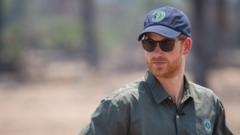
The red dirt of southern Africa does not wash out easily. It clings to the cuffs of heavy canvas trousers, works its way into the seams of well-worn boots, and stays beneath the fingernails long after the private planes have lifted off the tarmac and returned to the gray skies of London.
I know that dust. I have watched it rise in thick, golden plumes behind a Land Cruiser moving slowly across a parched reserve, the air heavy with the scent of dry acacia and distant rain. In those quiet moments, far from the flashbulbs and the endless hum of the British tabloid press, conservation is not a press release. It is a slow, exhausting negotiation with survival. Expanding on this idea, you can also read: Why Reality TV Mourning Rituals Are Pure Theatre.
Prince Harry spent years walking that dust.
When the news broke that he was stepping down from the board of African Parks—the non-profit conservation behemoth he helped guide for over a decade—the headlines flashed across the globe with predictable urgency. Royal steps back. Another parting of ways. The digital ink dried almost instantly, replaced by the next cycle of outrage and speculation. Analysts at Associated Press have provided expertise on this situation.
But public announcements rarely capture the weight of what actually happens when a figurehead lets go of the wheel. They reduce a complex human calculation to a simple corporate exit.
To understand why this departure matters, you have to look past the institutional coldness of charity boards and look straight at the terrain itself.
Conservation is a brutal math. It is the friction between hungry communities and protected borders, between poachers armed with modern technology and rangers walking miles of wilderness in worn boots on meager stipends. For years, Harry lent his name, his visibility, and a distinct personal fervor to African Parks. He did not just pose for photographs with sedated rhinos; he sat in dusty tents, listened to local elders, and absorbed the grinding, unglamorous realities of managing millions of hectares of wild space across a continent that is rapidly changing.
Consider what happens when a high-profile patron leaves an organization of this magnitude.
Board seats in major international charities are rarely just administrative positions. They are lightning rods for attention, bridges to philanthropic capital, and shields against political volatility. When a prince of the realm aligns himself with an African wilderness initiative, doors open. Wealthy donors write checks. Global media outlets point their cameras at forgotten parks in nations struggling with economic instability.
Yet, proximity to power always carries a cost.
Over the last few years, African Parks faced severe, harrowing allegations regarding human rights abuses committed by rangers in certain managed zones. These were not minor bureaucratic hiccups; they were profound moral crises that struck at the heart of fortress conservation models. When an organization dedicated to protecting nature is accused of failing the people who live alongside that nature, the entire paradigm fractures.
I remember talking to a veteran anti-poaching scout in Zambia years ago. He looked me dead in the eye and said something that stayed with me: "You cannot save the elephant by shooting the man who has nothing to feed his children."
It is a paradox that haunts modern conservation. The old colonial model of drawing a line around a vast tract of land, kicking out the indigenous populations, and putting men with guns at the gates has never worked sustainably. It breeds resentment. It turns neighbors into enemies of the wild.
Harry’s departure from the board cannot be divorced from this broader, agonizing reckoning.
When organizations grow too large, when the scandals touch the upper echelons of governance, the choices become stark. You stay and fight an internal war of reform against entrenched bureaucracy, or you step aside to clear the air, allowing the institution to rebuild its credibility without the deafening noise of your own celebrity drowning out the work.
Celebrity is a strange, double-edged sword. It can drag a dying cause into the light of global consciousness within seconds. But it can also cast a shadow so long that nobody can see the actual people doing the groundwork.
When the news of his exit settled, the internet did what it always does. It divided neatly into two camps. His detractors whispered about waning influence and fractured ties. His supporters pointed to his enduring commitment to environmental stewardship, arguing that his work behind the scenes had already transformed how protected areas are funded and managed.
Both missed the point.
The reality of conservation is lived in the dirt, not in the boardroom.
Think of the ranger waking up at four in the morning in the Liuwa Plain or Akagera. He does not care about Windsor Castle or the British press. He cares whether his radio battery is charged, whether his boots will hold together through the wet season, and whether the local community trusts him enough to tip him off about a snare line before the sun goes down.
Harry’s exit from the board does not mean the wilderness suddenly empties of danger or hope. The elephants will still walk their ancient migration routes across the Okavango. The lions will still hunt in the long grass of Zakouma. The sun will still rise over the dry riverbeds, baking the earth into cracked pottery.
What changes is the geometry of influence.
By stepping away, Harry sheds a layer of corporate armor. Whether that is a retreat from a burning house or a strategic recalibration of how an individual with a global megaphone can best serve a fragile planet remains to be seen. But there is a quiet dignity in recognizing when an institution needs to stand on its own two feet, unburdened by the collateral damage of a famous name.
We live in an era that demands constant, performative certainty. We want our public figures to either be spotless heroes or irredeemable villains, with neat resolutions tied up at the end of every news cycle.
The natural world does not operate on press releases. It operates on cycles of death and renewal, drought and flood, endurance and decay.
The dust settles slowly over the African plains. The Land Cruiser moves on, its taillights fading into the vast, indifferent dark. Somewhere out there, in the deep brush, a twig snaps, and the night holds its breath.