Dust tastes like pennies and pulverized plaster.
If you have ever stood a block away from a structural failure in a dense metropolis, you know that the sound comes second. First, there is a sudden, unnatural shift in air pressure—a heavy, silent shove against your eardrums that makes the hairs on your arms stand straight up before your brain even registers danger. Then comes the roar, a low-frequency grinding of centuries-old masonry giving up the ghost, followed immediately by a wall of gray powder that swallows the afternoon sun and turns a familiar neighborhood block into an unrecognizable lunar surface.
We watch these moments on glowing screens from the safety of our couches. A viral clip circulates showing a pregnant woman being pulled from a jagged mountain of shattered brick in New York City, her husband collapsing into tears of raw, unfiltered relief as paramedics guide her toward an ambulance. We double-tap. We feel a brief, sharp pang of sympathy. We marvel at the miracle of survival, and then we swipe to the next video.
Stop. Stay in that gray cloud for a minute longer.
Because the viral video shows you the climax, the miraculous exhale after the breath has been held, while hiding the slow, quiet rot that made the collapse inevitable. To understand what really happened in that pile of rubble—and what is quietly happening behind the brick facades of thousands of aging buildings across New York—you have to look past the miraculous rescue and examine the invisible architecture of neglect.
The Anatomy of a Sudden Silence
Imagine a typical Tuesday afternoon in a corner apartment—a hypothetical composite drawn from dozens of real structural failures across the five boroughs. Inside, the kettle is warming on the stove. A woman in her third trimester is resting on the sofa, her hand resting on the curve of her stomach, feeling the faint, rhythmic kick of a child who has not yet taken a breath. Outside, her husband is walking back from the corner bodega, carrying a paper bag of groceries, thinking about nothing more consequential than what to make for dinner.
Neither of them is thinking about mortar degradation. Neither of them is calculating the lateral load-bearing capacity of unreinforced masonry built during the Coolidge administration. Why would they? In a modern city, we enter into an unspoken, sacred covenant with the walls around us: we pay the rent, and the ceiling stays in the sky.
When that covenant breaks, it does not break with a polite warning.
Consider what happens at the exact millisecond a load-bearing wall fails. Think of an older brick building not as a solid block of stone, but as a meticulously stacked house of cards held together by a paste made of lime, sand, and water. Over eighty, ninety, or a hundred years, rainwater creeps into microscopic hairline cracks. Winter freezes that water, expanding it like tiny iron wedges driven into the joints. Summer bakes it dry. Decade after decade, the mortar turns from stone-hard glue into loose sand.
A single beam shifts by half an inch. That half-inch transfers tons of dead weight onto an adjacent wall that was never engineered to carry it. That wall bows outward, buckles, and snaps.
For the man on the sidewalk with the paper bag of groceries, the world simply disappears into a choking cloud of pulverized limestone. The building he walked out of ten minutes ago is no longer a home; it is a three-story pile of jagged teeth, twisted radiator pipes, and splintered floorboards. In that terrifying, breathless void between the crash and the first wail of a siren, time stops moving forward. Every second stretches into an eternity defined by a single, suffocating question: Where is she?
The Miracle of the Void Space
When rescue crews from the FDNY’s elite Urban Search and Rescue teams arrive at a collapse site, they are not looking at a pile of trash. They are reading a three-dimensional puzzle of physics and chance.
To the untrained eye, a collapsed building looks completely solid, compressed like a crushed tin can. How could anyone—let alone a pregnant woman carrying fragile new life—survive thousands of pounds of falling brick and timber?
The answer lies in a phenomenon structural engineers and rescue specialists call void spaces.
Picture dropping a heavy wooden dining table onto a pile of cinderblocks. The table doesn't lie flat; it catches on the edges of the blocks, creating a triangular pocket of open air underneath. Inside a collapsing building, heavy oak floor joists, cast-iron bathtubs, and reinforced doorframes act like that dining table. As the upper floors pancake downward, these rigid objects snag against one another, forming accidental caves—dark, dust-choked pockets just large enough to cradle a human body while deflecting the lethal weight of the masonry above.
Finding those pockets is agonizing, delicate work. You cannot simply bring in an excavator and start scooping away debris; moving one load-bearing beam at the top of the pile can trigger a secondary collapse that crushes a void space twenty feet below.
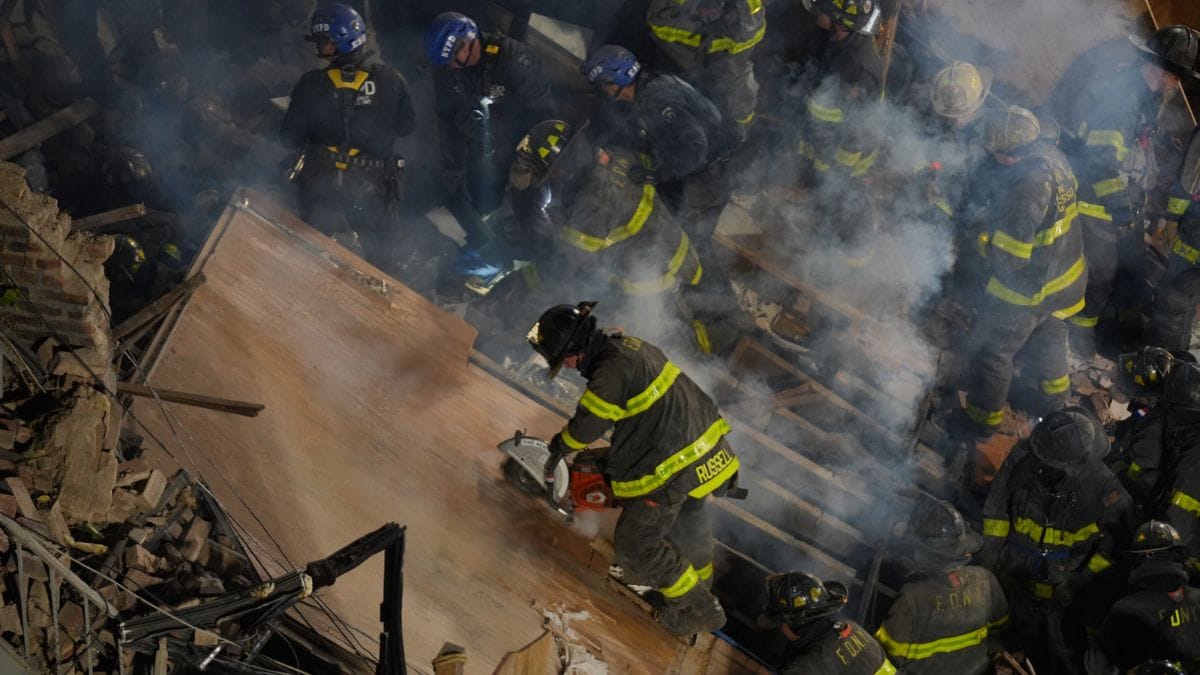
Instead, firefighters work on their hands and knees with five-gallon buckets, passing chunks of brick hand-to-hand in a human chain while listening devices—seismic sensors sensitive enough to pick up the faint scratch of a fingernail against drywall—probe the silence. Every few minutes, an officer blows an air horn, demanding absolute quiet across the entire block. Hundreds of firefighters, police officers, and bystanders freeze, holding their breath, straining to hear a muffled voice or a faint tap from beneath the ruins.
When they finally breached the pocket where that expectant mother was trapped, the scene captured on camera wasn't just a lucky break. It was the collision of sheer structural luck and surgical human grit. As firefighters lifted her clear of the jagged concrete and carried her into the daylight, covered from head to toe in fine white ash, the visual contrast was overwhelming. Life, fragile and insistent, emerging directly from the wreckage of urban decay.
And when her husband saw her—alive, breathing, cradling her belly—the sobs that tore out of him weren't just relief. They were the sound of a man being handed back his entire future after watching it vanish into dust.
What the Rubble Is Trying to Tell Us
It is tempting to end the story there. We love a story about heroes and survivors because it lets us feel good without asking anything of us. We praise the firefighters, we shed a tear for the couple, and we treat the collapse like an act of God—a random bolt of lightning that struck one unlucky corner.
That is a comfortable lie. Buildings do not simply fall down out of nowhere.
Across New York City alone, there are more than a million buildings, and a massive percentage of the residential stock was constructed before 1940. Many of these structures were built using unreinforced masonry—brick walls without modern steel rebar skeletons woven inside them to absorb shock and prevent sudden catastrophic failure. They are beautiful, historic, and enduring, provided someone actually takes care of them.
The real danger lives in the quiet math of deferred maintenance.
Let’s look at how a building dies slowly. A landlord notices a bulge in the exterior brickwork or a series of stair-step cracks running diagonally through the mortar. Fixing it properly requires scaffolding, structural engineers, masonry repointing, and tens—sometimes hundreds—of thousands of dollars. Cutting corners, however, is cheap. You slap a coat of waterproof sealant over the cracks, locking moisture inside the wall where it accelerates the rot. You ignore open violations filed by tenants who notice their doors no longer close squarely because the building frame is leaning. You file paperwork delays while collection notices pile up.
New York has strict inspection mandates, such as Local Law 11, which requires facades on buildings taller than six stories to be inspected every five years. Yet thousands of lower-rise buildings—the classic four- and five-story walk-ups where working families, students, and young couples actually live—slip through the regulatory cracks. They sit beneath the height threshold for mandatory periodic facade engineering reports, relying almost entirely on complaint-driven inspections.
In other words, the city often doesn't know a four-story walk-up is structurally compromised until a piece of cornice crashes onto the sidewalk, or until a wall buckles entirely.
If you live in an older apartment building, the warning signs are rarely dramatic until it is too late, yet they are almost always there if you know how to read the language of stress. Doors and windows that suddenly stick or refuse to latch aren't just seasonal humidity quirks; they are proof that the rectangular frame of your home is twisting into a parallelogram. Cracks in plaster that run diagonally from the corners of window frames, or exterior bricks that appear to be bowing outward like a pregnant belly, are the architectural equivalent of chest pain before a heart attack.
We have been conditioned to treat these red flags as minor annoyances—things we put up with in exchange for living in a vibrant, dense city. We jam a folded piece of cardboard under a rattling window frame and go back to sleep.
The Invisible Weight of Near-Misses
Anyone who has ever walked away from a sudden brush with mortality knows that the trauma doesn't end when the ambulance doors close.
For the couple pulled from that wreckage, the viral video ends at the happiest possible frame: the embrace, the tears, the survival. What the camera misses is the aftermath. It misses the hyper-vigilance that sets in weeks later, when the rumble of a passing garbage truck or the vibration of a subway train beneath the floorboards triggers a spike of pure adrenaline. It misses the sudden realization that the walls around you—the very structures designed to protect you from the elements—are heavy, indifferent masses of stone and steel held up only by human diligence and aging mortar.
And what about the unborn child? While doctors monitor the mother and baby for the subtle, delayed effects of crush syndrome, dust inhalation, and acute maternal shock, that child enters the world with a birth story written in brick dust and sirens.
Yet the most unsettling truth about a New York building collapse is how close it always is to being a mass-casualty tragedy. Had that wall failed at 8:30 in the morning instead of mid-afternoon, the sidewalk below would have been crowded with parents walking children to school and commuters rushing toward the subway. Had the heavy timber beams fallen six inches to the left, no void space would have formed, and the rescue crews would have been conducting a recovery operation instead of a miracle.
Survival in a structural collapse shouldn't depend on the geometry of falling debris. It shouldn't depend on whether an old cast-iron radiator happens to catch a collapsing ceiling joist at just the right angle.
Reading the Cracks Before They Open
We spend billions of dollars on sleek glass towers that pierce the clouds, while the brick-and-mortar bones of our everyday neighborhoods quietly age in the shadows. We celebrate the bravery of first responders who charge into unstable ruins with buckets and listening probes, yet we rarely summon the political or civic will to demand proactive structural accountability before the bricks hit the pavement.
Next time you walk down a city block, look up.
Look past the ground-floor storefronts and the bright neon signs. Look at the third and fourth stories of the old brick buildings flanking the street. Notice where the mortar has washed away into deep shadows between the bricks. Notice the rusting iron lintels above the windows, expanding as they corrode and pushing the stone apart. Notice the patched-over bulges that look like poorly healed scars.
Those walls are holding up lives. Inside them, kettles are boiling on stoves, toddlers are learning to walk across creaking floorboards, and expectant mothers are resting on sofas, waiting for the groceries to come through the door.
The dust from that collapse in New York has already settled, washed down into the storm drains by fire hoses and swept away by city crews. The viral video has stopped trending, replaced by fresher outrage and newer spectacles. Somewhere in the city, a husband and wife are trying to piece together a normal life, grateful beyond words that they are still breathing the same air.
Every aging building on every quiet corner is keeping a silent tally of the winters it has endured and the repairs it has been denied, waiting to see whether we will listen to the whispers in the mortar before the walls finally speak.


