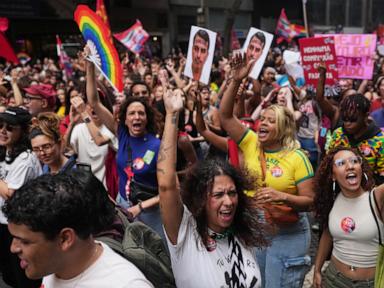
Street protests during a runoff election rarely decide a national race on their own, yet the October 7, 2026 march in Rio de Janeiro—captured under the banner "No to the father, no to the son"—exposed a structural shift in Brazilian politics: dynastic brand transfer carries sharp diminishing returns once institutional penalties and voter fatigue set in. Conventional reporting treats street demonstrations and candidate polling as separate stories, missing how mobilization costs, runoff vote arithmetic, and institutional memory interact across a two-round election. This analysis breaks down the mechanics behind the Rio march, evaluates what street energy can and cannot convert at the ballot box, and maps how dynasty-driven campaigns operate in polarized democracies.
Deconstructing the Street Mobilization Narrative
Standard election coverage frames anti-Bolsonaro demonstrations in Rio de Janeiro as a straightforward clash between youth-led democratic resistance and a resurgent far right. That framing captures the visible theater—students marching toward Cinelândia, flares, red Workers' Party apparel, and slogans rejecting both Jair Bolsonaro and Senator Flávio Bolsonaro—but it leaves the underlying political mechanics under-examined.
When reporters treat a rally as proof of momentum, they often confuse expressive intensity with electoral elasticity. Expressive intensity measures how strongly committed activists signal identity, grievances, and solidarity in high-visibility spaces such as central Rio de Janeiro. Electoral elasticity measures how many undecided or cross-pressured voters change their vote choice in response to that signal. A march of several thousand students and supporters in a historic protest corridor can powerfully re-energize a demoralized base after an unfavorable first round, yet it does not automatically persuade voters in interior municipalities or swing precincts who prioritize cost of living, public security, or administrative competence.
Reporting on the October 7 march also tends to flatten the generational and institutional distance between father and son. Jair Bolsonaro's political brand was forged as an anti-establishment disruptor before his presidency and subsequently tested by coup-plotting convictions and imprisonment. Flávio Bolsonaro entered the 2026 runoff inheriting both his father's core voter base and the accumulated legal and reputational liabilities tied to the family name, alongside external political friction involving U.S. alignment. Treating the protest purely as a rerun of past clashes misses how inheriting a political surname alters a candidate's ceiling and floor simultaneously.
Known Facts Versus Analytical Hypotheses
Separating verified electoral and political facts from analytical interpretation keeps risk assessment grounded.
Verified Facts
- A large student-led protest took place in Rio de Janeiro on October 7, 2026, opposing the Bolsonaro family and supporting President Luiz Inácio Lula da Silva ahead of the October 25 runoff election.
- Demonstrators marched through central Rio toward Cinelândia, raising themes around public education, democratic institutions, anti-fascism, and opposition to perceived U.S. interference.
- In the first round on October 4, 2026, Flávio Bolsonaro finished ahead of Lula in raw vote totals (roughly 47% to 45%, a margin of about 2.2 million votes), while right-leaning third-, fourth-, and fifth-place contenders collectively drew over 8 million votes.
- In the October 25, 2026 second round, Lula defeated Flávio Bolsonaro with 51.79% of the vote (64,256,232 votes) to 48.21% (59,826,041 votes), with runoff turnout rising to 80.78% compared with 78.92% in the first round.
- That runoff reversal marked the first time since Brazil's 1985 return to democracy that the first-round leader lost the second round.
Analytical Hypotheses
- The Rio protest likely functioned as a demoralization circuit-breaker for Lula's coalition immediately after the first-round deficit, helping convert low-propensity or abstaining anti-Bolsonaro voters into runoff ballots rather than convincing hard right-wing voters to switch sides.
- Framing the race around "the father and the son" likely compressed Flávio Bolsonaro's ability to broaden beyond his father's ceiling by keeping negative partisan mobilization—the desire to block a return of Bolsonaro-era governance—at peak salience.
- While street protests and legislative/local vote shares moved in different directions—evidenced by strong right-wing performance in congressional contests even as Lula won the presidency—the presidential runoff remained uniquely sensitive to consolidated anti-incumbent or anti-dynasty coalitions.
The Four Pillars of Dynastic Political Capital
To evaluate why a campaign built on family succession can lead after a first round yet falter in a runoff, it helps to model political dynasty as an asset portfolio rather than a simple transfer of popularity. In competitive presidential systems, dynastic political capital rests on four pillars.
Brand Equity and Name Recognition
A well-known political surname lowers information costs for voters. In a crowded first round with multiple candidates, name recognition acts as an immediate sorting heuristic, helping a candidate consolidate core ideological and partisan loyalists early. Flávio Bolsonaro's first-round lead demonstrates how durable that recognition remains among voters seeking an alternative to the incumbent administration.
Liability Inheritance
Name recognition is bundled with past controversies, legal rulings, and polarizing rhetoric. Unlike a fresh technocratic or outsider candidate who can define themselves from scratch, a political heir inherits a pre-existing ledger. Opponents can attach prior institutional conflicts, judicial outcomes, and polarizing symbols directly to the successor, making it harder to win over moderate or skeptical voters in a binary runoff.
Organizational and Patronage Reach
Dynasties often command loyal activists, media ecosystems, digital networks, and legislative allies who share incentives to keep the coalition intact. Yet organizational strength is uneven across levels of government: strong party and legislative traction in Congress does not guarantee a majority in a national runoff where every ballot carries equal weight.
Coalition Transferability
In two-round elections, finishing first in round one is only half the math; absorbing eliminated candidates' voters is the rest. When right-leaning third-, fourth-, and fifth-place candidates collect millions of first-round votes, a runoff contender must capture a high share of that pool while preventing the opponent from uniting everyone else. High polarization creates a ceiling effect: voters who strongly dislike the dynasty may turn out specifically to block it even if they hold reservations about the alternative.
Causal Chains Missed by Surface Reporting
Surface coverage of protests often treats street demonstrations as a direct poll proxy. In reality, cause and effect run through intermediate mechanisms that determine whether visible energy translates into votes.
From Post-First-Round Shock to Turnout Recovery
A first-round defeat or narrower-than-hoped margin often triggers voter apathy among the trailing camp. Public demonstrations in a symbolic urban hub like Rio de Janeiro provide visible proof of life, countering defeatism among activists and signaling to hesitant supporters that the race is contested. When runoff turnout rises—as it did between October 4 and October 25, 2026—mobilizing previously sidelined voters can outweigh static ideological arithmetic from the first round.
From Symbolic Framing to Salience Lock-In
Protesters invoking both father and son, alongside historical memory of authoritarianism and concerns over foreign influence, shift the electoral frame from everyday policy trade-offs to regime and sovereignty stakes. When a campaign or movement succeeds in locking in a regime-stakes frame, swing voters evaluate candidates less on incremental promises and more on perceived institutional risk. That dynamic helps explain why a candidate with strong first-round momentum can still face steep resistance when crossing the 50% threshold in a runoff.
From Urban Protest to National Electoral Geography
Rio de Janeiro's protest geography—boulevards, cultural landmarks, and Cinelândia—amplifies media visibility nationwide. However, national presidential runoffs are decided across hundreds of millions of votes and diverse regional economies. Protests act as an information and morale multiplier for campaign surrogates and digital creators, not a substitute for ground game, municipal alliances, and turnout operations across states.
Operational Playbook for Campaigns and Analysts
Practitioners managing campaigns or political risk assessments can apply a structured sequence to evaluate protests and runoff dynamics without falling for hype.
- Audit baseline vote math before interpreting street size: Compare first-round vote shares, unallocated votes from eliminated candidates, and historical runoff turnout gaps before assigning decisive weight to a demonstration.
- Separate expressive mobilization from persuasion indicators: Track whether post-protest shifts appear in turnout intent among base and lapsed voters rather than assuming rapid conversion among firm opponents.
- Map inherited liabilities against swing-voter priorities: List every legal, ethical, or foreign-policy vulnerability attached to a political family and test how opponents link those issues to everyday voter concerns.
- Monitor down-ballot divergence: Watch congressional, gubernatorial, and local results alongside presidential polling to distinguish personal or dynastic resistance from broader party strength or weakness.
- Re-baseline after every milestone: Update probability models after first-round tallies, major street actions, court rulings, and late campaign pivots rather than locking in a single narrative early.
Limitations and Failure Modes
No analytical framework eliminates uncertainty in high-stakes elections. Crowd estimates at street marches are notoriously imprecise and can be skewed by camera angles, weather, or timing. Furthermore, correlation between a protest and a subsequent runoff comeback does not prove causation; late campaign adjustments, media dynamics, court decisions, and voter migration from third-party candidates all operate simultaneously. Analysts who treat any single factor—protests, polls, or party labels—as deterministic will misprice tail risks in closely divided races.
Strategic Play for Political Strategists and Risk Teams
In polarized two-round democracies, any campaign relying on dynastic succession should treat the period immediately after a strong first-round showing as its highest-risk window, not its finish line. To protect a first-round lead in a runoff, the campaign must actively decouple the successor's governance pitch from past controversies while securing explicit, visible endorsements from eliminated candidates who can deliver second-round votes—and conversely, anti-dynasty coalitions should focus their late-stage resources on turning out low-propensity and lapsed voters through high-salience institutional and sovereignty messaging rather than spending scarce energy trying to convert entrenched loyalists.