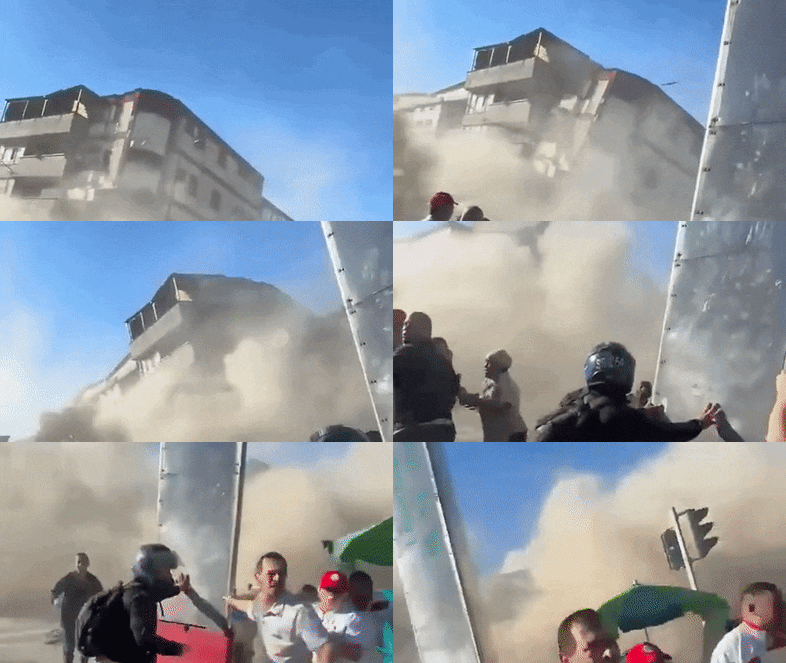
The ground does not roar. That is a lie whispered by movies and safe distances. When the earth breaks beneath your feet, it sounds like a dry branch snapping under a heavy boot, multiplied by a thousand, echoing deep within the marrow of your own bones. Then comes the sway.
It is the sensation of standing on the deck of a ship caught in a rogue wave, except the ocean is supposed to be solid. It is concrete turned to liquid. It is plaster falling like winter snow in the middle of a warm afternoon.
Hours earlier, the morning air in Colombia carried the usual hum of routine. Coffee beans were roasting in small family-owned shops, their rich, dark scent drifting into narrow streets. Bicycles rattled over cobblestones. Conversations about the price of fruit, the upcoming weekend, or the local football match bounced from open windows. Nobody looked up at the mountains with suspicion. The mountains are simply there—ancient, majestic, eternal sentinels framing the horizon. We trust the earth because we have no choice. We build our homes on its crust, plant our crops in its soil, and bury our dead in its dirt, assuming an unspoken contract of stability.
Then the crust shifted.
A powerful earthquake struck, tearing through the landscape with brutal efficiency. According to the preliminary seismic data and emergency reports, dozens of lives were extinguished in seconds, and an unknown number of human beings remain trapped beneath heavy slabs of concrete, twisted rebar, and the dusty remnants of their own living rooms.
Numbers are cold. They are ink on a digital screen. We read that dozens are dead, and our brains categorize the statistic, file it away under distant tragedies, and move on to the next headline. But behind every single digit in that death toll is a kitchen table where someone left half a cup of coffee. Behind every trapped soul is a pair of hands that were folding laundry, a mind that was worrying about tomorrow's bills, a heart that was beating with ordinary, beautiful human hope.
Consider what happens next.
In the immediate aftermath, the world goes deaf. Dust hangs thick in the air, a choking gray fog that blots out the sun and turns noon into twilight. The power grid fails. Sirens wail in the distance, but they sound thin and helpless against the magnitude of the ruin. Silence follows—the heavy, suffocating silence of shock.
Then, sound returns in waves. The desperate cries for help. The frantic scraping of bare hands against jagged concrete. The raw, guttural voice of a mother calling out a child's name, listening for a response that either comes too faintly or does not come at all.
This is where the true measure of humanity is taken. In the hours when governments are still mobilizing and heavy rescue machinery is miles away, the first responders are neighbors. They are strangers with dusty faces and bleeding fingers. They use kitchen spoons, iron pipes, and sheer adrenaline to claw at the rubble.
I have stood in the wake of such ruin before. I know the smell of pulverized brick mixed with dust and fear. I know the terrible weight of helplessness that settles over a crowd when a wall begins to groan and shift during an aftershock. You freeze. Your breath catches. Every instinct screams at you to run, yet your feet remain glued to the earth because you know someone you love—or someone who deserves to live just as much as you do—is buried inches away from the air you are breathing.
Seismology tells us why the earth breaks. Tectonic plates grind against one another, locked in a slow, violent dance beneath our feet, storing energy over centuries until the friction becomes too great and the rock fractures. It is physics. It is geology. It is an inevitable consequence of living on a living, breathing planet.
Yet science offers little comfort to the person sitting in the dark beneath three tons of debris.
Let us walk through a hypothetical scenario to understand the invisible stakes. Imagine Mateo, an ordinary teacher, who was grading papers at his wooden desk when the floor began to heave. In less than three seconds, the roof of his apartment building collapsed inward. He survived the initial impact inside a small pocket formed by a sturdy steel doorframe and a fallen bookshelf.
He is alive. But he cannot move his left leg. The air is thick with plaster dust, burning his throat with every shallow breath. In the dark, time loses its shape. Minutes stretch into hours. He hears distant footsteps above him—boots crunching on broken glass. He wants to shout, but his mouth is dry as ash. He taps a metal pipe with his wedding ring. Clink. Clink. Clink.
That tiny, rhythmic sound is the entirety of his existence. It is the bridge between life and the abyss.
Thousands of miles away, we look at our phones. We scroll past the breaking news alert. We feel a momentary pang of sorrow, perhaps a fleeting thought of gratitude for our own solid floors, and then we swipe to the next post. We are insulated by distance and routine. We forget that the ground beneath our feet is only pretending to be still.
We must confront the uncomfortable truth about our vulnerability. We build cities that touch the clouds, yet we remain utterly at the mercy of the ground we walk upon. Disaster preparedness is not merely a policy debate or a line item in a municipal budget; it is a moral imperative. Every reinforced pillar, every earthquake-resistant school, every well-trained volunteer brigade represents a vote of confidence in our shared future.
When the earth shook in Colombia, it did not just destroy buildings. It exposed the fragile thread that connects us all. It reminded us that beneath our carefully constructed lives of commerce, ambition, and trivial worries lies a primal wilderness.
The dust is still settling over the affected towns. The search lights are cutting through the Andean night, sweeping across mounds of gray rubble where homes once stood. Rescue workers are listening intently, holding their breath, waiting for a sound from the deep.
Listen closely.
Can you hear it?
It is the sound of resilience. It is the sound of people refusing to abandon their own. Long after the cameras leave and the news cycle shifts to newer crises, those communities will still be there, rebuilding their lives one stone, one tear, and one brick at a time. The earth can break our walls, but it cannot break the invisible bond that holds us together in the dark.