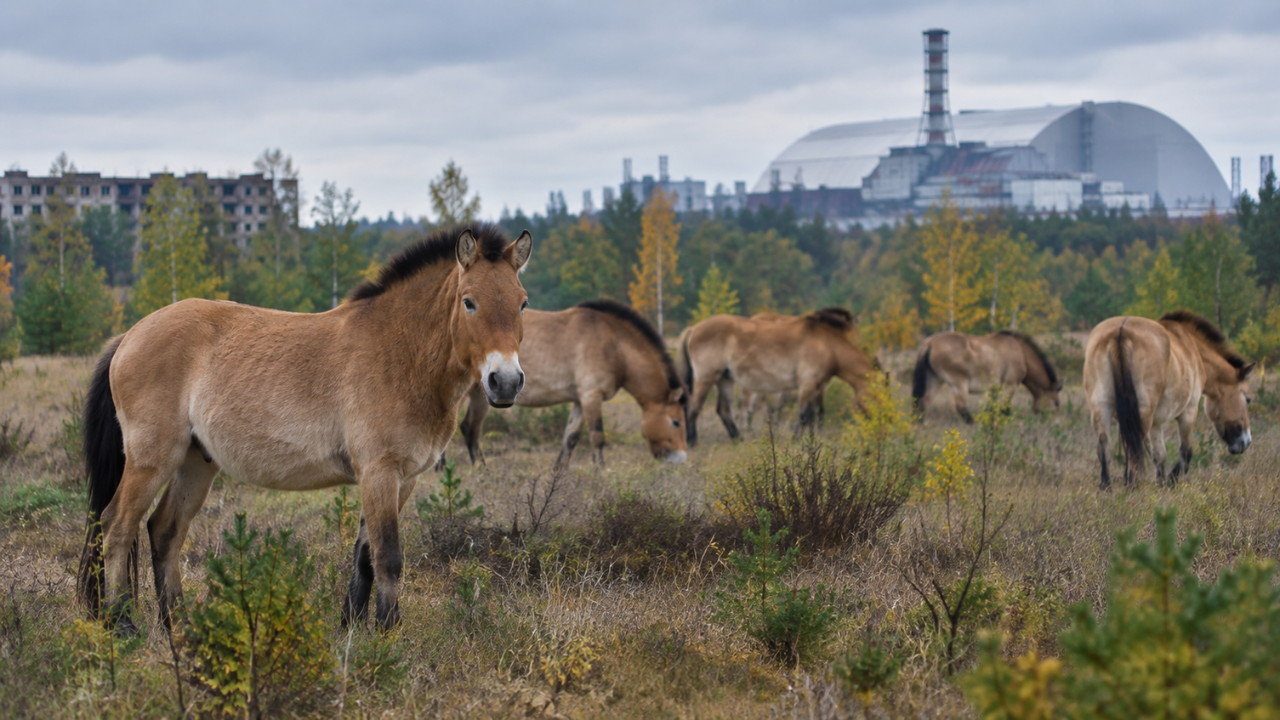
The paradox of the Chernobyl Exclusion Zone rests on a simple tension. Anthropogenic radiation represents an acute, systemic stressor to cellular integrity, yet the complete absence of human industrial and infrastructural pressure acts as a macro-scale restorative forcing mechanism. When 31 Przewalski horses (Equus ferus przewalskii) were introduced into this isolated ecosystem in 1998, they entered an environment where ionizing radiation existed alongside the complete removal of agricultural competition, hunting, and habitat fragmentation. By 2018, the population expanded to 137 individuals, demonstrating that behavioral adaptation and ecological release can significantly outweigh chronic low-dose radiological hazards at the population level.
Deconstructing this population trajectory requires analyzing the interplay between individual physiological cost functions and macro-environmental carrying capacities. Radiation acts as a mutagenic vector, increasing DNA strand breaks and elevating baseline oxidative stress across biological tissues. However, evolutionary survival at the demographic scale is not determined by sterile laboratory conditions of zero damage, but by net recruitment rates. If birth rates and juvenile survival exceed mortality vectors—including both natural senescence and radiation-induced pathologies—the population vector trends positive.
In standard pastoral or managed environments, Przewalski horses face intense habitat compression, culling, veterinary interventions, and genetic bottlenecks driven by human land-use priorities. Within the exclusion zone, these top-down pressures dropped to absolute zero. The landscape reverted to a mosaic of abandoned agricultural fields, regenerating early-successional forests, and open meadows. This spatial reconfiguration altered the resource distribution matrix, replacing scarce, fragmented forage with contiguous, unmanaged biomass.
The mechanics of population growth under these conditions are governed by density-dependent feedback loops. In the initial phase following the 1998 release, the population existed far below the carrying capacity of the abandoned infrastructure. Resource competition was negligible. Nutritional plane quality—defined by crude protein availability and digestible dry matter—remained exceptionally high during spring and summer vegetative flushes. This dietary abundance directly influences prime mare body condition scores, which dictate ovulation success, gestation length, and lactation efficiency.
Critics often assume that chronic internal and external radiation exposure creates an insurmountable bottleneck to generational replacement. Field data from large ungulates in the region, including wild boars, red deer, and these horses, challenge this by highlighting the resilience of demographic compensation. Even if sub-lethal genomic damage depresses individual lifespan or fecundity metrics by a measurable percentage, the elimination of human-mediated mortality shifts the demographic balance. Natural predators such as wolves (Canis lupus) are present within the zone, but pack densities and hunting dynamics are shaped by wild prey availability like cervids, reducing direct pressure on adult equids.
The spatial ecology of the herd further mitigates exposure risks. Przewalski horses are highly mobile grazers. They do not occupy static coordinate grids; instead, they select foraging patches based on nutritional yield rather than radiological gradients. Because radioactive deposition in the zone is highly heterogeneous—clustered in specific "hot spots" associated with particulate settling rather than uniformly distributed—herbivores naturally navigate around localized high-dose zones while utilizing vast tracts of uncontaminated or minimally contaminated terrain.
To evaluate the long-term viability of populations in such restricted landscapes, wildlife management must move past simple biological impact assessments and model cumulative systemic trade-offs. The survival of the Chernobyl herd indicates that macro-ecological sanctuary status provides a protective umbrella that can absorb, buffer, and offset significant environmental toxicity. The absence of habitat destruction, vehicular collisions, poaching, and chemical pesticide runoff creates an optimized baseline for species recovery, proving that human absence can be a more powerful determinant of population persistence than the presence of low-level radioactive contamination.