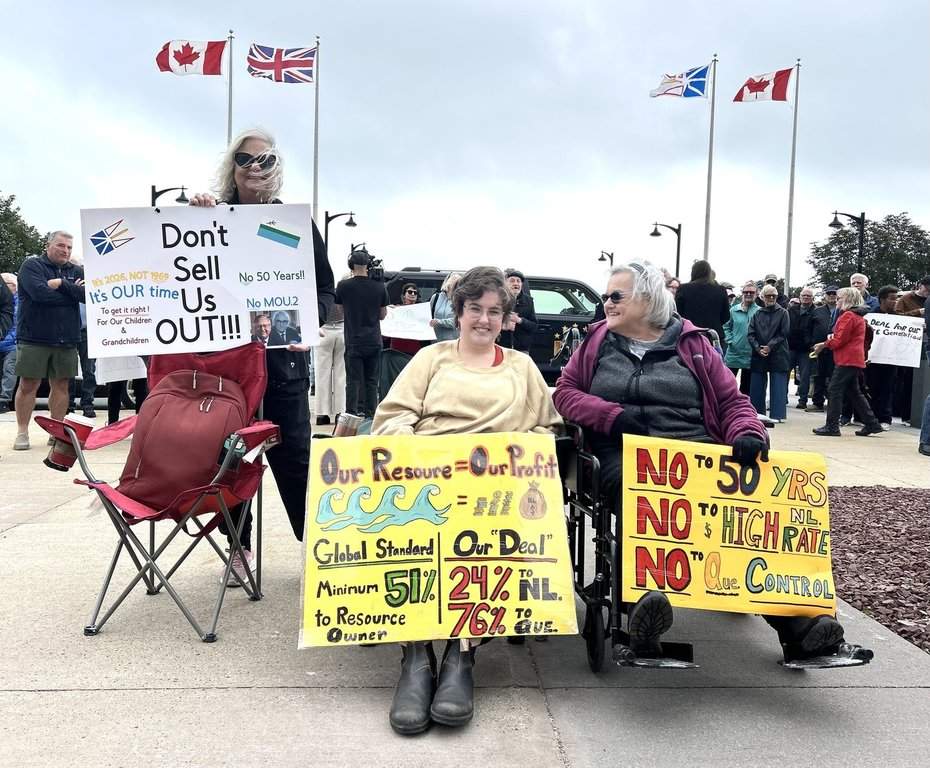
Macroeconomic negotiations involving interprovincial energy assets operate within strict thermodynamic, financial, and political constraints. When Newfoundland and Labrador and the province of Quebec attempt to restructure the long-term governance of the Churchill Falls hydroelectric system, the transaction cannot be evaluated through political rhetoric alone. It requires a rigorous dissection of asset control, capital cost recovery, discount rates, and regional opportunity costs.
The structural tension underlying the revised draft agreement—and the immediate parliamentary fallout, such as the floor-crossing of Lake Melville member Keith Russell—illustrates the profound friction of managing legacy infrastructure deficits against future energy demands.
The Valuation Asymmetry of Long-Term Resource Leases
The historical friction governing Churchill Falls stems from the 1969 power contract, a textbook example of asymmetric risk transfer. Under that framework, Hydro-Québec secured fixed-price offtake rights for the vast majority of the facility's 5,400-megawatt output until 2041. As inflation expanded over subsequent decades and energy spot prices climbed, Newfoundland and Labrador absorbed the opportunity cost of constrained revenue generation while Hydro-Québec captured the arbitrage value.
Any modern renegotiation framework must resolve three distinct economic variables:
- Time-Horizon Discounting: The duration of a power purchase agreement dictates capital amortization schedules. Proposals pushing contract horizons outward face intense skepticism from local stakeholders who view extended timelines as a forfeiture of future optionality.
- Volume Allocation Metrics: The ratio of energy retained for domestic industrial development versus energy exported to external grids determines regional gross domestic product multipliers. Securing blocks of power for local mining or hydrogen initiatives alters the net present value for the producing jurisdiction.
- Indexation Mechanisms: Fixed pricing models fail during inflationary cycles. Modernized structures require dynamic pricing floors linked to market indices or inflation adjustments to prevent real-term revenue erosion.
The Capital Expenditure Bottleneck and Federal Backstopping
The financial viability of developing adjacent assets like the Gull Island project or executing multi-billion-dollar infrastructure upgrades depends on debt servicing costs. Public-sector balance sheets in Newfoundland and Labrador operate under deficit pressures, limiting the province's ability to self-fund capital-intensive generation and transmission projects.
To bridge this liquidity gap, federal intervention—including approximately $10 billion in financing and debt guarantees for transmission corridors and facility enhancements—acts as a structural catalyst. Without this sovereign backstopping, the weighted average cost of capital would render greenfield development economically unviable. However, federal financing introduces a principal-agent problem: Ottawa optimizes for national clean energy targets and grid decarbonization, whereas regional constituencies optimize for immediate fiscal remediation and local resource sovereignty.
Legislative Disruption and Representative Volatility
Interprovincial resource pacts routinely trigger stress fractures within governing political coalitions. Representative democracy relies on alignment between constituent economic interests and party whip mechanisms. When a resource-dependent region perceives that a draft framework compromises long-term autonomy for short-term fiscal relief, legislative defection becomes a rational signaling mechanism for representatives.
The departure of a regional member from the governing Progressive Conservative caucus to sit as an independent highlights the acute political cost of managing asymmetrical resource dependencies. In resource-rich peripheries, legislative survival is tethered to the perception of hard bargaining against dominant central buyers. When executive leadership defends a compromise as pragmatic, backbenchers representing extraction zones face immediate electoral reprisal if constituents calculate the net present value of the concession as negative.
Interlocking Risk Factors in Cross-Border Energy Markets
Finalizing multi-decade energy pacts requires navigating exogenous variables that can destabilize foundational assumptions:
- Political Volatility: Electoral cycles in adjacent jurisdictions introduce leadership transitions that may seek to renegotiate or stall ratification processes.
- Alternative Opportunity Costs: The baseline value of hydroelectric generation must continually be benchmarked against emerging decentralized energy storage, localized wind integration, and shifting industrial demand curves.
- Regulatory Compliance: Transmission access rights and environmental review boards introduce timeline slippage, inflating carrying costs prior to commercial operation.
To insulate provincial balance sheets from structural undervaluation, future iterations of interprovincial accords must institutionalize periodic pricing reviews rather than locking jurisdictions into static fifty-or-sixty-year parameters. Stakeholder alignment requires transparency regarding the exact internal rate of return generated for both utilities, ensuring that capital deployment matches the generational scale of the underlying natural assets.