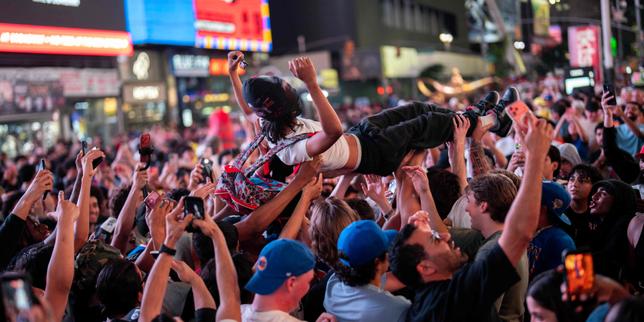
The valuation of a sports franchise typically rests on predictable ledger items: media rights, gate receipts, corporate sponsorships, and real estate yields. However, these metrics fail to capture the explosive inflection point that occurs when a historically underperforming legacy asset in a primary market enters a period of sustained competitive viability. The emotional output of the New York Knicks fan base is not merely a cultural phenomenon; it is a highly concentrated economic driver that operates on a non-linear scale.
When a franchise suffers from a multi-decade scarcity of success, the market dynamics shift. The return on investment for fan emotional capital yields an outsized premium compared to historically consistent franchises. To understand the current state of New York basketball requires moving past sentimental narratives of "joy" and instead analyzing the structural mechanisms of fan sentiment, the scarcity principle in legacy sports markets, and the velocity of consumer spending triggered by organizational stability.
The Scarcity Principle and Cumulative Emotional Equity
The intensity of consumer engagement in a sports market is inversely proportional to the historical availability of a premium product. In economic terms, the Knicks fan base has operated under an artificial supply constraint for the better part of twenty-five years. This structural deprivation alters consumer behavior through three distinct phases:
1. The Erosion of Value (1999–2020)
During this period, the franchise experienced a systemic devaluation of its on-court product. Standard management practices were replaced by short-term asset liquidation (trading draft capital for aging assets) and structural instability (frequent coaching and front-office turnover). The economic consequence was not a drop in baseline revenue—owing to the structural advantages of Madison Square Garden's geographic location and corporate ticket density—but a severe depression of the franchise's emotional equity. Consumer utility was derived almost exclusively from nostalgia rather than real-time performance.
2. The Preservation of Demand Elasticity
Unlike conventional consumer goods, where prolonged product degradation leads to permanent brand substitution, premium sports brands in monopolistic markets retain highly inelastic demand. New York consumers did not shift their loyalty to regional competitors in statistically significant numbers. Instead, the emotional capital was compressed, creating a highly volatile reservoir of latent demand.
3. The Reentry Inflection Point
The current phase represents the sudden release of this compressed demand. Because the market had priced in failure as the baseline operational state, the transition to functional competency—and subsequently to elite contention—creates a sentiment surplus. The utility curve of the consumer steepens sharply. A single playoff series victory in a starved primary market generates greater consumer velocity, merchandise liquidation, and media engagement than a championship in a saturated or smaller market.
The Operational Framework of Organizational Stability
The transition from a distressed asset to a high-performing enterprise requires a fundamental shift in capital allocation and asset management. The current iteration of the franchise operates on a model that prioritizes three distinct pillars of organizational health:
[Organizational Stability]
       │
       ├─► 1. Alignment of Executive Incentives (Front Office & Coaching)
       ├─► 2. Asymmetric Asset Acquisition (Undervalued Roster Creation)
       └─► 3. Structural Identity Selection (Defensive/Physical Archetype)
Alignment of Executive Incentives
Historically, the franchise suffered from a disconnect between the timeline of the front office and the execution window of the coaching staff. Short-term job preservation led to suboptimal resource distribution. The stabilization of the current regime established a unified operational horizon. Decisions are evaluated based on a multi-year compounding window rather than immediate public relations management.
Asymmetric Asset Acquisition
The construction of the current roster relied on identifying undervalued assets that possessed high synergy metrics. Rather than exhausting capital on maximum-contract players whose market value was fully realized or negative, management targeted talent with specific contract-to-production profiles. The acquisition of core personnel occurred at valuation points that allowed for subsequent roster flexibility, creating an insulated salary cap structure that defies the standard luxury-tax penalties plaguing contemporary contenders.
Structural Identity Selection
Sports franchises in major media markets frequently succumb to the pressure of entertaining rather than winning efficiently. The current tactical framework prioritizes a high-friction, low-variance style of play. By indexing heavily on defensive efficiency, rebounding differentials, and possession maximization, the team removes systemic variance from their seasonal projection. This operational predictability is the precise mechanism that converts skeptical consumers into highly engaged investors of time and capital.
The Microeconomics of the Arena Environment
The physical manifestation of this sentiment surplus occurs within Madison Square Garden, an arena that functions as a high-density economic accelerator. The financial ecosystem of the arena during a period of competitive viability operates through distinct operational channels:
- The Ticket Secondary Market Premium: The entry price for live consumption serves as a direct proxy for real-time fan sentiment. In a sustained winning environment, secondary market valuations experience a non-linear surge. This appreciation is driven not by casual consumers, but by high-net-worth individuals and corporate entities capitalizing on the social utility of live premium sports content in a primary financial hub.
- The Content Multiplier Effect: The economic footprint of a Knicks victory extends far beyond the physical gates of the arena. Local hospitality networks, regional sports networks (RSNs), and digital media ecosystems experience a localized GDP expansion. The velocity of content consumption—measured via impressions, subscription retention, and airtime monetization—escalates at a rate that far outpaces national averages.
- The Merchandising Liquidation Velocity: When an identity-driven team captures the public imagination, apparel ceases to be a passive consumer choice and becomes a tribal signifier. The monetization of specific player archetypes generates high-margin revenue streams that scale globally, leveraging New York's position as a cultural exporter.
Limitations and Systemic Vulnerabilities
An objective analysis requires outlining the structural constraints and failure points inherent in this high-intensity economic model. The emotional premium is a highly volatile asset class, subject to rapid depreciation if specific operational parameters are violated.
The first critical bottleneck is physical attrition. The exact tactical identity that generated the franchise's cultural and competitive renaissance—extreme physical output, condensed rotations, and high-intensity defensive schemes—introduces an elevated probability of structural injury. When an organization relies on a razor-thin margin of operational intensity, the removal of key human capital assets due to physical wear creates a disproportionate drop in competitive output.
The second limitation is the Salary Cap Hard Cap Squeeze. The collective bargaining agreement penalizes sustained spending above the luxury tax thresholds. The franchise faces an impending fiscal inflection point where the cost of maintaining the current roster will clash directly with team-building restrictions. If the front office is forced to liquidate depth to manage tax burdens, the structural insulation of the roster vanishes, threatening the very stability that revived the brand.
The Strategic Path Forward
To transition this emotional capital from a temporary market spike into an enduring institutional era, the organization must execute a precise sequence of capital and roster maneuvers.
First, the front office must treat future draft capital not as a means to acquire a singular, high-salaried superstar, but as a mechanism to continuously inject cheap, cost-controlled labor into the depth chart. This mitigates the financial pressures of the new salary cap restrictions while preserving the physical depth required by the coaching staff's tactical system.
Second, the commercial arm of the enterprise must decouple its marketing and partnership valuations from individual player brands and bind them permanently to the organizational architecture established during this revival. By institutionalizing the current culture as the permanent brand identity, the franchise ensures that the emotional premium remains resilient against the inevitable variances of sports longevity. The market has validated the current operational model; the mandate now is the ruthless optimization of its durability.