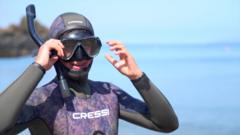
Ocean conservation efforts typically suffer from a fundamental execution problem. Traditional models rely on distant bureaucratic oversight, sporadic volunteer cleanups, or passive philanthropic donations that struggle to connect resource allocation with direct ecological impact. When an individual engages in high-level apnea diving—commonly known as free diving—they enter a closed-loop system where physical capability directly dictates environmental awareness. A 21-year-old athlete operating at significant depth experiences the marine ecosystem not as a detached observer, but as a biological stakeholder. This dynamic establishes a high-fidelity feedback loop between personal performance metrics and ecosystem health observations.
Understanding how elite breath-hold diving translates into structured marine preservation requires deconstructing the activity into three core operational vectors: physiological footprint minimization, high-resolution habitat auditing, and localized ecological intervention.
The Mechanics of Low-Impact Marine Presence
Standard maritime conservation operations often introduce friction through noise pollution, chemical runoff, and physical disruption. Scuba diving, while effective for prolonged bottom time, relies on compressed air tanks that generate acoustic signatures capable of altering marine animal behavior, alongside the mechanical bubble stream that disturbs water column stratification.
Apnea diving eliminates these variables. Operating without heavy mechanical apparatus, the free diver moves through the water column with near-zero acoustic impact. This behavioral invisibility allows the diver to observe undisturbed marine dynamics, establishing a baseline of normal ecological behavior that is otherwise inaccessible to motorized observation vessels.
The physical cost function of this approach is defined by oxygen efficiency and thermal regulation. A diver operating on a single breath must optimize hydrodynamic drag, reduce heart rate via the mammalian dive reflex, and maintain absolute buoyancy control. This stringent physiological discipline forces the individual to interact with the environment with extreme spatial awareness. Every fin kick is calculated; every point of contact with the substrate is eliminated to conserve energy. Consequently, the diver's physical engagement with the marine environment shifts from accidental habitat degradation to passive non-interference.
High-Resolution Habitat Auditing
Data collection in marine biology is frequently bottlenecked by temporal and financial constraints. Deploying remote underwater vehicles or funding multi-vessel research expeditions limits the frequency of data points gathered from shallow-to-mid-depth coastal zones. The elite free diver functions as a decentralized, mobile data acquisition node.
Operating at depths ranging from 10 to 40 meters, the practitioner covers vertical strata that traditional shore-based observers miss entirely. The auditing process relies on visual and kinetic telemetry:
- Substrate integrity assessment: Monitoring coral bleaching, siltation rates, and structural erosion caused by coastal runoff.
- Macro-fauna population tracking: Documenting the presence, density, and behavioral shifts of keystone species within specific reef boundaries.
- Anthropogenic debris localization: Identifying submerged synthetic waste accumulation points that evade surface-level detection.
Because the free diver can descend repeatedly over several hours, they map localized micro-climates with high spatial granularity. This granular observation pipeline provides local conservation groups with actionable intelligence regarding seasonal shifts in water temperature, nutrient influx, and pollution density long before broad satellite models or generalized macro-studies register the anomaly.
Ecological Intervention and Debris Extraction
Observation without intervention yields diminishing returns for active ecosystem management. The bridge between data collection and remediation lies in micro-scale physical intervention. Unlike surface sweeps that target floating refuse, elite breath-hold divers possess the specific physiological toolkit required to extract persistent subsurface pollutants.
Ghost gear—abandoned, lost, or discarded commercial fishing nets—represents one of the most lethal hazards in coastal ecosystems. These synthetic mesh structures sink to the benthos, where they continue to capture marine life through unbaited entrapment. Removing ghost gear requires precise knife-work, spatial reasoning under hypoxic stress, and buoyancy management while countering the dead weight of water-logged synthetic fibers.
When a diver executes a recovery dive to sever a net wrapped around a rocky outcrop or coral head, the operation demands strict risk management. The marginal utility of the intervention must outweigh the personal risk profile dictated by nitrogen-free, high-exertion apnea. By focusing efforts on high-leverage extraction points—such as removing single entanglement hubs that threaten multiple species—the practitioner maximizes ecological ROI per breath-hold cycle.
Scaling Individual Action to Systemic Impact
A common critique of individual-centric environmentalism is its negligible statistical weight relative to industrial pollution vectors. A single free diver removing kilograms of plastic waste from a reef cannot reverse systemic municipal dumping or commercial overfishing. However, framing this activity solely through the lens of mass removal misunderstands its actual leverage point.
The primary value of individual ocean stewardship via extreme sports is informational and cultural calibration. When an elite athlete documents subsurface conditions with visual proof, they bridge the psychological gap between the general public and unseen marine degradation. The ocean functions as an out-of-sight, out-of-mind sink for industrial externalities. By introducing high-definition telemetry and visceral human narratives rooted in physical mastery, the activity forces a re-evaluation of local resource management policies.
Municipalities and regional authorities often respond slowly to ecological decline because bureaucratic validation processes demand rigorous, expensive environmental impact reports. Grassroots interventions driven by specialized athletic communities bypass this inertia. By providing localized, verified audits of underwater health, free divers supply municipal planners with the baseline data necessary to justify targeted conservation zoning, mooring buoy installations, or localized commercial fishing restrictions.
Resource Allocation and Risk Calibration
Optimizing the intersection between extreme apnea sports and environmental restoration requires strict adherence to operational boundaries. Divers attempting to execute conservation tasks while managing maximum depth or static apnea time face compounded cognitive and physical loads. Hypoxia-induced judgment impairment can turn a routine debris extraction into a safety critical incident.
Therefore, sustainable engagement demands structural compartmentalization:
- Separate performance-focused training sessions from conservation-focused operational dives.
- Establish strict safety thresholds, ensuring that breath-hold limits are never compromised for the sake of salvaging non-critical debris.
- Integrate local marine biologists into the planning phase to ensure that physical interventions do not inadvertently disrupt nesting sites or fragile micro-habitats during extraction procedures.
The long-term viability of this model hinges on transforming isolated acts of stewardship into repeatable, standardized protocols that other coastal athletic communities can replicate without degrading the very ecosystems they aim to protect.
Integrate autonomous underwater cameras into standard apnea setups to automate continuous visual logging of benthic health indicators during routine training descents, creating an open-source telemetry database for regional marine research institutions.