Rain does not fall uniformly across the British Isles. In Edinburgh, it drives horizontally off the North Sea, grey and scouring, tasting of salt and ancient basalt. In Cardiff, it rolls in heavy and soft from the Bristol Channel, smelling of wet slate and coal-dust memories. In Belfast, it mists over the lough with a quiet persistence that feels like an unvoiced question.
For centuries, these distinct climates were held inside a single, formidable architectural drawing. London was the keystone. Westminster was the anchor. No matter how much the weather varied at the edges, the central pillar remained fixed, heavy enough to weather any storm.
Until recently.
Consider what happens when the anchors begin to drift. Not with the theatrical violence of a revolution, but with the quiet, methodical coordination of neighbors realizing they have more in common with each other’s weather than with the master builder sitting three hundred miles to the south.
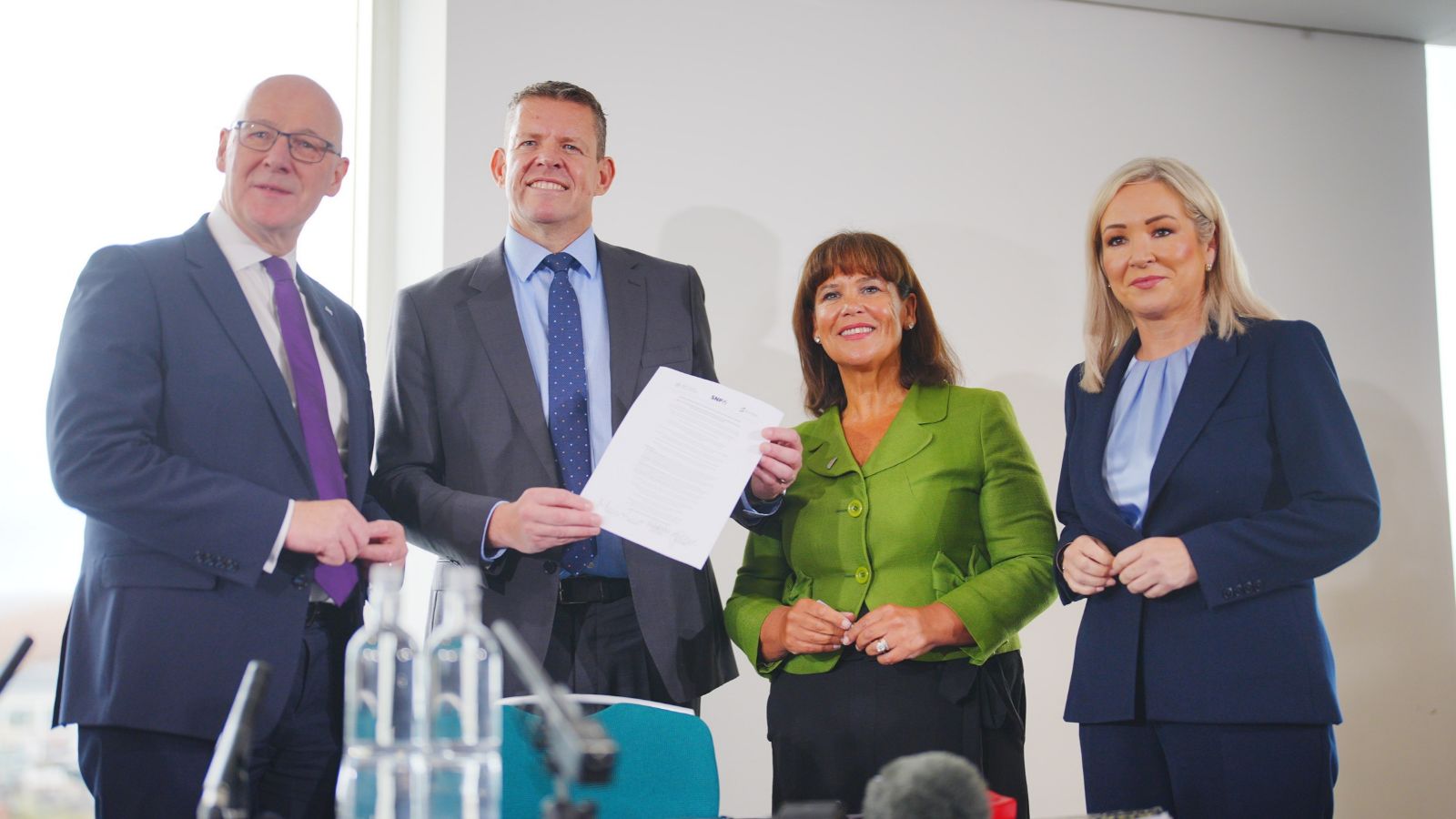
When the leaders of Scotland, Wales, and Northern Ireland step into the same room to forge a united front, the sound you are hearing is not just political maneuvering. It is the creak of structural timber. It is the sound of a union being forced to ask itself an existential question: What keeps a collection of distinct nations together when the centripetal force of shared history loses its grip?
To understand why this moment matters, you have to look past the crisp press releases and the formal handshakes on television screens. You have to step down from the abstract terminology of constitutional law and walk through the streets where these shifts actually land.
Imagine a town like Merthyr Tydfil in the Welsh valleys, or a coastal village in the Scottish Highlands, or a housing estate in West Belfast. In these places, governance is not an intellectual exercise about parliamentary sovereignty. Governance is the state of the local hospital waiting list, the condition of the bus routes connecting isolated communities to regional hubs, and the price of heating oil when winter bites. For decades, the bargain of the union was simple: share the burdens, pool the risks, and trust that the massive economic engine centered around the Thames would keep the lights on in the shires and the valleys.
That bargain is fraying.
When regional administrations find themselves locked in recurring friction with central fiscal planning—facing budgetary constraints that feel increasingly disconnected from local realities—something predictable happens. They look sideways. They look at each other.
In political science, this is described as intergovernmental friction or devolved alignment. In human terms, it is simply what happens when people sharing a corridor decide to check if the locks on their doors match.
The mechanics of this current alignment are striking precisely because they cross ideological and historical fault lines that were once thought impassable. Nationalist administrations in Edinburgh and Cardiff, operating alongside the complex power-sharing architecture of Stormont, have begun coordinating positions on funding, legislative consent, and economic autonomy. They are not necessarily drawing up blueprints for immediate secession, which would ignore the profound economic complexities and deep-seated divisions within their own populations. Instead, they are doing something potentially more transformative: they are establishing a counterweight.
They are proving that the political geography of the United Kingdom no longer runs on a simple, singular axis from the capital outward. It is becoming multi-polar.
History is full of unions that imagined they were permanent because they were old. We romanticize endurance. We look at centuries of shared currency, shared blood on distant battlefields, and shared literature, and we assume these things are immutable laws of nature rather than fragile human arrangements maintained by continuous consent.
The 1707 Act of Union was forged in financial desperation and political calculation, driven by the collapse of the Darien scheme and the imperative of Protestant succession. The incorporation of Ireland, and the subsequent partition that birthed Northern Ireland, was written in trauma and barbed wire. Devolution itself—the radical redistribution of power in the late 1990s that created the Scottish Parliament, the Senedd, and the Northern Ireland Assembly—was designed as a pressure valve. The architects of devolution believed that by giving the peripheries a voice over their own schools, hospitals, and roads, they would strengthen the center. They thought that letting people paint their own walls would make them appreciate the roof more.
For a long time, that logic held. But a pressure valve works only if the steam can escape without blowing apart the boiler.
Today, the tension is no longer about local control over education or local taxation rates. It is about fundamental competence, economic vision, and the right to define a future that looks distinctly different from the one prescribed by Whitehall. When leaders from three distinct devolved nations align their leverage, they are testing the tensile strength of a constitutional settlement that was never truly designed to handle multi-directional power struggles.
What makes this dynamic so compelling is its quietness. There are no barricades in the streets. There is no dramatic overnight collapse. There are only committees meeting behind closed doors, shared communiqués drafted with exquisite diplomatic caution, and the slow, tectonic shift of public imagination.
A citizen in Glasgow or Caernarfon or Derry wakes up and realizes that their primary political horizon is no longer defined by the Prime Minister's Questions broadcast from Westminster, but by the decisions made in their own regional capitals—and increasingly, by the solidarity those capitals are finding with one another.
This is the invisible stake of the current unity challenge. It is not merely a dispute over block grants or legislative vetoes. It is a battle for the narrative of belonging.
Every nation is ultimately a story we tell ourselves about who we are and who we share a future with. For three hundred years, the dominant story of these islands was an imperial and unitary epic: many lands, one crown, one parliament, one destiny. But stories lose their grip when the characters at the edges find their own voices, realize their own agency, and discover that they can write a different plot together.
When leaders from the Celtic fringes coordinate their moves, they are rewriting the narrative in real time. They are suggesting that the periphery is no longer a collection of separate outposts waiting for orders from the center, but a coalition of interests with its own gravitational pull.
And that is where the real anxiety lies for those who view the union as a sacred, unalterable trust. You can manage a disagreement between London and Edinburgh. You can negotiate terms with Cardiff. You can navigate the delicate, high-wire act of Belfast politics. But when the edges begin to talk to each other directly, bypassing the switchboard in Westminster, the entire architecture of power changes its shape.
We are watching the renegotiation of an empire's ghost.
The United Kingdom has spent the last several decades trying to figure out how to be a modern democracy while carrying the heavy, cumbersome furniture of a centralized state built for a different century. It is an impossible friction. On one side stands the inertia of sovereignty, clinging to the idea of an undivided, indivisible parliamentary supremacy. On the other side stands the stubborn reality of geography, identity, and the everyday demand for self-determination.
The leaders joining forces today are not the executioners of the union. They are its diagnosticians. They are pointing to the fractures in the foundation and asking whether the house can be remodeled before the weather gets in.
Or perhaps, more radically, they are simply refusing to wait for permission to find out what lies beyond the horizon.
The rain continues to fall across the islands. It hits the stones of Edinburgh Castle with a sharp, historic chill. It washes down the valleys of Wales where the old mines are now green hills. It brushes against the peace walls of Belfast, where history is written in fresh paint every marching season. Each place is different. Each place remembers yesterday through a different lens.
Yet today, across those wet, beautiful, fractured landscapes, a single, resonant frequency is beginning to echo—a reminder that maps are never permanent, and that the geography of the heart always outlasts the lines drawn by kings.