Cold.
That is the first thing you notice when you kneel in the heavy marine clay of northern Friesland in late autumn, pressing your bare knuckles into earth that refuses to yield its warmth even at noon. Anyone who has spent a Saturday sweeping a coil over plowed Dutch farmland knows that the ground here does not merely hold objects; it swallows them whole, sealing iron, brass, and gold inside an anaerobic vault that slows corrosion to a crawl while erasing every landmark on the surface above.
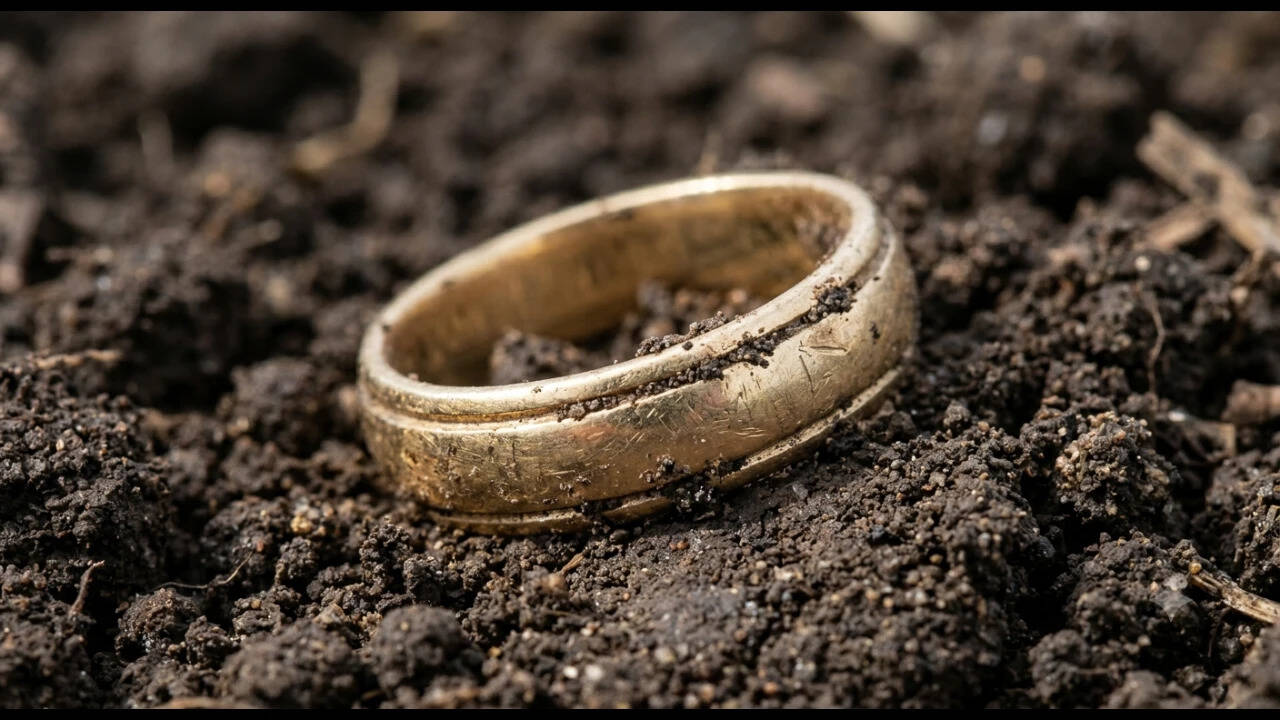
When a metal detectorist recently pulled a slender gold band from that dark soil—eighty-three years after it slipped from a finger during the Second World War—the headlines treated it like a tidy human-interest curiosity. A lost ring. A lucky beep. A neat bow tied across eight decades.
That reading misses the weight of what actually happened in that field.
A wedding ring lost in 1943 or 1944 on a Dutch farm was never just a piece of jewelry misplaced during a chore. To understand why that small circle of gold matters—and why its recovery hits so hard—you have to strip away the comfortable distance of eighty-three years and look at what life on a farm in the occupied Netherlands actually felt like when the ring went missing.
The Weight of a Small Circle in 1943
Picture a hypothetical couple—let’s call them Hendrik and Anke, though the real names etched inside the band belong to a specific Dutch family whose private history suddenly collided with modern technology. By the fourth year of the German occupation, life in the rural provinces had narrowed to a tight, exhausting routine of scarcity and quiet defiance. Rubber tires had been confiscated, forcing farmers onto wooden wheels or bare rims. Copper, brass, and tin were requisitioned for the German war machine. Even food was rationed down to the gram, turning every potato clamp and milk churn on a Friesland farmstead into something worth hiding from inspectors.
Work went on anyway. It always does on a farm.
Hands grew thin. That is a detail modern readers rarely consider when they read about wartime losses, yet it is the single most common mechanical reason wedding rings vanished between 1940 and 1945. Months of caloric deficit—long before the catastrophic Hongerwinter of 1944–1945 starved the western cities—shrank knuckles and thinned fingers. A gold band fitted during a prosperous prewar wedding suddenly turned loose when slick with wet clay, lye soap, or cold rain.
Imagine the moment it happened. You are pulling sugar beets out of sticky furrow mud before frost locks the rows, or hauling buckets from the well at dusk, or hiding sacks of grain beneath straw in the barn loft because an inspection patrol was spotted two polders over. You wipe your hands on your apron or wool trousers. Your thumb brushes your left ring finger.
Nothing. Just bare, chapped skin.
Panic in wartime has a sharper edge than panic in peacetime. You cannot simply drive to a jeweler in Leeuwarden or Groningen and order a replacement; precious metals were strictly controlled, civilian goldsmithing had ground to a near halt, and every guilder was needed for survival. Worse still, a wedding ring in occupied Holland was often one of the few portable stores of real wealth a family possessed—an emergency currency sewn into coat linings or traded quietly if someone had to go into hiding (onderduiken). Losing it meant losing a symbol of marriage, an irreplaceable family heirloom, and a silent insurance policy all in one unremarkable second.
You drop to your knees in the furrow. You sift clods between your fingers until your nails bleed and the light fails completely. You come back at dawn with a wooden rake, combing the same three-meter stretch of dirt until the neighbors start asking questions you cannot afford to answer.
Eventually, you have to stand up and walk back to the farmhouse empty-handed.
Why Dutch Farmland Keeps Secrets So Well
To appreciate how a ring survives eighty-three winters intact, think of northern Dutch soil less like a garden bed and more like a giant, slow-motion freezer made of silt and peat.
Unlike rocky hill country where freeze-thaw cycles churn stones to the surface every spring, the coastal clay and polder soils of the Netherlands are dense, fine-grained, and remarkably stable once you drop below the top twenty or thirty centimeters of regular plowing. When a heavy object like a solid gold ring falls into wet mud, its own specific gravity—gold is roughly nineteen times denser than water—pulls it downward every time rain saturates the topsoil. A single pass of a horse-drawn plow or an early tractor blade can nudge it sideways by a meter and bury it just beyond the reach of an iron harrow.
Once there, chemistry takes over.
Iron nails from the same war bloom into ragged crusts of rust within twenty years. Brass shell casings turn green and pitted. Silver blackens under sulfur compounds in the soil. Gold, however, is famously indifferent to oxygen, moisture, and soil acids. Unless a steel plowshare strikes it dead-on, an 18-karat or 14-karat band sits in the dark unchanged, keeping the exact warmth of its alloy and the crisp edges of whatever date or initials an engraver cut into its inner curve a century ago.
For decades, that ring existed in a state of suspended animation. Above it, the war ended. Canadian tanks rolled north across the bridges in April 1945. Horse teams gave way to diesel tractors. Drainage ditches were widened, farmhouses modernized, children grew old, and the people who had once crawled through the mud looking for that tiny flash of yellow died believing it was gone forever.
The Strange Intimacy of the Signal
Modern metal detecting looks deceptively simple from the road: a person in rubber boots walking slow grids across a harvested field, swinging a carbon-fiber shaft back and forth like a pendulum. Anyone who has actually done it knows that ninety-nine percent of the hobby is humbling, repetitive labor. You dig bent nails. You dig aluminum foil shredded by rotary tillers. You dig lead seals, tractor bolts, shotgun primers, and bottle caps from 1978.
Then, every few hundred holes, the machine gives a clean, narrow, mid-tone signal that refuses to drift when you swing from ninety degrees.
On a modern detector, small gold rings occupy one of the trickiest neighborhoods on the conductivity scale. They rarely scream like a silver coin or a copper kettle. Instead, they sit right alongside pull-tabs and small bits of foil—the exact signals impatient searchers skip when their backs ache and the wind is cutting off the Wadden Sea. Finding a gold ring in plowed farmland is never pure luck; it is the reward for stubbornness, for digging the faint, ambiguous chirp that could easily be trash.
When the spade turns over a clod and a clean rim of yellow gold catches the gray afternoon light, time collapses.
There is a visceral jolt to holding an object that no human hand has touched since the German occupation. You wipe away the black clay with your thumb, turn the band toward the sky, and look at the inside wall. Almost every Dutch wedding ring from that era carries an inscription—initials, a wedding date, sometimes a simple voor eeuwig. In that moment, the object stops being an artifact and becomes a debt. You are holding someone else’s unfinished business.
How a Name Outlives Eighty-Three Years
Finding the ring is only half the work; returning it is a detective story of its own.
In the Netherlands, strict rules govern metal detecting under the Heritage Act (Erfgoedwet). Responsible detectorists log finds through national databases like Portable Antiquities of the Netherlands (PAN), obtain landowner permission before stepping onto a field, and treat engraved personal items not as trophies for a display case, but as clues pointing toward living descendants.
And here, Dutch bureaucracy—often mocked for its obsession with paperwork—becomes an extraordinary tool for grace.
Municipal population registers (Bevolkingsregister), church marriage ledgers, local historical societies, and regional archives across provinces like Friesland and Groningen preserve astonishingly detailed records of who lived on which farmstead in the 1930s and 1940s. Even when an inscription contains only two sets of initials and a date—say, 14-5-1938—local genealogists can cross-reference farm ownership records, parish marriage announcements, and wartime census lists within days.
Consider what happens next when a researcher finally connects those engraved letters to a surname, traces the children or grandchildren through municipal records, and makes a phone call out of nowhere.
At first, the person on the other end of the line rarely believes it. Eighty-three years is long enough for family stories to thin into rumor, or vanish altogether. Often, the original couple never even told their children about losing the ring—or mentioned it once in passing fifty years ago, a minor wartime grief overshadowed by larger losses. Sometimes the surviving spouse quietly wore a cheap brass replacement for the rest of their life, or went without a ring entirely because money went to rebuilding the barn or educating the kids.
Then the envelope arrives, or the detectorist sits down at a kitchen table with a small plastic bag resting on the oilcloth.
What We Are Really Looking For in the Dirt
We live in an era built around disposability. If a phone cracks, we replace it before the weekend. If a cheap ring slips off in a lake, we order an identical one online before we even dry off. Because our own objects carry so little friction, it is easy to misread why stories like this travel around the world in twenty-four hours.
People do not share news about an eighty-three-year-old wedding ring because they are fascinated by metallurgy or hobbyist electronics. They share it because every human life is full of things dropped in the mud and left behind—promises cut short by crisis, heirlooms lost in transit, family histories severed by war, migration, or ordinary forgetting.
Most of those losses stay buried. The earth keeps almost everything it takes.
Yet every so often, an ordinary person walks across a cold field with patience enough to listen to a faint signal beneath their boots, kneels down in the clay, and lifts a small circle of gold back into the light. And somewhere in a quiet Dutch living room, an elderly hand closes around the exact band their parent wore during the darkest years of the twentieth century—still warm, still round, and finally home.


