The lock does not care about memories. It turns with a clean, mechanical snap, indifferent to the four decades of Sunday dinners cooked on the stove inside, indifferent to the pencil marks on the doorframe measuring the growth of children now grown and gone, indifferent to the sheer, stubborn weight of a life lived entirely within four walls.
Metal meets metal. Click. For an alternative perspective, read: this related article.
Outside, the Madrid morning is cold. Inside, eighty years of existence are reduced to taped cardboard boxes.
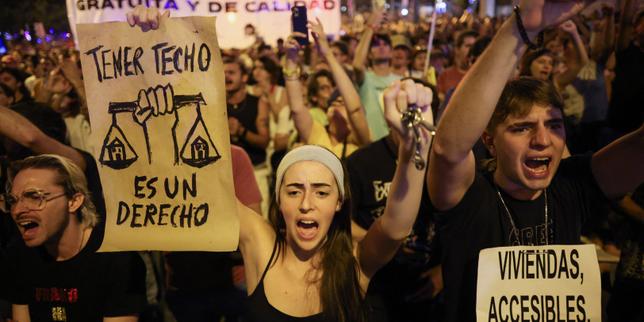
Across the Spanish capital, the streets are beginning to swell. They do not look like a mob. They look like a cross-section of humanity itself. There are students with worn-out sneakers, toddlers bundled in woolen coats riding on their fathers' shoulders, and silver-haired retirees walking with the slow, deliberate rhythm of people who have survived harder times than this. They are marching for her—an octogenarian whose name most of them do not know, but whose fate they recognize as their own shadow. Related coverage on this trend has been provided by Al Jazeera.
Houses were once built to keep the weather out. Now, they seem designed to keep people out.
To understand what happened in Madrid, you have to look past the bureaucratic language of eviction notices and court rulings. You have to look at the math of modern survival. For decades, a home in Spain was an anchor. It was the place where you weathered economic storms, raised your family, and grew old in quiet dignity. But somewhere along the way, the ground shifted. Concrete and mortar were converted into abstract ticker symbols on screens in distant financial districts. Apartments stopped being shelters and started acting as assets, yields, portfolios.
Consider how this works in practice. Imagine sitting at a mahogany table in a high-rise office, staring at a spreadsheet where a residential block in central Madrid is represented not by names and faces, but by a percentage point increase in quarterly return. The algorithm dictates that the current tenants—the ones who planted geraniums on the balconies and swept the stairwells—are mathematically obsolete. Their rent, anchored to a different era, is too low. The solution is simple on paper. Clear the slate. Renovate. Flip. Rent it out to digital nomads or transient tourists who will treat the neighborhood as a weekend hotel rather than a community.
The human cost of that spreadsheet is an eighty-year-old woman standing on a sidewalk with a plastic bag containing her medication and a photograph of her late husband.
It feels absurd. It feels like a glitch in the software of civilization. You work, you obey the social contract, you pay your taxes, you buy bread from the same baker for thirty years—and yet, overnight, a court order can unseat your entire existence because the land beneath your feet has suddenly become too valuable for you to inhabit.
The crowd in Madrid grows denser. The noise rises, a low, rumbling tide of voices echoing off the stone facades of the grand avenue. Banners snap in the wind. The slogans are simple, stripped of political jargon, cutting straight to the bone of the matter: Housing is a right, not a luxury.
Why does this resonate so deeply? Because the fear of displacement has become the ambient background noise of modern life. It hums quietly beneath every conversation about the future. Young people look at the rental market and laugh through their exhaustion, knowing that independent adulthood is a door permanently locked to them. Families calculate whether to buy groceries or pay the rent hike, knowing that the margin between stability and sleeping in a car has grown razor-thin. When an octogenarian is thrown onto the pavement, the public does not just see an isolated tragedy. They see a warning flare. They see the future coming for them, too.
The roots of this crisis run deep into the soil of economic policy and urban design. For years, the normalization of short-term vacation rentals hollowed out historic neighborhoods. Entire city blocks transformed into ghost towns of lockboxes and rolling suitcases, while long-term residents were pushed further and further toward the periphery, trading hours of their days for the crime of being working class. Institutional investment funds swept up residential portfolios with the appetite of locusts, driving prices upward in a dizzying spiral that severed any connection between local wages and local rents.
When the market disconnects entirely from human reality, something has to break.
Usually, what breaks first is silence. People internalize their struggles. They feel shame when they cannot make rent, as if poverty were a personal moral failure rather than a structural design. They suffer eviction notices in quiet humiliation behind closed curtains.
Not this time.
The thousands who flooded the streets of Madrid decided that shame belongs to the system, not the individual. They formed a human wall around an elderly woman’s belongings, turning their bodies into a physical barrier against an invisible, faceless pressure. They chanted not just for her apartment, but for the fundamental idea that a city belongs to the people who walk its streets, buy its coffee, and care for its elders.
We live in an era obsessed with connectivity, yet we have engineered societies where the most fundamental human connection—having a place to lay your head safely at night—is treated as a speculative privilege. We talk endlessly about innovation, smart cities, and digital transformation, while basic shelter becomes an unattainable horizon for the very people who built the infrastructure of the metropolis.
As the sun climbs higher over Madrid, casting long shadows across the packed asphalt, the protest reaches the steps of the municipal offices. There are no speeches from grand podiums, no orchestrated political grandstanding. Just ordinary people standing shoulder to shoulder, breathing the same cold air, refusing to look away from a broken system.
The octogenarian is safe for tonight, sheltered by neighbors and activists who refused to let her vanish into the statistical ether. But the locks across the city are still turning. The spreadsheets are still calculating. The invisible machinery of displacement never truly sleeps.
Yet neither do the people.
In the quiet moments after the chants fade and the banners are rolled up, a lingering truth remains suspended in the air. A society can measure its wealth in skyscrapers and foreign investments, but its true character is revealed at the front door. When that door is locked from the outside against the people who built the home, the whole city stands out in the cold.