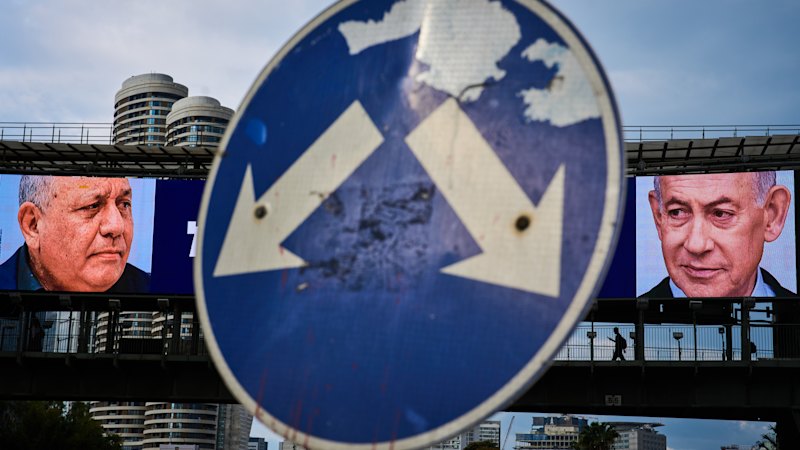
Israeli parliamentary elections are never referendums on a single leader; they are stress tests of a hyper-fragmented proportional representation system where marginal shifts in voter turnout determine whether a prime minister retains executive control or faces immediate political extinction. The first national vote since the October 7, 2023 attacks strips away the traditional ideological abstractions of Israeli politics—peace process diplomacy versus territorial maximalism—and replaces them with a raw audit of institutional failure, security doctrine, and coalition math. Benjamin Netanyahu enters this electoral cycle not merely defending an incumbency, but attempting to decouple his personal political survival from the catastrophic intelligence and operational collapse that occurred under his watch.
To understand the trajectory of this election, one must discard surface-level narratives about popularity ratings and examine the structural mechanics of the Knesset. Israel operates under a single nationwide electoral district with a 3.25% electoral threshold. Power is secured by assembling a minimum of 61 seats out of 120. Because no single party has ever won an outright majority in Israeli history, elections are won or lost at the margins of bloc aggregation—specifically, how efficiently competing camps convert raw votes into Knesset mandates without wasting ballots on parties that fall beneath the 3.25% cutoff.
The Structural Breakdown of the Post-October 7 Electorate
The electorate entering the polling booths is defined by three overlapping fault lines that override historical voting patterns.
1. The Security Competence Deficit
For two decades, Netanyahu’s core value proposition to the Israeli median voter was risk management. Branded as "Mr. Security," his strategy relied on containment, deterrence, and the preservation of a manageable status quo in Gaza while expanding regional normalization agreements. The October 7 attack invalidated the foundational premise of that doctrine.
In electoral terms, this creates a severe trust deficit among soft-right and center-right voters—the exact demographic required to push a right-wing bloc past the 61-seat threshold. Unlike ideological hardliners who vote based on identity or religious alignment, these pragmatic voters treat national security as a performance metric. When the state fails to perform its primary social contract—protecting citizens within its sovereign borders—incumbency transforms from an asset into a liability.
2. The Burden-Sharing Cleavage
Extended multi-front warfare across Gaza, the northern border with Lebanon, and regional theaters has imposed an unprecedented strain on the Israel Defense Forces (IDF) reserve system. Hundreds of thousands of secular and national-religious citizens have served extended deployments, absorbing severe economic and personal costs.
This reality has weaponized a long-simmering structural issue: the military service exemption for ultra-Orthodox (Haredi) men. Historically, Netanyahu relied on Haredi parties (Shas and United Torah Judaism) as his most disciplined, guaranteed coalition partners. Yet the wartime manpower shortage has turned Haredi conscription from a routine political bargaining chip into an existential issue for secular and traditional right-wing voters. Netanyahu faces an acute optimization problem: conceding to judicial and public demands for Haredi enlistment risks triggering the immediate defection of his ultra-Orthodox base, while protecting their exemptions alienates the very reservist demographic whose votes he needs to reconstruct a parliamentary majority.
3. The State Inquiry and Institutional Accountability
The refusal to establish a formal State Commission of Inquiry prior to the election has bifurcated the electorate over institutional legitimacy. Critics view the delay as a deliberate tactical maneuver to prevent an independent judicial body from assigning direct ministerial responsibility before ballots are cast. Supporters frame the delay as an operational necessity to avoid distracting military and political leadership during active hostilities. For undecided voters, how a candidate positions themselves on institutional accountability serves as a proxy for whether they prioritize state governance over partisan preservation.
Coalition Mechanics and the 61-Seat Threshold
Analyzing the election requires mapping the exact mathematical pathways to a governing majority. The Knesset is effectively divided into two competing architectures, neither of which possesses an effortless path to 61 seats.
- The Pro-Netanyahu Bloc (Likud, Haredi Parties, Religious Zionism): This coalition relies on high discipline and demographic growth. Ultra-Orthodox fertility rates steadily expand the baseline seat count of Shas and United Torah Judaism over successive election cycles. However, this bloc suffers from a structural ceiling. The inclusion of far-right factions alienates centrist voters and complicates diplomatic coordination with Washington, while the Likud brand itself absorbs the brunt of public anger over the October 7 intelligence failure. For this bloc to reach 61 seats, it requires near-zero vote wastage and suppressed turnout among opposition demographics.
- The Opposition Bloc (Centrist, Left-Wing, and Right-Wing Anti-Netanyahu Factions): This grouping is united primarily by a negative consensus—the removal of Netanyahu from office—rather than a coherent governing platform. It encompasses secular centrists, traditional left-wing factions, and hawkish right-wing politicians who broke with Netanyahu over governance and personal trust. The primary vulnerability of this bloc is internal fragmentation. In previous cycles, center-left parties failed to form technical blocs, resulting in smaller factions falling just below the 3.25% threshold and discarding tens of thousands of anti-Netanyahu votes.
- The Arab Parties (Ra'am, Hadash-Ta'al): Representing roughly 20% of Israel's population, Arab citizens hold the mathematical potential to act as kingmakers, yet political polarization limits their integration. While the Islamist Ra'am party previously demonstrated willingness to join a governing coalition in exchange for municipal funding and infrastructure investment, the post-October 7 atmosphere has hardened positions on both sides. If Arab voter turnout drops below 45%, the right-wing bloc gains a structural advantage in seat distribution; if turnout surges past 55%, the pro-Netanyahu coalition's path to 61 seats narrows dramatically.
The Voter Turnout Multiplier and the Surplus-Vote Equations
In a proportional system with a rigid threshold, raw polling numbers frequently mislead observers because they fail to account for two mechanical variables: differential turnout and the Bader-Ofer method of surplus vote distribution.
First, differential turnout acts as an invisible thumb on the scale. Haredi communities consistently achieve turnout rates exceeding 80% due to centralized rabbinical directives. Conversely, secular centrist voters in Tel Aviv and central Israel exhibit higher elasticity; disillusionment with opposition leadership or fatigue from prolonged conflict can depress their participation by 5 to 10 percentage points. A 5-point drop in secular turnout translates directly into 3 to 4 additional Knesset seats for the religious-right bloc without a single voter changing their ideological preference.
Second, the Bader-Ofer law governs how leftover votes—those not sufficient to secure a full seat—are allocated. Parties sign surplus-vote agreements prior to the election, pooling their remaining fractions to claim an extra mandate. Historically, the right-wing bloc has executed these agreements with ruthless efficiency, ensuring every fractional vote is captured. The opposition has repeatedly suffered from asymmetrical alliances where a partner falls below the 3.25% threshold, rendering their surplus agreement void and forfeiting seats to the opposing camp.
Economic Strain as an Unpriced Electoral Variable
Standard political commentary often treats Israeli elections exclusively as security contests, underestimating the compounding impact of macroeconomic deterioration. Prolonged war has necessitated massive deficit spending, triggered sovereign credit rating downgrades, and inflated debt-servicing costs.
This fiscal reality forces the incoming government into a zero-sum budgetary allocation:
- Defense Expenditure Expansion: Permanent increases in military procurement, force size, and reserve compensation require tens of billions of shekels annually.
- Reconstruction Costs: Rebuilding devastated communities along the Gaza envelope and the northern border demands immediate capital deployment.
- Sectoral Subsidies: Maintaining coalition stability with Haredi and nationalist partners requires billions in discretionary coalition funds for religious institutions and settlement infrastructure.
Middle-class taxpayers bear the brunt of this equation through higher value-added taxes (VAT), frozen tax brackets, and cuts to civilian ministries. For Likud, whose historical ascent in 1977 was fueled by working-class economic grievances, presiding over a declining standard of living while protecting sectoral coalition payouts creates an acute vulnerability among its traditional socio-economic base in Israel's periphery.
Limitations of Predictive Polling in Post-Trauma Electorates
Relying heavily on pre-election polling in this environment introduces severe analytical blind spots. Standard survey methodologies struggle to capture three specific dynamics:
- The "Shy" Incumbent Voter: Voters who remain deeply critical of Netanyahu’s handling of October 7 frequently express support for opposition figures in mid-cycle polls as a protest mechanism. Yet inside the voting booth, tribal loyalty and fear of a fragmented, indecisive opposition often pull a percentage of these voters back to Likud.
- The Displaced Electorate: Tens of thousands of residents evacuated from northern and southern border communities face logistical hurdles in voting, alongside profound psychological alienation from state institutions. Standard polling samples rarely weight the behavioral shifts of displaced populations accurately.
- Late-Breaking Security Shocks: In an active multi-front conflict, an escalation on the northern border, a hostage negotiation breakthrough, or a major tactical operation within 72 hours of the vote can invalidate months of polling data by instantly shifting voter priorities from institutional accountability to immediate crisis management.
Strategic Forecast and Operational Realities
The outcome of this election will not produce a sweeping ideological mandate; it will yield a fragile, narrow governing architecture constrained by severe structural realities.
If Netanyahu’s bloc secures 61 seats, it will rely on maximum mobilization of its Haredi and nationalist base paired with opposition vote wastage. However, governing with a narrow right-religious majority will immediately collide with domestic judicial battles over military conscription, acute fiscal deficits, and intense diplomatic friction with international allies over post-war governance in Gaza.
Conversely, if the opposition bloc captures a majority, its survival will depend on neutralizing its own internal contradictions. A coalition spanning secular centrists, left-wing democrats, and ideological hawks can only function by narrowly scoping its legislative agenda to institutional stabilization, passing a wartime austerity budget, and establishing a State Commission of Inquiry—while indefinitely deferring polarizing questions regarding Palestinian statehood or permanent territorial borders.
Ultimately, the decisive variable on election day will not be campaign rhetoric, but organizational execution: whichever camp successfully eliminates small-party defections beneath the 3.25% threshold and maximizes turnout among its disillusioned core will dictate Israel's post-October 7 trajectory.