The coffee in the mess hall at Powidz Air Base usually tastes like scorched earth and long nights, but lately, it tastes like uncertainty. For months, the rhythmic thud of American combat boots on Polish soil served as a metronome for European security. It was a steady, heavy beat that signaled a promise kept. Now, that rhythm is skipping.
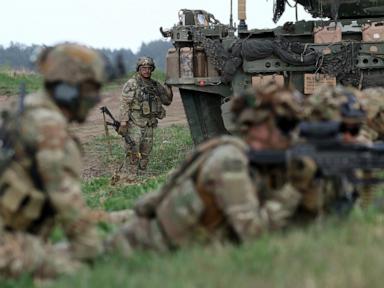
The Pentagon has moved with a suddenness that caught even the most seasoned observers off guard. Without the usual fanfare of diplomatic lead-ins or joint press conferences, the United States has begun a sharp reduction of its combat forces stationed in Poland. Thousands of soldiers who were once the primary human tripwire against eastern aggression are packing their gear. The heavy metal—the Abrams tanks and Bradley Fighting Vehicles that crushed the gravel of Polish training grounds—is being loaded onto railcars.
It is a quiet retreat that screams.
Consider a hypothetical sergeant named Miller. For the last six months, Miller hasn't just been a soldier; he has been a neighbor. He ate pierogi in local taverns. He trained Polish recruits on the intricacies of thermal optics. His presence was a physical manifestation of Article 5. To the people living in the shadow of the Suwalki Gap—that narrow strip of land connecting Poland to the Baltic states—Miller was the difference between a restless sleep and a peaceful one. When Miller’s unit leaves, they don't just take their equipment. They take the psychological shield they provided.
The Math of Deterrence
Military strategy is often discussed in the abstract, using terms like "force posture" and "strategic depth." But on the ground, it is simple math. If you remove three thousand soldiers from a frontline, you create a vacuum.
The Pentagon insists this is not a sign of waning commitment. They speak of "rotational shifts" and "optimizing the footprint." They suggest that air power and rapid-deployment capabilities can bridge any gap left by departing ground troops. It sounds logical in a briefing room in Arlington. It sounds much thinner when you are standing in a field in eastern Poland, looking toward a border that has become increasingly volatile.
The timing is what stings. We are witnessing a moment where the geopolitical tectonic plates are grinding against each other with terrifying force. To pull back now feels like stepping away from a door just as someone is trying to kick it in.
There is a specific kind of silence that follows a departing convoy. It’s the sound of a promise being recalculated.
The Invisible Stakes
Why would the United States pull back now? The answers likely lie in the grueling reality of global overstretch. The American military is a finite resource being asked to solve an infinite number of problems. With tensions simmering in the South China Sea and the Middle East demanding constant attention, the "pivot" is no longer a choice—it is a survival tactic for a superpower trying to be everywhere at once.
But the cost of this pivot is paid in trust.
Poland has transformed itself into the center of gravity for NATO's eastern flank. They have spent billions on American hardware. They have opened their homes and their bases. They did this under the assumption that the "permanent" presence discussed in years past was more than a political talking point.
The withdrawal of combat forces suggests that "permanent" is a flexible word in Washington.
Imagine the local shopkeeper in a town like Żagań. For two years, his business thrived on the patronage of American GIs. He bought more stock, hired his nephew, and felt a sense of communal pride. Now, he watches the trucks roll out. His ledger is bleeding, but his sense of security is what has truly taken the hit. This isn't just about the loss of spending power; it is about the feeling of being left alone on the edge of the map.
The Weight of Steel
Steel has a memory. The tracks of a tank leave deep ruts in the soft earth of the Polish plains. Those ruts remain long after the tank is gone, filling with rainwater and reminding everyone who passes what used to be there.
The Pentagon’s decision to cut these forces isn't just a logistical move; it is a communication. It tells the Kremlin that the American appetite for a long-term, high-intensity ground presence in Europe has its limits. It tells the European allies that the era of relying solely on the American infantryman might be drawing to a close.
Consider the ripple effect. If Poland is no longer the fortress it was six months ago, what does that mean for Lithuania? For Estonia? For a continent that had finally started to believe that the ghost of the Cold War had been laid to rest?
The shift toward a "lighter, more mobile" force is a gamble. It assumes that technology can replace boots. It assumes that a missile fired from hundreds of miles away carries the same deterrent weight as a nineteen-year-old from Ohio standing guard at a checkpoint.
History rarely favors the side that assumes.
The Ghost of 1939
In this part of the world, history isn't something you read in a book; it’s something you feel in your bones. The Polish people have a collective memory of being the bargaining chip in the games of great powers. They know what it feels like when the "guarantees" of distant allies begin to fray at the edges.
This sudden drawdown triggers those old, buried anxieties. It brings back the ancestral fear that when the sky turns dark, those who promised to stand with you might find a reason to be elsewhere.
The Pentagon's officials will point to the statistics. They will show charts of increased naval patrols and cyber-defense initiatives. They will argue that the total "combat effectiveness" of the region remains high. But you cannot shake a hand with a cyber-defense initiative. You cannot see the resolve of a naval patrol from a village in the Polish interior.
We are entering a phase of "liquid security," where the presence of the West’s primary protector is fluid, moving where the crisis of the week dictates. This might be efficient, but it is not reassuring.
Efficiency is for warehouses. Deterrence is for people.
The Empty Space
As the last of the heavy equipment is secured onto the transport ships at the port of Gdynia, the landscape of European defense looks fundamentally different. The "Ironclad" commitment has been traded for a more flexible, and perhaps more fragile, arrangement.
The soldiers who remain are looking at the empty bunks in their barracks. They are checking their perimeters and realizing how much more ground they have to cover. They are professional, they are capable, and they are spread thin.
There is a cold wind that blows across the plains of Central Europe this time of year. It whistles through the gaps in the fences and rattles the doors of the now-vacant hangars. It is a lonely sound.
The tanks are gone. The ruts in the mud are beginning to smooth over. The promise is still there, written on paper in high-ceilinged rooms in Brussels and D.C., but the ground itself feels lighter, and the horizon feels much, much closer.
A soldier stands at the edge of the base, watching the tail lights of the final transport disappear into the treeline. He adjusts his rifle, pulls his collar against the chill, and looks out toward the east. The sky is a bruised purple, and for the first time in a long time, the silence is absolute.