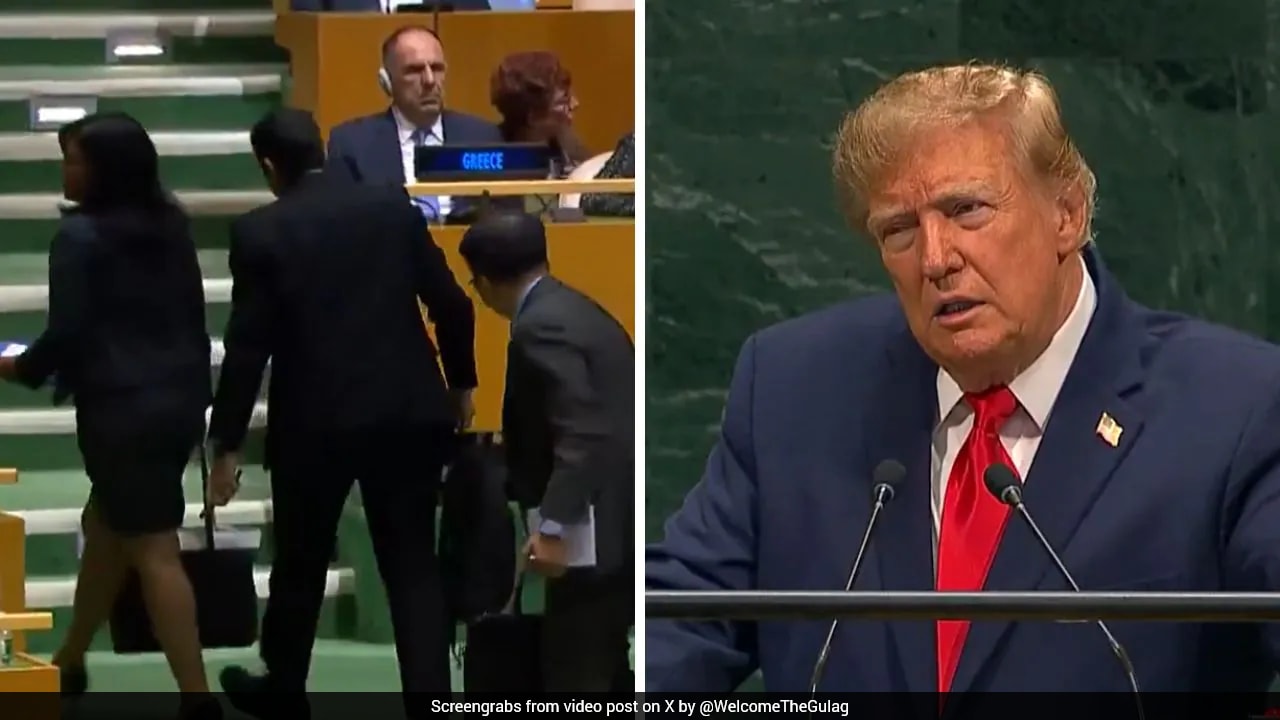
The marble of the General Assembly hall absorbs sound the way an old tomb absorbs grief. It is a vast, domed arena built on the desperate hope that men might learn to speak instead of bleed. On that particular afternoon, the air felt thin, heavy with the stale scent of ambition and procedural translation. Delegates sat in their ergonomic chairs, scrolling through phones or whispering behind leather-bound folders, waiting out the rituals of global diplomacy.
Then the words dropped. Read more on a related topic: this related article.
They did not arrive as a policy paper or a nuanced diplomatic cable. They came blunt, sharp, and stripped of the polite camouflage that nations usually wear in public. The pronouncement was simple: the island nation will fall.
In the Cuban delegation rows, the reaction was not a gasp. It was a collective, mechanical motion. Chairs scraped against the floor. Files snapped shut. Without a word of theatrical protest, the diplomats stood, turned their backs on the podium, and walked out. Their departure was rhythmic, synchronized by decades of institutional muscle memory. They left behind a row of empty leather chairs facing a world that often treats sovereign nations like disposable chess pieces. More reporting by NPR delves into comparable perspectives on this issue.
To understand the weight of that exit, one has to step away from the podium and look at what life actually looks like when a government is told from a global stage that its days are numbered.
Imagine a pharmacy in Miramar, a quiet neighborhood in Havana where the paint peels in pastel flakes under a relentless sun. The shelves hold dust and memories rather than medicine. A pharmacist named Mateo wipes down a glass counter that hasn't seen a full shipment of imported antibiotics in months. He is not a political theorist. He is a man who knows that his mother's heart medication depends on cargo ships that navigate a labyrinth of economic blockades, fuel shortages, and shifting geopolitical winds. When a foreign leader declares from behind a bulletproof glass podium thousands of miles away that his country will fall, Mateo does not hear a rhetorical flourish. He hears a threat to his mother's next prescription.
History is rarely made in grand council chambers; it is endured in kitchens where the gas is turned off early to save the cylinder.
The relationship between Washington and Havana has never been a simple disagreement between neighboring states. It is a generational grudge match, scarred by the Bay of Pigs, the Cuban Missile Crisis, and an economic embargo that has outlived multiple American presidencies and several iterations of the global map. It is an ideological feud where both sides are trapped inside scripts written decades ago.
When the rhetoric turns existential, when words cross the line from disagreement into a prediction of collapse, the temperature in the room changes. It ceases to be about trade tariffs or human rights reports. It becomes personal. It becomes about survival.
Consider what happens when a nation is treated as an inevitable casualty of history. The pressure does not crush the apparatus of the state; it compresses the ordinary citizen. Every power outage that plunges a Havana block into darkness for twelve hours, every ration book that shrinks by another ounce of rice, every young doctor or engineer who calculates that their only future lies on a makeshift raft crossing the Florida Straits—these are the invisible shockwaves of words spoken in air-conditioned halls in New York.
The Cuban diplomats who walked out of the General Assembly knew the script well. They have walked out before. They will likely walk out again. Their gesture was not designed to change the mind of the speaker at the podium. It was an assertion of dignity. In the calculus of international relations, where small nations are so often treated as variables in a superpower equation, dignity is sometimes the only currency left to spend.
There is a strange theater to the United Nations. It is a place where empires and micro-states occupy the same floor space, pretending for a few hours that equality is an operational reality rather than a diplomatic fiction. When a superpower pronounces a death sentence upon a smaller neighbor, it shatters that fragile illusion. It reminds everyone in the room that the law of the jungle still lurks just beneath the polished veneer of international law.
Yet, predictability is the truest signature of modern politics. We have rehearsed these grievances so many times that the actors know their lines even in their sleep. The American official delivers the warning, framed as an inevitability of economic gravity and political failure. The Cuban delegation performs the silent exodus, embodying the defiance of a small island that has stubbornly refused to vanish despite six decades of economic strangulation.
Meanwhile, back in Havana, the sun sets over the Malecón, painting the concrete seawall in shades of bruised purple and gold. Waves crash against the stone, throwing up plumes of salt spray that mist the windshields of 1950s Chevrolets sputtering along the avenue.
A young man sits on the seawall strumming an acoustic guitar with two rusted strings. He isn't watching the news broadcasts from New York. He is worrying about where he will find enough gasoline tomorrow to get to his job at the state-run bakery, and whether his cousin in Hialeah managed to wire enough money through the underground remittance networks to help pay for his grandmother's surgery.
The speeches at the UN echo into the ether, parsed by analysts, spun by pundits, and filed away into the archives of ongoing hostility. But the people on the island remain, caught between the gravity of a superpower's ambition and the stubborn resilience of their own daily routines. They do not live in a geopolitical abstraction. They live in the quiet spaces between the pronouncements, holding their breath, waiting to see what breaks next.