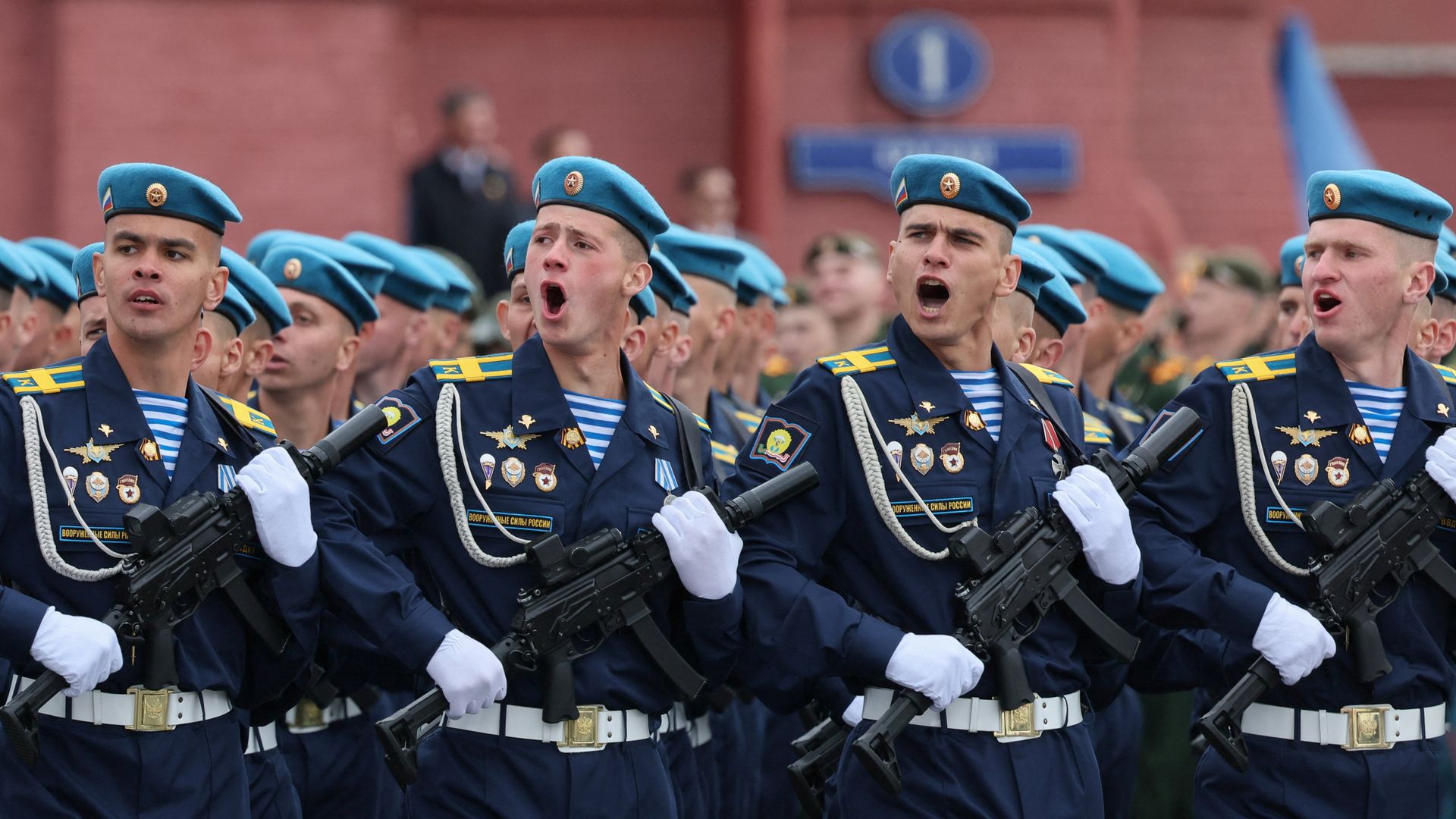
The sight of a solitary, 80-year-old T-34 tank rattling across the cobbles of Red Square was not just a historical nod. It was a loud, unintentional admission of a logistical nightmare. For decades, the Victory Day parade served as the Kremlin’s premier marketing event, a high-octane display of "invincible" hardware designed to keep NATO planners awake at night. But the most recent iterations have stripped away the veneer. When the smoke cleared, it became obvious that the Russian military-industrial complex is no longer capable of maintaining the optics of a superpower while simultaneously feeding a high-intensity war of attrition.
This isn't just about a lack of tanks for a photo op. It is about a fundamental breakdown in the cycle of production, preservation, and prestige. The scaled-back nature of these displays reveals that Vladimir Putin has reached a point where he can no longer afford to lie with steel. Every vehicle kept in Moscow for a parade is a vehicle not being used to plug a gap in the Donbas or defend a supply line in Crimea. The Kremlin has traded its long-term image for immediate survival, and the cracks are showing in the most public way possible.
The Myth of the Infinite Inventory
Western intelligence spent years cataloging the thousands of armored vehicles Russia supposedly held in deep storage. On paper, the numbers were staggering. In reality, the "steel mountains" of the Urals have turned out to be a graveyard of rusted hulls and stripped electronics. As the war in Ukraine dragged into its third year, the Russian Ministry of Defense faced a brutal choice. They could either refurbish modern platforms for the cameras or salvage whatever could still move to replace the staggering losses on the front lines.
They chose the latter. The disappearance of the T-14 Armata—the much-hyped "next-generation" tank—from recent parades is particularly telling. After years of being touted as the future of armored warfare, the Armata has essentially become a ghost. Its absence suggests that the platform is either fundamentally flawed or so prohibitively expensive that the factory lines have stalled. You cannot parade a revolution that doesn't actually work.
Instead of a display of strength, the world witnessed a desperate prioritization. The heavy armor that usually anchors these events is currently being incinerated in the fields of eastern Ukraine at a rate that far outstrips Russia's ability to manufacture new units. By parading vintage equipment, the Kremlin is inadvertently signaling that its "modern" reserve is dangerously thin.
Behind the Scenes of a Logistics Crisis
Maintaining a world-class military requires a constant influx of high-end components, many of which Russia historically imported. Sanctions have not stopped the Russian economy, but they have choked the precision engineering sector. To keep the war machine grinding, Moscow has been forced to cannibalize civilian technology and rely on gray-market microchips.
The Microchip Bottleneck
Modern warfare is defined by optics and guidance systems. Russia’s inability to mass-produce domestic high-end semiconductors means that even their "new" equipment is often a patchwork of older tech and smuggled components.
- Targeting Systems: Rely on Western-origin sensors that are increasingly difficult to procure in bulk.
- Precision Munitions: Stockpiles are being depleted faster than they can be replenished, leading to a reliance on "dumb" bombs and North Korean shells of questionable quality.
- Electronic Warfare: While still a Russian strength, the equipment is bulky and difficult to replace once destroyed on the battlefield.
When you see a parade lacking modern air defense systems like the S-400 in their usual numbers, it’s not because they aren't needed for show. It’s because those systems are being frantically repositioned to protect refineries and command centers from drone strikes. The "impenetrable" shield has holes, and the Kremlin is using every available asset to patch them.
The Psychological Toll of a Quiet Square
Dictatorships rely on the illusion of inevitability. The Victory Day parade is traditionally a tool of internal cohesion, a way to remind the Russian populace that they are part of a global titan. When that display is reduced to a handful of armored cars and a single museum piece, the message to the domestic audience shifts from "We are invincible" to "We are stretched thin."
The silence where the roar of heavy treads should be is a psychological blow that no amount of state media spin can fully mask. It forces the Russian public to confront the cost of the "Special Military Objective" in a way that casualty lists—which are suppressed—cannot. The absence of the hardware is a physical manifestation of the war’s drain on the nation’s wealth and future.
Strategic Distrust Among Allies
It isn't just the Russian public watching. Central Asian leaders and other traditional partners see the diminished spectacle and recalculate their own security dependencies. If Russia cannot spare more than one tank for its most important national holiday, how can it be expected to honor security guarantees in the Caucasus or the Steppe? The "security umbrella" that Moscow once extended over its neighbors is looking increasingly tattered.
The Production Gap Reality Check
Russia has moved to a "war footing" economy, with factories running triple shifts. However, raw output doesn't equal modern capability. There is a massive difference between welding cages onto 1960s-era T-62s and producing a modern T-90M.
Recent data suggests that while Russia can produce or refurbish roughly 100 to 150 tanks a month, their loss rate frequently meets or exceeds that number during offensive pushes. This creates a "zombie" military—one that can replace its numbers but only by lowering the overall quality of its force. A parade is meant to show off the peak of your capability. When the peak is missing, it’s because the foundation is crumbling.
The Tactical Shift to Obscurity
We are seeing a shift in how the Kremlin manages its image. In previous years, transparency (at least of the theatrical kind) was a weapon. Now, secrecy is a shield. By scaling down public displays, they hope to hide the true extent of their equipment shortages. If they don't show the tanks, they don't have to explain where they went.
This tactical retreat from the public eye extends to the cancellation of the "Immortal Regiment" marches in many cities. Nominally cancelled for "security reasons," many analysts believe the real fear was that the crowds would bring portraits of those killed in Ukraine, turning a state-sponsored celebration into a massive, uncontrolled funeral procession.
The Kremlin is trapped in a loop. To win in Ukraine, they must spend their prestige. To maintain their prestige, they must win in Ukraine. Currently, they are doing neither with any degree of efficiency. The empty spaces on the Moscow asphalt are the most honest thing to come out of the Russian government in years.
Every engine that didn't start and every missile battery that stayed at the front is a data point in a larger trend of decline. The era of the Russian military as a peer-competitor to a unified West is being buried in the mud of the Donbas, one tank at a time. The glory has been replaced by a grim, utilitarian struggle to keep the wheels from falling off entirely.
The solitary T-34 wasn't a guest of honor; it was a placeholder for a future that is no longer arriving.