The bricks at the corner of Sixth and Market Streets in Philadelphia do not look like a battleground. By day, they are just part of the urban background, a place where tourists buy soft pretzels and school groups chatter on their way to see the Liberty Bell. But if you stood there in the quiet hours just before dawn on a recent Wednesday, you would have heard a sound that had nothing to do with historic preservation.
The sharp scrape of metal. The heavy sigh of screws being forced from their anchors.
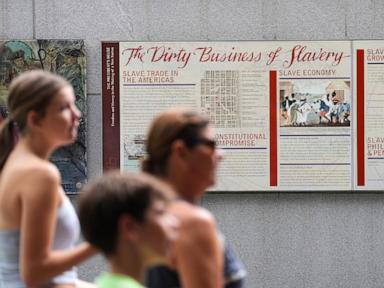
Under the cover of darkness, workers dispatched by the federal government dismantled a decade and a half of public memory. They unbolted heavy, weather-worn panels that had stood since 2010—panels that dared to tell a complicated story about the very ground beneath their boots.
This was the President's House Site, the open-air memorial marking the spot where George Washington lived during his presidency. More importantly, it was the place where he held nine human beings in bondage.
By morning, the old panels were gone. In their place stood a sanitized replacement, approved by a federal appeals court and installed by an administration determined to reshape how America remembers its past.
A plaque once titled "The Dirty Business of Slavery" had vanished. It was replaced by a sign reading: "Celebrating Independence Throughout the Years".
History, it turns out, can be undone with a socket wrench.
The Ghosts in the Grand House
To understand why a few pieces of printed plastic and metal matter so much, you have to look past the grand mythology of the presidency and look at the physical reality of the house that once stood here.
Imagine a cold November morning in 1790. George Washington is stepping out of a carriage, his mind heavy with the fragile state of a young republic. Behind him, carrying his trunks, are people who are legally his property.
Among them is Oney Judge, a young woman gifted with extraordinary skill at needlework, whose hands drape Martha Washington in the finest silks of the era. There is Hercules, the celebrated chef whose culinary masterpieces delight foreign dignitaries, yet who remains enslaved.
The paradox of America was lived in every square inch of this household.
Pennsylvania had passed a law stating that any enslaved person brought into the state by an out-of-state owner would automatically become free after six months of continuous residence. Washington knew this. To bypass the law, he systematically rotated Oney, Hercules, and the others back to his Virginia estate, Mount Vernon, just before their six-month clock ran out, resetting the timer on their captivity.
It was a calculated, legalistic maneuver.
For fifteen years, the original memorial at Sixth and Market forced visitors to sit with this discomfort. It didn't ask you to hate George Washington; it asked you to see him clearly. It placed the names of the enslaved—Austin, Paris, Hercules, Christopher Sheels, Richmond, Giles, Oney Judge, Moll, and Joe—on the same level as the man who held their deeds.
Now, the narrative has shifted.
The new panels installed by the National Park Service still mention the nine enslaved individuals, but the focus has drifted. The text now heavily emphasizes Washington’s private "discomfort" with slavery and his signing of measures like the Northwest Ordinance, which restricted its expansion.
Consider the emotional gymnastics required to read that. We are asked to comfort ourselves with a powerful man’s private moral qualms, even as he actively rotated human beings across state lines to prevent their emancipation.
The Battle for the Narrative
This overnight swap was not an isolated bureaucratic hiccup. It is the direct result of a federal directive aimed at purging "divisive narratives" from national parks and historic sites. The goal, explicitly stated, is to focus on the "greatness of the achievements and progress of the American people".
But whose progress? And at what cost?
When we edit the ugly parts of our history, we aren't just protecting the feelings of the dead. We are robbing the living of the context they need to understand the present.
Michael Coard, a Philadelphia attorney and activist who spent years fighting to get the original memorial built, watched the replacement with a mixture of grief and anger. To him, and to many in the local community, the sudden nighttime installation felt like a confession.
"That it did so at night shows it understands this action is shameful," noted Philadelphia Mayor Cherelle L. Parker in a searing statement.
The federal government defends the changes, arguing the new displays offer a "broader context" and highlight the "momentous events" of the early presidency. They argue it is a step toward a "more perfect union".
But a union cannot become more perfect by pretending it started without flaws.
The Power of What We Choose to See
History is not a collection of static facts carved in stone. It is an active, ongoing conversation between the past and the present. When we walk through a historic site, we are looking for clues about who we are and who we are allowed to be.
For a young Black child visiting Independence Mall, the original President's House monument was a rare, vital mirror. It said: Your ancestors were here. They were not just footnotes in the margins of great white men's biographies. They built this city. They fought for their own freedom in the shadow of the Liberty Bell.
To soften that story is to dim that mirror.
Oney Judge eventually escaped. She slipped out of the President's House while the family was eating dinner, boarded a ship to New Hampshire, and never looked back, despite Washington sending agents to hunt her down. Her escape was an act of supreme patriotism—a literal demand for the liberty the nation’s founders wrote about so eloquently.
Her story is not a disparagement of America. It is the very definition of the American spirit.
As the sun rose over Philadelphia the morning after the swap, the city awoke to a different landscape. The physical structure of the monument remains, but its soul has been quietly recalibrated. The names of the nine are still there, etched in stone, but the words surrounding them have been tamed.
We are left to walk past the glass vitrines, looking down at the exposed brick foundations of a house that no longer stands, wondering if we have the courage to remember the people who were kept in its basement.