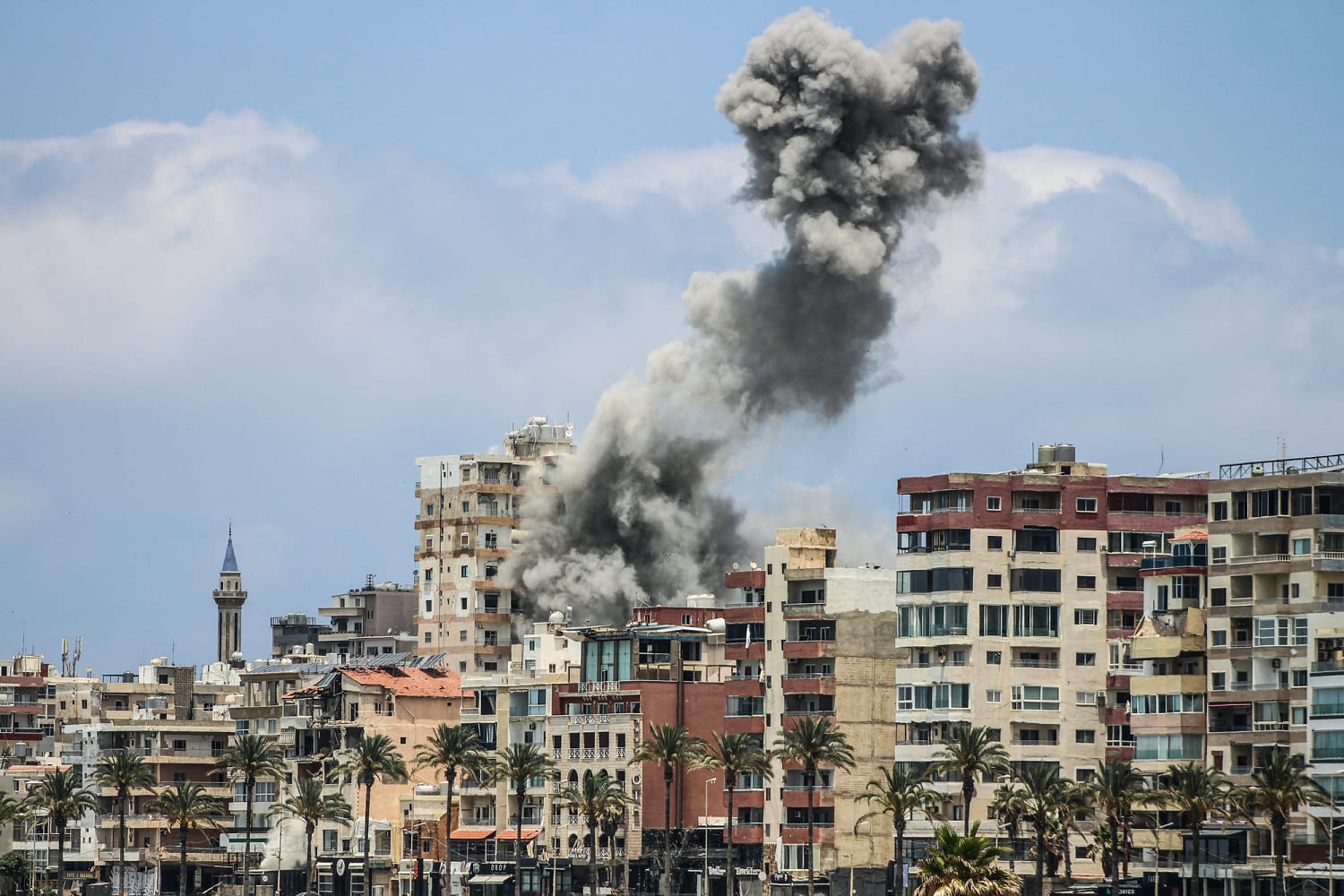
The Israeli military’s sweeping evacuation mandate for Tyre, including its historic Christian Quarter, marks a grim new chapter for one of humanity’s oldest continuously inhabited cities. Within hours of the announcement, a mass exodus drained the Lebanese port city of its remaining life. This is not merely a tactical maneuver in an ongoing border war; it is a profound historical rupture. By forcing the total abandonment of a UNESCO World Heritage site, modern warfare is achieving through bureaucracy and airpower what ancient empires took months of bloody siege to accomplish.
The immediate justification from the Israel Defense Forces (IDF) follows a familiar script. The military alleges that Hezbollah operatives have compromised the urban fabric of Tyre, utilizing its dense neighborhoods to station assets and launch operations. To minimize civilian casualties, the army issues digital maps and Arabic-language warnings via social media, instructing everyone to flee north of the Zahrani River.
On paper, this is presented as a humane application of precise, rule-bound conflict. In reality, it represents a systematic uprooting of a civilian population and the abandonment of irreplaceable human heritage to the whims of heavy artillery and airstrikes.
The Myth of Surgical Conflict
Modern military doctrine heavily emphasizes precision. We are told that smart bombs, real-time drone surveillance, and targeted warnings separate civilian populations from combatants. Tyre proves that this distinction is breaking down. When an entire city is ordered to empty out instantly, the concept of "proportionality" becomes an abstraction.
The targeted inclusion of the Christian Quarter in the latest evacuation orders underscores how deeply the conflict has permeated parts of the city previously considered relative safe havens. For months, displaced people from surrounding border villages had sought refuge in Tyre’s historic churches and old stone alleys, believing the city's profound historical and diverse religious footprint would offer an invisible shield. That shield has shattered.
The economic and psychological toll of these orders is absolute. A city does not simply pause when it is emptied; its social fabric unravels. Businesses close, hospitals operate on skeletal crews, and the elderly or infirm are left with an agonizing choice between a perilous flight to nowhere or staying behind in a designated free-fire zone. The international market reacts with cold indifference—the US Dollar Index and oil prices barely register a tremor—but on the ground, the cost is measured in absolute displacement.
The Palimpsest of Siege Warfare
Tyre is no stranger to existential threats. Its history is a literal palimpsest of human civilization, built layer upon layer by the Phoenicians, Persians, Greeks, Romans, Byzantines, Crusaders, and Ottomans. To understand why Tyre matters is to understand how its geography has dictated its bloody relationship with empires for millennia.
In 332 BC, Tyre was a formidable island fortress located roughly a kilometer off the coast, boasting massive walls that rose 150 feet above the Mediterranean. It possessed two natural harbors and a navy that dominated the regional trade networks. When Alexander the Great marched through Phoenicia, he demanded to offer a sacrifice at the Temple of Melqart—the Tyrian equivalent of Heracles. Recognizing this as a Trojan horse intended to compromise their independence, the Tyrians refused, suggesting instead that Alexander sacrifice at the old ruins on the mainland.
Alexander’s response was an extraordinary feat of engineering and sheer military willpower:
- The Construction of the Mole: Alexander ordered his army to tear down the buildings of old mainland Tyre and use the stone, timber, and rubble to construct a massive causeway—a mole—through the 18-foot-deep water toward the island's walls.
- The Tyrian Counteroffensive: The besieged Tyrians fought back with terrifying ingenuity. They deployed fire ships to destroy Alexander's initial siege towers and poured cauldrons of red-hot sand over the walls. The wind-blown sand penetrated the Macedonian armor, burning flesh to the bone and forcing men to strip off their protection mid-battle.
- The Naval Blockade: Realizing he could not breach the city without naval superiority, Alexander gathered more than 220 ships from Cyprus, Sidon, and Rhodes to completely blockade Tyre's twin harbors, cutting off their supply lines from Carthage.
When the walls were finally breached after a brutal seven-month siege, Alexander’s patience had evaporated. His troops slaughtered 8,000 Tyrians, crucified 2,000 along the beaches, and sold 30,000 survivors into slavery. Yet, ironically, Alexander’s destructive rage permanently altered the geography of the Levant. The silt that collected around his siege causeway over the centuries transformed Tyre from an impregnable island into a permanent peninsula.
Centuries later, the Crusaders recognized the same strategic value. They spent months blockading the peninsular city before it surrendered to Christian forces in 1124. For more than a century and a half, Tyre served as a crucial economic hub for the Kingdom of Jerusalem, defended by massive fortified walls until the Mamluks razed its defenses to the ground in 1291.
The Invisible Destruction of Heritage
The tragedy of the 21st-century conflict is that destruction no longer requires a seven-month engineering project or a wooden siege tower. It requires the push of a button from a control room miles away. While the human toll is the most immediate crisis, the long-term erasure of cultural heritage is an quiet catastrophe.
Tyre holds an Outstanding Universal Value designated by UNESCO. It is the birthplace of the purple dye that clothed ancient royalty, the cradle of the Phoenician maritime empire, and the culture that exported the alphabet to Greece. Beneath its current streets lie unexcavated Roman hippodromes, Crusader foundations, and submerged Phoenician harbors that have barely been touched by modern archaeology.
+------------------+------------------------------------+-----------------------------------+
| Historical Era   | Nature of the Conflict             | Long-term Geographic Impact       |
+------------------+------------------------------------+-----------------------------------+
| 332 BC           | Alexander the Great's 7-month      | Permanently turned the island     |
|                  | amphibious siege and engineering   | into a peninsula via the mole     |
+------------------+------------------------------------+-----------------------------------+
| 1124 AD          | Crusader naval and land blockade   | Reinforced urban fortifications   |
|                  | against the Fatimid Caliphate      | and trade infrastructure          |
+------------------+------------------------------------+-----------------------------------+
| Modern Era       | Digital evacuation mandates and    | Depopulation, urban ruin, and     |
|                  | standoff aerial bombardment        | suspension of heritage preservation|
+------------------+------------------------------------+-----------------------------------+
|                  |                                    |                                   |
+------------------+------------------------------------+-----------------------------------+
When a city is evacuated, the archaeologists flee, the preservation projects halt, and the historic structures are exposed to the concussive shocks of nearby detonations. The nearby 12th-century Crusader citadel of Chamaa has already suffered severe damage in this campaign, demonstrating that international heritage conventions offer little protection when a landscape becomes a combat zone.
The Illusion of Choice
We must confront the harsh reality of what an "evacuation order" actually means in modern asymmetric warfare. It is often framed by state militaries as a legal defense against accusations of war crimes—a way to shift the moral burden of civilian casualties onto the civilians themselves for failing to leave.
But where do tens of thousands of people go when an entire region is under fire? The roads heading north are choked, fuel is scarce, and Lebanon’s infrastructure is already buckled under years of economic collapse. The evacuation order transforms a living, breathing historical treasure into a desolate grid map of targets. It reduces a monument of human endurance into a generic theater of war.
Alexander the Great built a physical bridge of stone and dirt to conquer Tyre. Modern military strategy achieves the same isolation through digital decrees and airborne devastation, leaving a historic city hollowed out, its residents scattered, and its ancient stones waiting in silence for the next wave of explosions.
The Fall of Tyre provides a detailed historical breakdown of the strategies and brutal mechanics used during the ancient siege of this coastal fortress.


