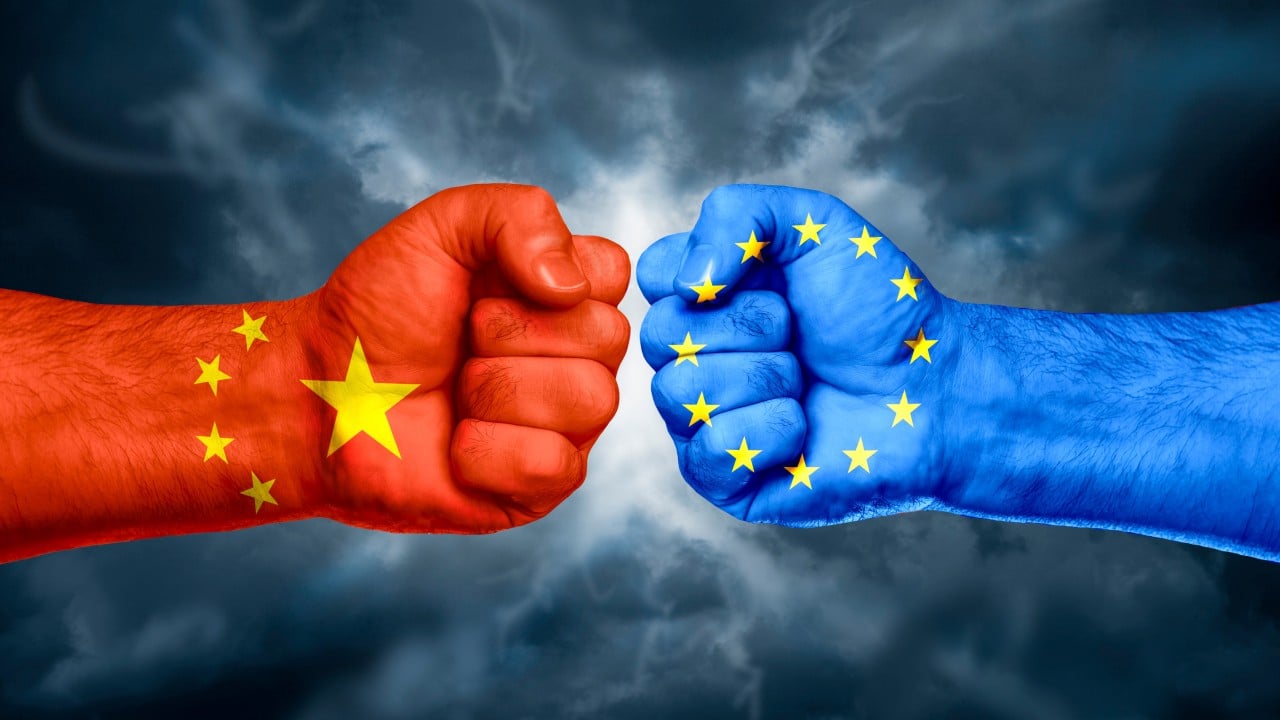
Brussels is asking the wrong question, and policy commentators are parroting it like gospel.
"Can Europe win a trade war with China?"
The moment you frame the debate around tariffs, defensive levies, and retaliatory duties, you have already lost. The consensus among European policy circles—that victory means carving out temporary market protection for legacy manufacturers while "de-risking" supply lines—is an illusion built on mid-20th-century economic mechanics.
China is not playing a standard tariff game. It is deploying a deeply integrated state-capital system designed to absorb foreign profit margins and export overcapacity directly into Europe’s heavily regulated markets. Meanwhile, European leaders act as if slapping a 20% or 38% tax on imported electric vehicles will force Beijing to bow, rebalance its domestic economy, or play fair.
It will do none of these things.
Instead, European tariffs operate as a self-imposed tax on green transition targets and a dynamic protection scheme for uncompetitive corporate boardrooms. I have sat in policy meetings where executives from legacy automotive giants celebrated defensive tariffs as strategic triumphs. Within three years, those exact companies were forced to slash guidance because they spent their capital reserves lobbying for trade protection rather than refactoring their cost structures.
If Europe wants to survive this geopolitical shift, it must abandon the fantasy of "winning" a trade war and start treating its own industrial policy like an emergency restructuring.
The Tariff Trap: Taxing Your Way to Technological Obsolescence
The standard playbook says that when a foreign power heavily subsidizes a domestic sector, you impose countervailing duties. This logic works when you are dealing with minor trade imbalances or localized dumping. It completely breaks down when the competitor controls the entire raw-material-to-finished-product stack.
Take the electric vehicle sector. European regulators spent decades enforcing complex emissions standards that pushed carmakers toward incremental tweaks rather than foundational innovation. China, operating under a multi-decade industrial plan, seized control of critical battery chemistry, lithium processing, and scale manufacturing.
When Brussels responds with tariffs on Chinese EVs, who actually pays?
- The European Consumer: Forces citizens to pay higher prices for entry-level clean mobility during an ongoing cost-of-living crisis.
- European Auto Manufacturers: Exposes European brands to immediate, targeted retaliation in China—a market where German luxury brands still derive a massive chunk of their operating profit.
- The Energy Transition: Delays decarbonization timelines by artificially restricting supply while European battery plants struggle to match Chinese yield rates.
Tariffs do not buy time for legacy industries to catch up; they buy time for legacy management teams to collect bonuses while delaying structural reform. Protectionism creates a false sense of security. It tells domestic firms that they do not need to cut structural bloat, fix software deficits, or re-engineer their supply pipelines.
You cannot protect your way to technical superiority.
The De-Risking Illusion
"We are not decoupling; we are de-risking."
This linguistic hedge has become the favorite slogan of European diplomats. It sounds sensible, prudent, and measured. In practice, it is an expensive posture that creates the illusion of independence while multiplying operational costs across the continent.
True independence requires substitute capacity. If Europe wants to de-risk from Chinese battery cells, solar components, or refined rare earths, it needs to build domestic alternatives that can compete on unit economics—not just under heavy government subsidy.
What happens when you subsidize capacity without fixing the underlying cost inputs? You create zombie gigafactories.
Europe’s energy costs remain astronomically higher than those in East Asia or North America. Permitting timelines for raw material extraction across Western Europe are measured in decades, not months. High labor costs, rigid employment markets, and sprawling compliance frameworks mean that a battery cell produced in Northern Europe starts with a multi-hundred-percent cost penalty relative to one produced in Asia.
A Quick Economic Check: If energy costs twice as much, raw materials take five times longer to permit, and labor operates under rigid output restrictions, no amount of targeted subsidy will yield a market-clearing price. You are merely building industrial museums funded by national debt.
Attempting to "de-risk" without addressing fundamental energy pricing, regulatory friction, and raw material access is not strategic autonomy—it is fiscal theater.
China's Overcapacity Is a Structural Reality, Not a Temporary Tactic
The Western commentary class frequently treats Chinese overcapacity as an aggressive short-term maneuver designed to crush foreign competitors. This misdiagnoses the structural reality of China’s internal political economy.
China's domestic consumption remains depressed due to long-term real estate sector balance sheet contractions, structural savings patterns, and deliberate state resource allocation toward manufacturing rather than household stimulus. Beijing does not export industrial overcapacity merely to dominate Europe; it exports overcapacity because its domestic system cannot absorb what its factories produce, and its political structure refuses to pivot toward a Western-style consumer economy.
This structural reality changes the dynamic entirely:
- China Cannot Stop Exporting: Beijing cannot simply shut off industrial output without triggering catastrophic domestic employment shocks.
- Diversion to Secondary Markets: If Western markets slam the door, Chinese goods flow through third-party hubs—Southeast Asia, Mexico, South America—before entering Western value chains under modified rules-of-origin tags.
- Price Inelasticity: Chinese manufacturers, backed by state banking systems that prioritize capital deployment over quarterly return-on-equity, will cut prices until margins turn negative, outlasting private Western firms that operate under public market capital constraints.
When you fight an opponent who measures success through long-term industrial output and employment stability against your system that measures success through quarterly earnings and shareholder returns, a traditional tariff war is a mathematical mismatch.
Dismantling the "Winning" Question
People also ask: How can Europe protect its manufacturing base while maintaining strong trade ties with China?
The answer is brutal: It cannot.
The premise itself is broken. Europe cannot preserve its mid-tier manufacturing cost structures while simultaneously attempting to isolate China through trade barriers without causing severe domestic inflation and destroying its export competitiveness globally.
Trade policy is not an academic debate over fairness; it is a cold calculus of relative advantage.
When Europe attempts to shield its legacy industries, it starves its emerging industries of capital. Every euro spent subsidizing high-cost legacy manufacturing is a euro not deployed toward next-generation software, AI-driven automation, advanced grid infrastructure, or nuclear energy deployment.
Europe is trying to preserve its 20th-century industrial peak rather than funding its 21st-century survival.
| Strategy | Traditional European View | The Market Reality |
|---|---|---|
| Tariffs on EVs | Shields domestic automakers from unfair state subsidies. | Increases consumer costs, delays EV adoption, and invites targeted retaliation against high-margin European exports. |
| Industrial Subsidies | Creates domestic green champions through public grants. | Funds high-cost, inefficient manufacturing that cannot survive without continuous state capital infusions. |
| De-Risking | Secures critical supply chains by diversifying input sources. | Adds layers of supply chain complexity and cost without securing genuine raw material independence. |
| Regulatory Standards | Uses market size to force global alignment with European rules. | Drives capital away to lower-compliance jurisdictions with cheaper energy and faster scaling speed. |
The Only Path Forward: A Cold-Blooded Realignment
If Europe wants to avoid becoming an economic museum squeezed between American tech hegemony and Chinese industrial scale, it must stop fighting a trade war it is structurally ill-equipped to win.
Instead, European leadership needs to execute three painful, non-negotiable moves:
1. Kill the Industrial Zombies
Stop using public funds to keep uncompetitive legacy manufacturers alive. If a company requires perpetual tariffs and direct capital injection to survive against foreign competitors, let it restructure or fail. Free up that talent, physical capital, and land for high-efficiency sectors that do not require state armor to exist.
2. Slash the Energy and Regulatory Penalty
You cannot build an industrial base on high energy prices and hyper-regulation. Europe must aggressively expand nuclear energy capacity, deregsulate permitting processes for domestic mining and refining, and dismantle bureaucratic red tape that delays greenfield capital projects. Energy cost parity is not a luxury; it is the absolute prerequisite for industrial survival.
3. Deploy Asymmetric Trade Offense
Stop playing defense with passive tariffs. Use trade access as an aggressive bartering tool: Chinese firms seeking access to Europe’s half-billion consumers must execute genuine joint ventures, transfer core technology, and construct fully integrated domestic manufacturing plants within the European Union using local labor and supply chains. If Beijing used this model successfully for thirty years against Western firms, Europe should execute the exact same blueprint today without apology.
Stop Playing Defense
The debate over "winning" a trade war with China is a distraction engineered by politicians unwilling to tell voters the truth.
Europe will not win this war by filing trade disputes in Geneva or slapping incremental taxes on imported cars. It will only survive by fixing its own uncompetitive fundamentals, lowering its energy costs, and accepting that some 20th-century industries are not worth saving.
Stop trying to shield legacy industrial models from reality. Accelerate the restructuring, absorb the short-term pain, and rebuild capital efficiency from the ground up.
Anything else is just decorating a declining balance sheet.


