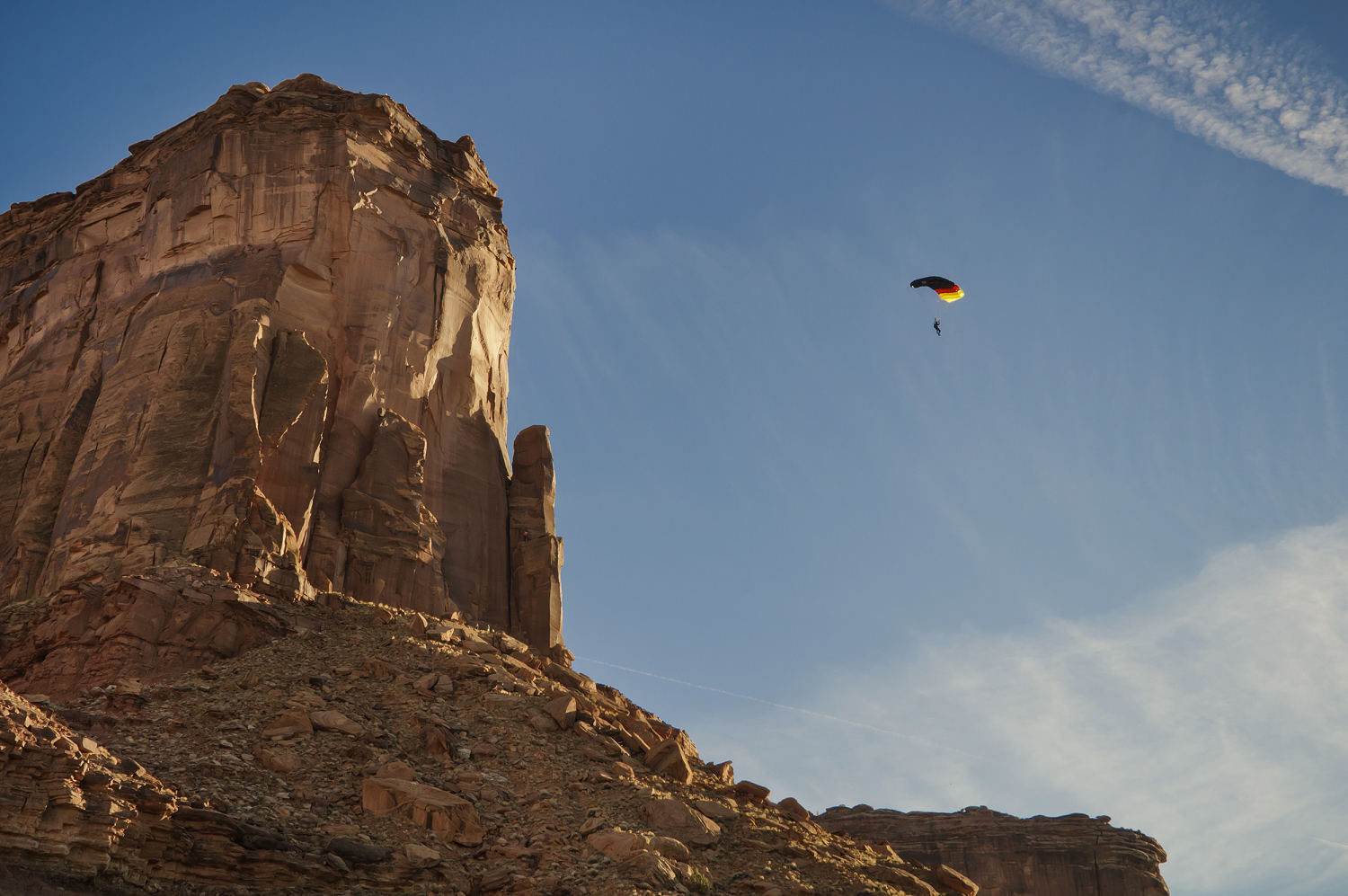
Another headline drops. A jumper plunges seven hundred feet in Utah after a wingsuit failure. The media machine spins its familiar, lazy yarn. They call it a tragic accident. They blame a sudden wind gust, a rogue equipment malfunction, or the inherent madness of adrenaline-addicted daredevils dancing with death. They mourn the loss, nod solemnly at the inherent danger of extreme sports, and sweep the debris under the rug until the next body hits the dirt.
It is all complete nonsense.
I have watched friends burn through their luck, spent decades analyzing flight telemetry, and picked apart the wreckage of fatal incidents that the mainstream press reduces to a tragic sentence on page four. The Utah fatality was not a freak occurrence. It was a mathematical certainty engineered by a community that refuses to look in the mirror. Wingsuit BASE jumping does not suffer from a gear failure crisis. It suffers from a cognitive crisis. The safety protocols, the progression checklists, and the sanitized educational videos taught on dropzones and cliff edges are comforting fairy tales designed to help people sleep at night while walking tightropes over meat-grinders.
Let us tear down the house of cards.
The Myth Of Equipment Reliability
Every time a pilot augers into a talus slope, the post-mortem conversation defaults to the nylon. Was it a line-over? Did the bridle twist? Did the reserve deploy too late? This gear-obsessed diagnostic autopsy is a smokescreen. It shifts the blame from the pilot's brain to the manufacturer's stitching.
Modern wingsuits and container systems are marvels of modern engineering. They are more reliable than they have ever been. Zippers do not just burst spontaneously. Bridles do not misroute themselves. When a wingsuit pilot fails to establish a clean track or flubs a pull sequence at terminal velocity, blaming the equipment is like crashing a Ferrari at one hundred and fifty miles per hour into a brick wall and blaming the brake pads.
The dirty secret of wingsuit flight is that the pilot is the weakest link in a feedback loop moving too fast for human hardware to process. At terminal velocity, you are covering roughly one hundred and eighty feet every single second. At that speed, a hesitation lasting four tenths of a second eats up seventy feet of altitude before your conscious mind even registers that your hands are out of position.
When a pilot punches out of a wall in Utah or the Swiss Alps, they are managing a multi-variable aerodynamic equation where a fraction of a degree in angle of attack separates a high-speed glide from an uncontrollable flat spin. If your deployment mechanics require absolute perfection under crushing physical G-forces and surging adrenaline spikes, your system is already broken. You do not have a safety margin. You have a prayer.
Risk Homeostasis And The Illusion Of Progression
Look at how pilots train. They start with skydiving. They jump out of airplanes with altimeters screaming in their ears, pulling at three thousand feet with acres of open sky and cushiony fabric above them. They log five hundred skydives, buy a beginner wingsuit, and assume they are ready to step off a vertical cliff in Utah or Norway.
This is where the lethal delusion begins.
Skydiving and BASE jumping share a parachute, and that is where the similarity ends. In a skydive, altitude is your savings account. You can make a mistake, spend your balance, and still walk away. In a wingsuit BASE jump, altitude is a credit card with an instant debt collection agency. The moment you step off the exit point, you are immediately in the red.
The progression model used by modern extreme athletes is built on risk homeostasis. This psychological principle dictates that people subconsciously adjust their behavior based on their perception of safety. When you give jumpers better helmets, radio links, laser rangefinders, and high-performance suits with better glide ratios, they do not use those tools to make the sport safer. They use them to jump off bigger walls, fly closer to trees, and shorten their deployment altitudes.
Safety gear does not reduce mortality. It increases exposure to risk.
When a jumper reads about someone surviving a low-pull or clearing a cliff by ten feet, their brain recalibrates the boundary of what is possible. They stop seeing the fatality as a warning and start seeing it as an outlier—something that happened because the victim lacked skill, while they possess superior instincts. This hubris is lethal. It is the exact mindset that puts pilots seven hundred feet deep into a rocky canyon with their deployment handles untouched or half-pulled.
The Aerodynamics Of Denial
Let us talk about glide ratios and angle of attack, terms thrown around dropzones by people who can barely solve a high school algebra problem. A standard wingsuit has a glide ratio of roughly two-and-a-half to one under optimal conditions. That means for every foot you drop vertically, you move forward two-and-a-half feet.
Sounds great on paper. But here is what the brochures omit.
That glide ratio is not a constant. It is a fragile, bleeding asset. The moment you pitch your nose down to gain speed, your sink rate skyrockets. The moment you flare to bleed off energy before deployment, your lift decays instantly, and you drop like an anchor. In complex mountain terrain, wind shear, thermal turbulence, and rotor off cliff faces can slash your lift by fifty percent in the blink of an eye.
Imagine a scenario where a pilot flying a high-performance suit encounters a down-draft while navigating a technical line through a Utah canyon. The mountain breathes downward. The air holding their wings up simply vanishes. In that microsecond, their glide ratio collapses from three-to-one to one-to-one. They are no longer flying an aircraft. They are steering a falling rock.
Most pilots do not understand boundary layer separation. They do not know how to read micro-weather on a rock face. They rely on visual cues, line-of-sight estimations, and pure muscle memory. When terrain rushes up to meet them, they panic-pull. Pulling early ruins forward speed, which destroys lift, which drives them directly into the cliff they were trying to clear. Pulling late turns them into a statistic.
The Utah incident was not a mystery. It was a physics lesson written in blood, executed by a pilot who flew past the envelope of their aerodynamic reality.
Dismantling The Culture Of Silence
The most dangerous part of wingsuit culture is not the rocks, the trees, or the wind. It is the code of silence.
When someone dies, the community locks ranks. Out of respect for the dead and their grieving families, critical accident analysis is replaced by platitudes. "He died doing what he loved." "She was living life on her own terms."
This emotional shielding destroys the sport. It sanitizes incompetence. It prevents the hard, uncomfortable autopsies required to keep the next generation alive. If a commercial airline pilot crashes a Boeing aircraft due to spatial disorientation or poor crew resource management, the black box is analyzed, the NTSB publishes a brutal, unsparing report, and procedures change worldwide.
In BASE jumping, an experienced mentor whispers behind closed doors that the victim made a stupid mistake, while the public-facing narrative portrays it as an unavoidable tragedy of the elements. Beginners never hear the raw, unfiltered truth. They never learn that their hero miscalculated density altitude, flew overweight, or let ego override their altimeter.
Without radical transparency, the sport becomes an echo chamber of survivorship bias. The people still alive assume they are doing it right because they are still breathing, completely ignoring the graveyard of peers who used the exact same techniques.
The Uncomfortable Truth About Risk
If you want to survive wingsuit BASE jumping, you must abandon every comforting illusion the community sells you.
Stop believing that experience makes you immune. Experience only grants you a wider catalog of close calls that you managed to survive through luck disguised as skill. Stop believing that better gear will bail out bad decision-making. Gear does not think for you; it just lets you go faster when you make a bad choice. Stop believing that you can control the mountain. You cannot. The mountain is an indifferent mass of stone and weather that cares nothing for your goals, your family, or your Instagram follower count.
The real answer to the safety crisis in extreme sports is not more regulation, more permits, or more government oversight. Bureaucrats cannot legislate physics. The answer is a ruthless, unsparing culture of self-audit.
You must assume that every jump you survive is a loan shark operation where the interest is compounding daily. You must look at every successful landing not as a validation of your brilliance, but as a lucky evasion of a mistake you didn't realize you made.
Until the community stops glorifying the adrenaline and starts treating flight planning with the cold, sterile rigor of an aerospace engineer, bodies will continue to drop out of the Utah sky.
Put down the camera. Burn the highlight reels. Stop listening to the gurus who preach about pushing boundaries while ignoring the body bags piling up at the base of the cliffs.
The wall does not negotiate. The math does not care about your passion. Respect the margins, or become another headline.