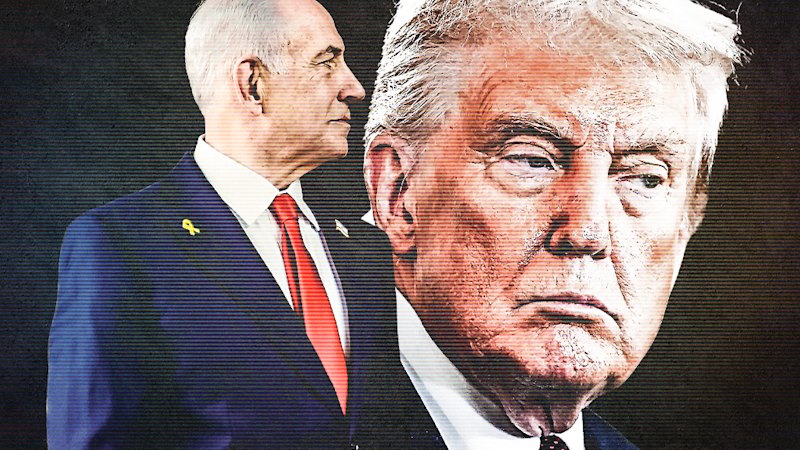
The lazy consensus writes itself. Every time a foreign leader touches down at Joint Base Andrews, the pundits roll out the exact same tired script. They talk about alignment, pressure, ticking clocks, and high-stakes diplomacy. They treat foreign policy like a high school debate club where the loudest voice wins or a chess match played by predictable rules.
It is completely, utterly wrong.
I have spent years watching analysts dissect these summits, treating them as moral dramas or ideological showdowns. They miss the mechanical reality entirely. When Benjamin Netanyahu walks into Washington, nobody is trying to change anyone's mind. Minds were locked into place months ago. What you are actually watching is a masterclass in domestic signaling disguised as international statecraft.
Let us dismantle the core illusion. The mainstream narrative assumes that American presidents hold all the cards because of military aid and diplomatic cover, while visiting leaders are supplicants begging for permission. That power dynamic flipped decades ago.
The Myth of the Great Lever
Every Sunday morning talk show treats foreign assistance as a rigid leash. The premise is simple: Washington holds the purse strings, therefore Washington dictates the terms.
It is a child's understanding of geopolitics.
Look at the mechanics. Foreign aid is not a blank check handed out by benevolent Uncle Sam; it is a closed-loop industrial subsidy. Billions of dollars approved by Congress flow straight back into American defense contractors in Ohio, Texas, and Arizona. It is a domestic jobs program wrapped in an international flag. When a leader arrives in Washington to discuss these packages, they are not asking for a favor. They are coordinating supply chains and domestic political cover for both administrations.
Pretending that an American president can simply snap their fingers and alter decades of integrated strategic doctrine is lazy analysis. It ignores the structural inertia of the Pentagon, the Intelligence Community, and Capitol Hill.
Imagine a scenario where an administration genuinely cuts off the supply lines to force a sudden, radical pivot in foreign strategy. Within forty-eight hours, domestic defense manufacturing lines stall, congressional representatives from manufacturing districts panic over local employment, and the strategic deterrence balance in an entire volatile region collapses. No modern administration wants to own that economic and security fallout, least of all during an election cycle. Both sides know this. The leverage is an illusion both parties find useful to maintain.
The Domestic Audience Trap
The real audience for these Washington summits is never sitting in the Oval Office. It is sitting in living rooms in Tel Aviv, Haifa, Washington, and key swing states across America.
When you see a tense handshake or read leaks about tough conversations behind closed doors, you are watching performance art designed for domestic consumption. Netanyahu needs to look uncompromising to his coalition back home. The White House needs to look like the adult in the room to internationalist voters and party purists.
It is a symbiotic theater of defiance and reassurance.
Analysts who treat these meetings as friction-filled arguments fail to see the coordination. Real friction happens quietly, through backchannels, intelligence-sharing cutoffs, or quiet financial compliance checks. Public theater is loud precisely because it is safe. If two leaders are screaming at each other on the front page of the newspaper, it means the underlying alliance is strong enough to absorb the shockwaves of political posturing.
The Economic Reality No One Mentions
Let us talk about technology and intelligence integration, because this is where the actual relationship lives.
The mainstream media loves to focus on old-school infantry, artillery, and territory. That is nineteenth-century thinking applied to a twenty-first-century theater. The real binding agent between Washington and Jerusalem today is code, cyber defense, and semiconductor supply chains.
I have watched companies blow millions trying to decouple domestic tech sectors from international security partnerships because they bought into political rhetoric. They learned the hard way that intelligence sharing and cyber defense architecture are deeply baked into financial markets. You cannot unring that bell.
When tech sectors merge at the code level, political disagreements at the podium become background noise. Cybersecurity protocols developed in Unit 8200 protect American financial infrastructure just as much as American satellite networks feed targeting data across the Middle East. It is an unseverable knot.
Stop Asking the Wrong Questions
People ask: "How can Washington force a breakthrough?"
That is the wrong question. It assumes Washington wants a breakthrough more than it wants stability, and it assumes Washington has the unilateral power to manufacture one.
The right question is: "How do both leaders manage the status quo without triggering an accidental escalation that breaks domestic political support?"
Once you frame it that way, everything changes. The stalled peace initiatives, the endless joint statements, the choreographed leaks—they all stop looking like failures of diplomacy. They look like successful management of a permanent crisis.
Politicians do not solve intractable structural conflicts; they survive them. And as long as both domestic political survival depends on maintaining this high-stakes dance, the script will never change, no matter who is standing at the podium.