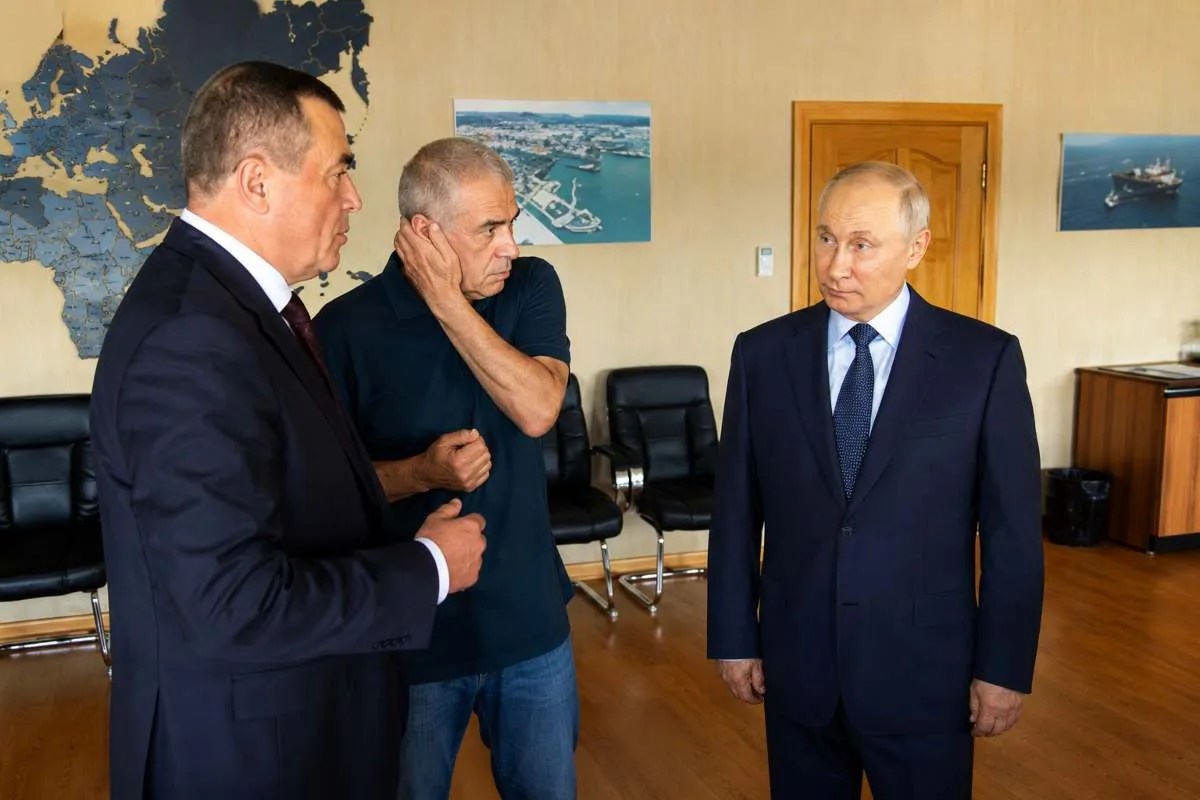
The media wants you to believe that Vladimir Putin’s landing on Iturup is a sudden escalation, a fresh diplomatic crisis, a shocking twist in a frozen frontier. Tokyo hyperventilates about stolen sovereignty. Moscow doubles down on historical inevitability.
It is all theater.
The lazy consensus treats the Kuril Islands dispute as a territorial disagreement waiting for a clever mediator. It is not. Viewing these volcanic rocks through the lens of modern diplomacy or international law is a fundamental category error. The islands are not a negotiation piece. They are an unmovable aircraft carrier and a geopolitical choke point, and pretending they will ever be handed back over a cup of green tea is a delusion perpetuated by politicians who need a domestic punching bag.
Stop buying the narrative that a peace treaty was ever close, or that a sudden shift in Tokyo's mood triggered Moscow's defiance. The map was drawn in blood in 1945, and concrete does not negotiate.
The Geography Dictates the Outcome
Look at a map without political coloring. The Kuril chain separates the Sea of Okhotsk from the open Pacific. For Russia, the Sea of Okhotsk is a vital sanctuary bastion where its strategic nuclear submarine fleet hides from Western detection.
If Moscow hands Iturup and Kunashir back to Japan, foreign anti-submarine warfare assets gain immediate acoustic and visual access to Russia's nuclear backyard. No government in Moscow—tsarist, Soviet, or democratic—would ever accept that strategic vulnerability.
Japan knows this. Washington knows this. Yet Tokyo keeps up the ritualistic protest choreography because domestic political optics demand an annual grievance.
"The islands are a sovereign decision of the Russian leadership and cannot be subject to discussion with foreign states."
That is not just boilerplate Kremlin arrogance; it is a raw assessment of military reality.
The Myth of the Legal Precedent
Let us dispense with the legalistic hand-wringing. Tokyo cites the Treaty of Shimoda and historical maps from the nineteenth century to prove ownership of the Northern Territories.
By that logic, half of Europe and North America should redraw borders based on nineteenth-century treaties. International law regarding territorial changes is written by the victors of total war. The Yalta Conference and the Potsdam agreements handed those islands to the Soviet Union.
Imagine a scenario where a corporation signs away its core assets under bankruptcy, then demands them back eighty years later because management changed. Courts would laugh them out of the room. Yet in geopolitics, analysts pretend that time erases the unconditional surrender of an empire. Japan rolled the dice on a militaristic expansionist campaign, lost the empire, and lost the administrative control of the archipelago.
Treaties signed under the shadow of total defeat carry absolute weight until power dynamics shift fundamentally. And right now, power dynamics are moving in the exact opposite direction.
The Economic Mirage
Every few years, op-eds surface about joint economic development, visa-free travel, and joint ventures on fish-processing or geothermal energy. Analysts foam at the mouth about a breakthrough.
It is an illusion. Moscow invited Japanese investment into the Kurils in the 2010s precisely to anchor Tokyo into a subordinate economic relationship without conceding an inch of sovereignty. Tokyo walked into the trap, tried to negotiate sovereignty through commercial backdoors, and then watched the whole framework collapse the moment global sanctions hit.
Today, fish processing plants on Iturup are integrated into the Russian Far East supply chain. The inhabitants speak Russian, use rubles, and look to Sakhalin, not Hokkaido, for their governance. There is no hidden pro-Japanese sentiment waiting to bloom. There is a hardened, militarized frontier equipped with Bastion coastal defense systems and radar arrays designed to project power across the North Pacific.
The Real Question Nobody Is Asking
Instead of asking when Russia and Japan will sign a peace treaty, ask why anyone still pretends a peace treaty matters.
A piece of paper ending a World War II technicality will not alter the acoustics of the Sea of Okhotsk. It will not alter the strategic alliance between Moscow and Beijing, nor will it erase the deep integration of the Russian Far East into Asian supply chains that bypass Tokyo entirely.
Japan’s current strategy is a dead end. Clinging to the illusion of recovery for territories fortified with advanced missile batteries is strategic self-delusion.
The border is closed. The archipelago is anchored. Deal with the map as it is, not as your textbook wishes it were.