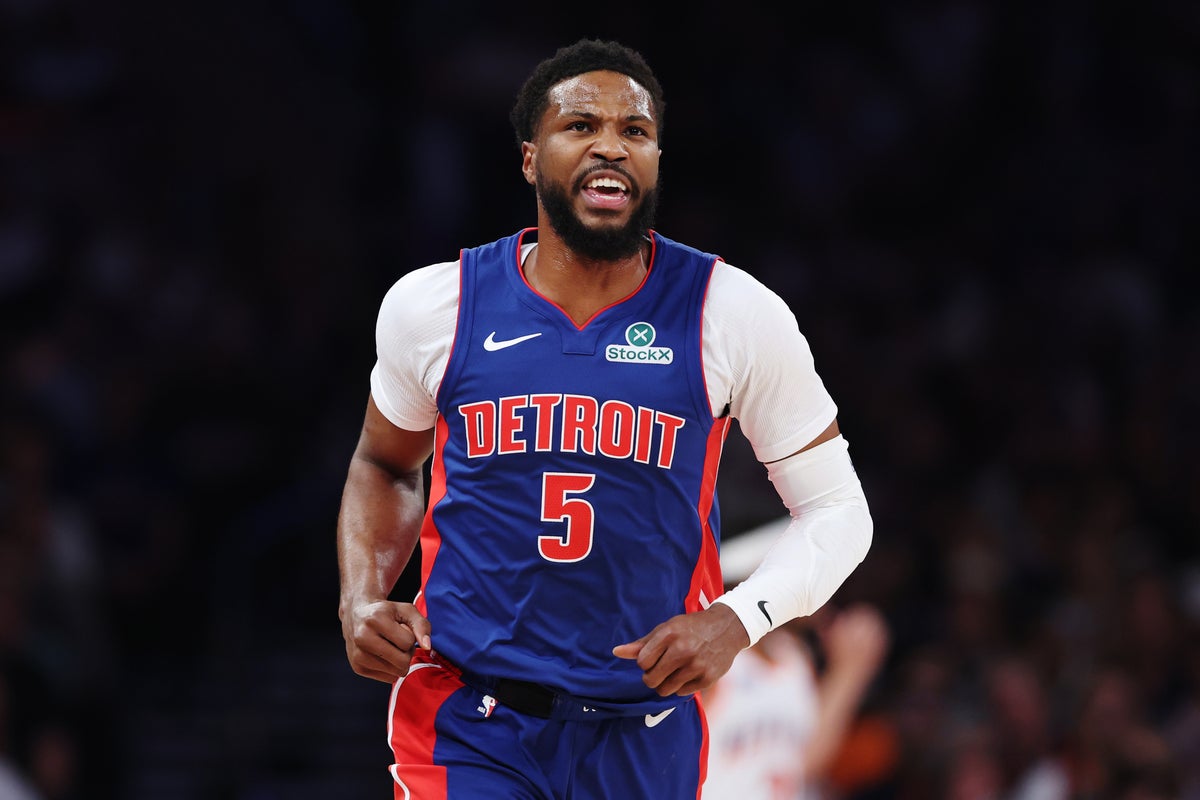
The federal indictment of nine-year NBA veteran Malik Beasley isn't just another headline about a rich athlete making a bad choice. It's a flashing red warning light for the entire ecosystem of professional sports. When news broke that Beasley pleaded not guilty on Wednesday to federal sports bribery, wire fraud, and money laundering charges in a Brooklyn federal court, the immediate reaction online was predictable. Fans cracked jokes about prop bets, while analysts lamented a wasted basketball career.
But if you look closely at the unsealed court documents, you find a story that is far more dark and desperate than a simple case of greed. This situation reveals how professional leagues have opened the door to a system that easily swallows up players who are dealing with serious financial trouble.
Beasley stood in front of U.S. Magistrate Judge Taryn Merkl, flanked by his legal team, and entered a not guilty plea. He walked out on a $100,000 bond package that required his parents to co-sign over the phone. Think about that for a second. This is a guy who has made tens of millions of dollars in his NBA career. Yet, his parents had to jump on a phone line to help secure his release. It tells you everything you need to know about where his money went.
The desperate reality behind the prop bet manipulation
The federal government alleges that Beasley rigged his own games during the 2023-24 NBA season while playing for the Milwaukee Bucks. The details are wild. Prosecutors say he didn't just bet on games. He active tailored his on-court performance to hit specific player proposition lines. He did this to pay off millions of dollars in gambling debts to his former teammate, Ed Davis, who acts as the alleged gatekeeper in this operation.
Look at the specific game on March 10, 2024, against the Los Angeles Clippers. The over-under line for Beasley's rebounds was set at 3.5. With just one second left on the clock and the Bucks holding a comfortable seven-point lead, the game was essentially over. Any casual player would have let the clock run out. Instead, Beasley chased down a meaningless shot and fought past four players to grab the rebound right as the horn sounded.
That single rebound gave him exactly four for the night. The over hit. According to the indictment, a co-conspirator texted afterward, noting that Beasley had a massive sigh of relief once he secured the ball.
In other games, Beasley allegedly did the opposite. He intentionally underperformed to make sure specific under bets cashed. This isn't just a minor rule infraction. It changes how we have to look at every single possession in a professional game. When an athlete cares more about a minor stat line than the natural flow of the game, the sport itself breaks down.
How a multi-millionaire loses control of his finances
People always ask how a professional athlete who signs massive contracts ends up in a position where he is allegedly fixing games for bookies. The answer is usually a slow, quiet bleed of bad decisions and compounding debt. Beasley's financial issues weren't a secret in the basketball world. They were piling up in public court records across multiple states for years.
He had a highly publicized dispute with a landlord in Detroit. He got sued by a barber in Milwaukee and a dentist in Minnesota over unpaid bills. Then came the heavy blow in 2025. While he was in New York for a playoff series with the Detroit Pistons, a local sports marketing agency served him with a lawsuit. Beasley didn't even respond to it, which led to a massive $1 million default judgment against him.
When you owe millions to traditional businesses and legal entities, the pressure is immense. When you owe millions to illegal gambling rings, the pressure becomes dangerous. The feds claim Ed Davis stepped into that exact void. Davis wasn't just a friend; he was a teammate of Beasley's back during the 2020-21 season with the Minnesota Timberwolves.
According to the prosecution, Davis offered to clear or reduce Beasley's gambling debts in exchange for insider information and manufactured performances. It's a classic predatory setup.
The widening circle of the federal investigation
This case goes much deeper than just one player trying to clear his ledger. The indictment names six people in total, and the names involved show how deep the rot goes. Alongside Beasley, a registered National Basketball Players Association agent named Paolo Zamorano was arraigned and also pleaded not guilty.
Think about the implications of an active, certified player agent allegedly placing bets based on rigged insider data. Agents are supposed to protect players. They are supposed to guide their careers and safeguard their wealth. When the people trusted to manage the players are allegedly participating in the betting rings, the system is broken from the inside out.
We already know this is part of a massive, sweeping investigation by the U.S. Attorney's Office for the Eastern District of New York. Back in April, former NBA player Damon Jones pleaded guilty to wire fraud conspiracy charges, admitting he used inside basketball connections to clean up on major sportsbooks like DraftKings and FanDuel.
The federal government is making it clear that they aren't looking at isolated incidents. They are pulling on a thread that connects active players, former veterans, agents, and offshore books. Beasley's case is being handled by U.S. District Judge LaShann DeArcy Hall. Interestingly, she is the same judge handling a separate case involving former Miami Heat guard Terry Rozier under similar sports betting accusations.
Step back and look at the whole picture. You have Beasley indicted. You have Ed Davis indicted. You have Terry Rozier facing charges. You even have an entirely separate federal case involving players rigging mafia-linked poker games, which lists former player and current Portland Trail Blazers coach Chauncey Billups in the court documents. This isn't a few bad apples. It's an entire orchard showing signs of decay.
The hypocritical stance of modern professional sports
You can't talk about Malik Beasley without talking about the environment that allowed this to happen. The NBA, like every other major sports league, has spent the last several years completely embracing sports betting companies. You can't watch a game without seeing betting lines plastered across the screen. Commercials during every timeout tell you how easy it is to place a prop bet from your couch. Leagues are making billions of dollars licensing data and partnering with sportsbooks.
Yet, when a player gets caught up in the exact vice the league promotes every night, the executives act shocked. NBA spokesperson Mike Bass released a standard statement saying the league takes the allegations with the utmost seriousness and that the integrity of the game is the top priority.
That statement feels incredibly hollow when you consider the sheer volume of gambling content pushed onto fans and players daily. Players live in the middle of this culture. They see the point spreads. They hear fans screaming at them from the front row about their prop bets. It creates a blurred line where some players eventually convince themselves that altering a single rebound or sitting out a fourth quarter doesn't really hurt anyone.
Beasley hasn't played in the NBA since his stint with the Detroit Pistons during the 2024-25 season, where he actually played well, averaging 16 points per game. He is historically a phenomenal shooter, holding a spot as one of only five players in NBA history to knock down over 300 three-pointers in a single season.
Because of this lurking federal investigation, he spent the last season completely blackballed from the league, forced to play briefly for a team in Puerto Rico just to get a paycheck. If he gets convicted on these federal charges, he faces up to 20 years in prison for wire fraud and money laundering conspiracy, and another five years for sports bribery. His career at the highest level is done.
What happens next for sports betting enforcement
If you think the feds are stopping with Malik Beasley, you are completely misreading the situation. His defense attorney, Jason Goldman, spoke outside the courthouse and pointed directly at the broader issue, stating that a larger conversation about an industry profiting billions while fueling addiction needs to happen. He is right, even if he's saying it to defend a client.
The immediate step for leagues, teams, and players is to recognize that federal law enforcement is actively monitoring text messages, bank accounts, and betting patterns. They aren't relying on simple red flags from sportsbooks anymore. They are running deep conspiracy investigations using wiretaps and leaked digital messages between players and associates.
If you're an athlete anywhere near this line, you need to cut ties immediately. The era of assuming a prop bet scheme can stay hidden in private text threads is completely over. The feds have proven they can and will pull down anyone involved, regardless of how many three-pointers they've hit.