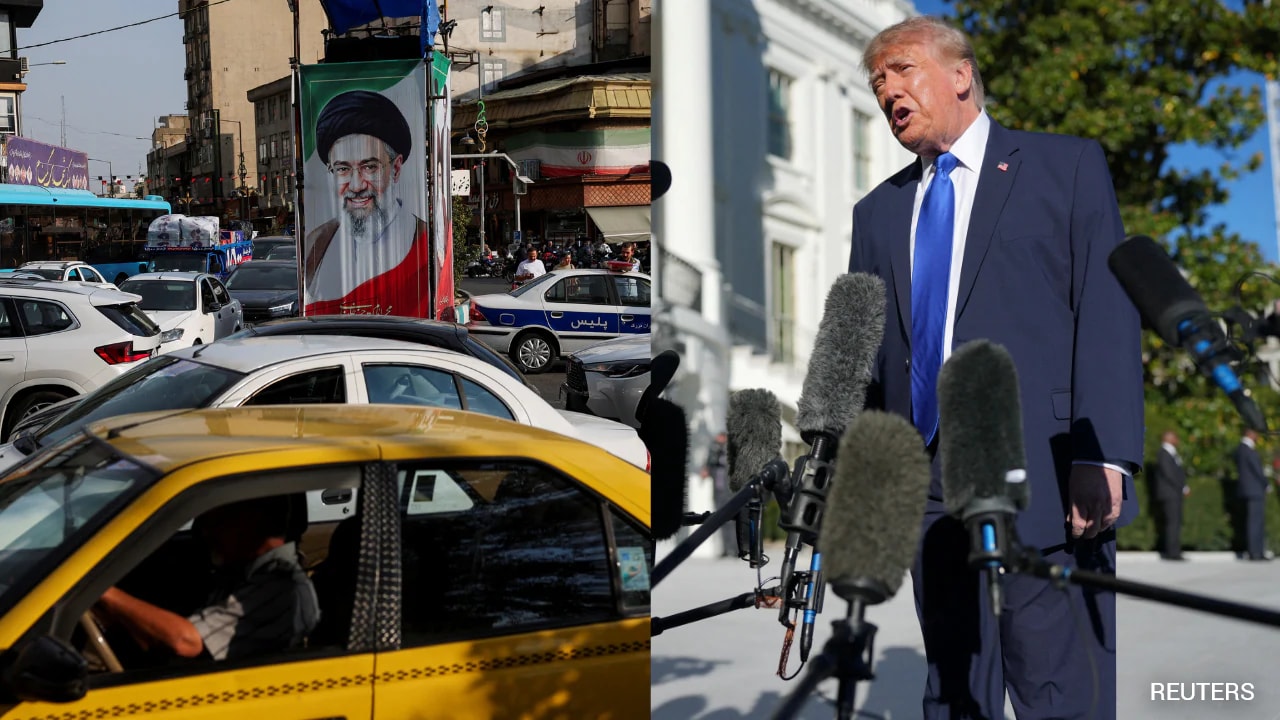
Cable news analysts love a forever war. It keeps the chyrons glowing red, the retired generals on retainer, and the ad revenue flowing. When Tehran responded to Donald Trump’s warning about hitting "one or two sites" by claiming any new conflict "could last longer," the media took the bait whole. They printed the quote as gospel, wrapped it in maps of the Persian Gulf, and started calculating the cost of another twenty-year Middle Eastern quagmire.
They are reading the script backward.
Tehran is not issuing a prophecy of endless attrition. They are issuing a desperate bluff designed to hide a terrifying reality: Iran cannot afford a long war, and Washington has zero intention of fighting one. The lazy consensus assumes that any kinetic clash between the United States and the Islamic Republic automatically defaults to the 2003 Iraq playbook—boots on the ground, nation-building, and decade-long insurgencies. That mental model is twenty years out of date. Modern coercion does not look like Fallujah. It looks like targeted, asymmetric destruction of regime solvency in forty-eight hours.
If you want to understand what happens next, stop listening to Tehran's press releases and start looking at their balance sheets, their air defense gaps, and the precise mechanics of limited coercive strikes.
The Myth of the Endless Quagmire
Every time tensions spike in the Strait of Hormuz, the same pundits trot out the same tired tropes. They point to Iran’s population of nearly 90 million, its mountainous terrain, and its network of regional proxies from Lebanon to Yemen. Their argument is simple: you can start a war with Iran, but you cannot finish it.
This is a fundamental misunderstanding of strategic objectives. A war only lasts forever when your goal is regime change and democratic reconstruction. Nobody in Washington—least of all Trump—is proposing an amphibious invasion of Bandar Abbas or a march on Tehran.
When analysts conflate a punitive strike on "one or two sites" with a full-scale ground invasion, they commit a category error. You do not need to occupy a country to break its leverage. You only need to destroy the specific assets that keep its leadership in power and its economy breathing.
I have sat in enough defense briefings and watched enough wargames to know how quickly the "quagmire" narrative collapses once you look at actual target decks. In Pentagon planning, limited kinetic options are built around escalation dominance—the ability to inflict unacceptable damage at a chosen rung of the ladder while convincing the adversary that climbing higher means total ruin. Tehran knows this. That is precisely why they are screaming about a "longer war" before a single Tomahawk has left its tube. They are trying to deter a short, surgical strike by convincing American voters that the price of admission is another Afghanistan.
Decoding Tehran's Rhetoric of Endurance
To see through the noise, you have to understand how the Islamic Revolutionary Guard Corps (IRGC) communicates. Their entire military doctrine, often referred to as mosaic defense, was built after watching the U.S. military dismantle Saddam Hussein’s conventional army in three weeks in 2003. Recognizing they could never win a symmetrical fight, Iranian planners decentralized their command structure and invested heavily in ballistic missiles, drones, and naval swarm tactics.
The point of mosaic defense is not to win a war. It is to raise the perceived cost of starting one.
When Iranian officials warn that a conflict "could last longer," they are engaging in classic deterrence by punishment. They want Washington to believe that hitting one or two nuclear or military facilities will trigger a multi-front, multi-year hemorrhage of global oil supplies, maritime trade, and American lives.
Look closely at the wording, though. "Could last longer" is a hedge. It is a defensive posture masquerading as aggression. Compare that to the actual capabilities on the ground:
- Air Defense Vulnerability: Recent exchanges in the region demonstrated that Iran’s premier air defense networks, including Russian-supplied S-300 systems, can be blinded and bypassed by fifth-generation stealth aircraft and standoff munitions without a single coalition pilot entering lethal range.
- Economic Fragility: Iran’s economy is strangled by chronic inflation, currency collapse, and crumbling energy infrastructure. In a protracted conflict, the regime cannot subsidize basic goods, maintain domestic security forces, and fund regional militias simultaneously.
- Proxy Exhaustion: The so-called "Axis of Resistance" has taken generational losses over the past two years. Hezbollah’s leadership and stockpiles have been degraded, Hamas is shattered as a conventional fighting force, and the Houthis are under persistent pressure. Tehran’s forward defense shield has massive holes in it.
A nation facing severe domestic unrest, rolling blackouts, and an empty treasury does not want a five-year war. A prolonged conflict does not unite the Iranian public around the flag; it starves them until they tear down the regime themselves.
What "One or Two Sites" Actually Means in Practice
People hear "one or two sites" and picture a symbolic pinprick—a few cruise missiles hitting an empty warehouse in the desert at 3:00 AM, followed by a press conference declaring mission accomplished. That is the Obama-era playbook, and it is dead.
In modern coercive strategy, targeting one or two high-value sites is not about symbolism. It is about structural decapitation of a specific capability.
Consider what happens if those two sites are not empty barracks, but the hardened enrichment halls at Fordow and the primary crude export terminal at Kharg Island.
- Fordow: Buried deep under a mountain near Qom, Fordow is the crown jewel of Iran’s nuclear breakout capability. Destroying or sealing it requires massive ordnance penetrators delivered by B-2 stealth bombers. If Fordow goes dark, years of covert nuclear leverage vanish in seconds.
- Kharg Island: Roughly 90 percent of Iran’s crude oil exports flow through this single island in the Persian Gulf. It is the financial jugular of the Islamic Republic. Taking Kharg Island offline does not require a single American boot on Iranian soil, yet it severs the regime's primary revenue stream overnight.
Imagine a scenario where Washington executes that exact strike package on a Tuesday night. By Wednesday morning, Iran’s nuclear breakout timeline is reset by half a decade, and its oil revenue drops to near zero. Now put yourself in the shoes of the Supreme Leader. What is your next move?
If you do nothing, you look weak to your hardline base and invite domestic revolt. If you launch a massive ballistic missile barrage at U.S. bases or Gulf oil fields, you validate Washington’s escalation and guarantee that the next target deck includes your refineries, your power grid, and your naval fleet.
That is the trap. Tehran’s threat of a "longer war" is an attempt to escape this binary choice before it is forced upon them.
Answering the Questions Nobody Wants to Ask
When readers search for news on a potential US-Iran clash, their queries are shaped by decades of media fear-mongering. Let us dismantle the three biggest misconceptions driving the current panic.
Will a strike on Iran trigger World War III?
No. Great powers do not commit suicide over regional clients. Neither Russia nor China has a mutual defense treaty with Tehran. Moscow is bogged down in its own grueling war of attrition and relies on Iranian components, meaning it cannot afford to open a direct front against the U.S. military. Beijing buys discounted Iranian crude, which makes China heavily invested in stability in the Persian Gulf. If Iran tries to close the Strait of Hormuz to punish the West, it cuts off China’s primary energy artery. Beijing will pressure Tehran to stand down long before it ever considers firing a shot on Iran’s behalf.
Can Iran actually close the Strait of Hormuz for months?
They can disrupt it for days, perhaps weeks, using sea mines, coastal anti-ship missiles, and fast-attack craft. They cannot close it indefinitely. The U.S. Fifth Fleet and allied naval forces have spent forty years gaming this exact scenario. Clearing mines and hunting mobile missile launchers is dangerous, grinding work, which is why shipping insurance rates would spike immediately. However, the U.S. Navy possesses overwhelming maritime and air superiority. Every time an Iranian fast-attack boat or coastal battery lights up its radar to target a tanker, it paints a bullseye on itself for airborne strike assets. A blockade is a self-depleting strategy for Tehran.
Does bombing nuclear sites just push Iran to build a bomb faster?
This is the favorite talking point of diplomatic think tanks, and it relies on flawed logic. The argument goes that if you bomb their facilities, they will kick out international inspectors, go underground, and sprint for a weapon. What this ignores is physics and engineering. You cannot sprint for a weapon if your centrifuges are crushed under three hundred feet of collapsed granite, your uranium conversion facilities are smoking craters, and your supply chains are under total blockade. Desire does not enrich uranium; intact industrial infrastructure does.
The Heavy Hitters Know the Score
You do not have to take my word for it. Look at the foundational work of Thomas Schelling, the Nobel Prize-winning economist who wrote the book on nuclear strategy and coercion. In Arms and Influence, Schelling drew a sharp line between brute force and coercion. Brute force succeeds when it is used; coercion succeeds when it is held in reserve—the power to hurt, paired with the credibility to use it.
Trump’s "one or two sites" framing is pure Schelling. By explicitly stating that the response could be limited to one or two targets, Washington is signaling two things simultaneously: first, that it has the capability to destroy what Tehran values most; and second, that it is leaving an off-ramp open so the regime can survive if it backs down.
Compare this to military strategist Edward Luttwak’s insights on the logic of war. Luttwak noted that the paradoxical logic of strategy often turns a tactical success into a strategic failure when a victorious power overreaches. A massive, open-ended air campaign against hundreds of targets across Iran would represent classic overreach—it would rally the population around the regime and force Tehran into a fight to the death. A surgical strike on one or two critical nodes avoids that trap entirely. It inflicts maximum strategic pain with minimum political blowback.
The Real Risk Nobody Is Talking About
If the media is dead wrong about a twenty-year quagmire, does that mean a limited strike is a clean, painless silver bullet? Hardly. Any strategist who tells you a kinetic operation carries zero risk is lying to you.
The genuine danger is not an endless war; it is miscalculation in the first seventy-two hours.
Here is the flaw in the "one or two sites" doctrine: it assumes rational actors operating with perfect information on both sides. In the fog of war, command-and-control networks degrade. A local IRGC commander in the Persian Gulf, cut off from Tehran by electronic warfare, might decide on his own initiative to fire an anti-ship missile at a U.S. destroyer. If that missile hits and kills fifty American sailors, the political calculus in Washington changes instantaneously. The off-ramp disappears. A limited coercive strike transforms overnight into a punitive campaign to sink the entire Iranian navy.
There is also the problem of regional spillover. Even if Tehran avoids a full-scale war, it can unleash asymmetric chaos through cyberattacks on Western financial infrastructure or activate sleeper cells to target soft assets abroad. These actions do not win wars, and they do not last forever, but they create sharp, ugly shocks that markets hate.
Admitting these risks does not validate the "forever war" narrative. It simply puts the danger where it actually belongs: in the immediate, violent friction of crisis management, not in a fictional replay of the Iraq invasion.
How to Read the Geopolitical Chessboard Now
If you are an investor, a policymaker, or simply someone trying to separate signal from noise, stop reacting to every threatening headline out of Tehran. Use a sharper filter:
- Watch oil infrastructure, not troop deployments. If Washington moves additional carrier strike groups or heavy bombers into the region, that is standard deterrence posture. If you see evacuation orders for non-essential personnel at diplomatic posts in Iraq and the Gulf, coupled with sudden spikes in war-risk maritime insurance, the strike window is open.
- Ignore the rhetoric; track the intermediaries. When Tehran is genuinely worried about an imminent strike, their public statements get louder while their backchannel messages through Oman and Qatar get frantic. Watch the flight trackers of Qatari and Omani diplomatic aircraft—that is where the real negotiations happen.
- Price in volatility, not catastrophe. In any kinetic exchange, crude oil will spike violently on the initial news as algorithms trade the worst-case scenario. Historically, unless physical export capacity like Kharg Island is destroyed, those spikes fade within weeks as spare capacity from Saudi Arabia and the UAE absorbs the shock.
Tehran’s warning of a "longer war" is the geopolitical equivalent of a cornered fighter yelling about how much stamina he has before the first bell rings. It is theater meant for an American audience conditioned by two decades of Middle Eastern fatigue to flinch at the mere mention of escalation.
Wars do not last longer because the weaker side wishes it. They last longer when the stronger side lacks a clear objective. Washington’s objective here is brutally simple, tightly scoped, and measured in hours, not years. Tehran knows it cannot survive a long fight—which is why, if the bombs actually start falling, this will be over before the cable news panels even finish designing their graphics.