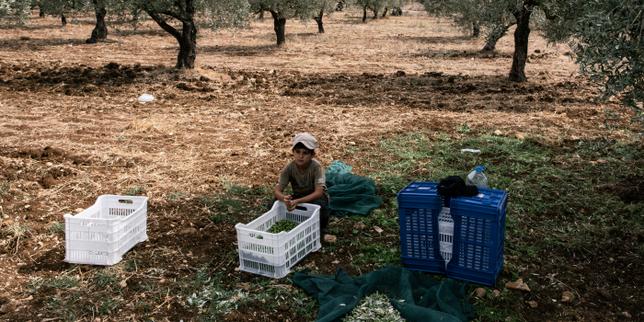
Olives still fall onto nets in southern Lebanon. Cameras still find weathered hands. Headlines still write the same tidy elegy.
Stop. Look closer. If you found value in this piece, you might want to read: this related article.
When commentators read a story like "Dans le sud du Liban, une récolte des olives dans l’ombre de l’occupation israélienne," the reflex is predictable. They see a simple binary: heroic farmers versus military pressure, ancient tradition versus modern conflict, resilience versus ruin. That framing feels emotionally complete. It is also analytically lazy.
Real agricultural economies along contested borders do not run on sentiment. They run on input costs, labor bottlenecks, irrigation logistics, press capacity, transport risk, currency friction, and buyer trust. Ignore those mechanics and you do not understand southern Lebanon's olive sector. You only see a postcard with barbed wire in the margin. For another look on this story, refer to the recent coverage from The Washington Post.
I have spent years advising agricultural supply chains, commodity buyers, and rural development teams across fragile markets in the Eastern Mediterranean and Levant. I have watched well-meaning NGOs and foreign buyers blow millions of dollars on "solidarity" sourcing deals that collapsed within two seasons because nobody checked moisture levels, cold-chain transit, or basic pruning schedules. Good intentions do not press oil. Margin, yield, and logistics do.
You Are Asking the Wrong Question About the Harvest
Most people ask whether southern Lebanese farmers can still harvest their olives. That is the wrong question. Even in harsh conditions, people pick fruit when survival or family pride is on the line.
The real question is whether a high-cost, high-friction, rain-fed agricultural model can survive structural shocks without collapsing into subsistence nostalgia.
Let us separate botany from romance. Olea europaea is a tough tree. It tolerates poor, rocky soils and dry summers better than most commercial crops. Yet resilience of the tree is not resilience of the business. Olive yields swing naturally from year to year—a biological pattern known as alternate bearing—and when conflict or military restrictions delay pruning, pest control, soil tilling, or timely picking, yield quality takes a direct hit.
Pick too late because access near the border is restricted or unsafe, and acidity rises, bitterness shifts, and flavor profile degrades. Miss the pressing window or rely on backed-up mills, and oxidation starts early. International buyers who pay premiums for extra virgin olive oil care about free fatty acid percentages, peroxide values, polyphenol counts, and traceability—not just a tragic backstory.
The Lazy Consensus That Keeps Failing Farmers
The standard media consensus treats southern Lebanon's olive harvest almost exclusively as a story of political shadow and human endurance. There is truth in the human strain. Border zones carry real danger, displacement, psychological fatigue, and sudden access limits. Denying that would be dishonest.
Where the consensus goes off the rails is pretending that political pressure is the only reason the sector struggles.
Consider the structural flaws that existed long before any single military flare-up:
- Fragmented landholdings: Small family plots make mechanized harvesting and shared irrigation coordination difficult. Labor per kilo stays high.
- Macroeconomic distortion: Lebanon's prolonged currency crisis and banking freeze wrecked credit access, imported inputs, and predictable domestic pricing. When diesel, fertilizer, nets, and spare mill parts cost more or become erratic, every hectare costs more to work.
- Export bottlenecks: Shipping high-value food products out of a volatile market faces higher insurance, routing delays, compliance hurdles, and buyer skepticism.
Calling every failure in the grove a direct byproduct of military occupation lets domestic policy failures, supply-chain inefficiency, and bad commercial planning off the hook. That is not sharp reporting. It is intellectual outsourcing.
A Quick Reality Check on Terms Before We Go Further
Precision saves money. People throw around three terms as if they mean the same thing:
- Harvest volume: Total weight of olives picked. High weight does not mean high value if fruit is bruised, overripe, or pressed late.
- Extraction rate: The percentage of oil squeezed out of the olive paste by weight. Poor orchard care or stressed trees can pull extraction down sharply, turning a busy harvest into a thin return.
- Extra virgin status: A strict chemical and sensory standard—not a marketing adjective. Free fatty acidity must stay low (typically at or below 0.8% for extra virgin under International Olive Council standards) with zero sensory defects.
I have seen buyers sign off on "artisan extra virgin" lots without lab certificates because the story sounded authentic. One lab test later, high acidity or lampante-grade defects killed the contract. Sentiment cannot pass a chemical assay.
Imagine a Scenario Where Border Tensions Vanish Tomorrow
Thought experiment: Imagine a scenario where military friction along the Blue Line stops completely on Monday morning. Checkpoints disappear. Drone surveillance ends. Every grove opens up without restriction.
What happens next?
Within a few weeks, the relief would be real. Farmers would reach neglected terraces. Families would breathe easier. Yet by the next harvest, the hard commercial math would still be waiting. Young workers who left for Beirut, the Gulf, or Europe do not automatically return to backbreaking seasonal picking for low margins. Aging trees still need disciplined rejuvenation pruning. Mills still need reliable power and maintenance. Export brands still need consistent volume and quality year after year, not just when headlines spike.
Ending hostility is necessary for peace and human dignity. It is not, by itself, a business plan.
What People Also Ask—And Why Half the Premise Is Broken
Why is the olive harvest so important to southern Lebanon?
Because it is both a cultural anchor and an economic buffer in regions with limited industrial alternatives. In rural southern Lebanon, olive work mobilizes extended families, anchors seasonal income, and ties households to ancestral land.
Still, do not mistake cultural centrality for macro-economic salvation. Olives matter deeply at the household and village level, especially when cash is tight, but they cannot carry an entire regional economy on their own without value addition, better post-harvest handling, and real market access.
How does military presence or occupation affect olive farmers on the ground?
Direct access limits, fear of shelling or unexploded ordnance, damaged roads, and disrupted daily routines shrink the window to prune, spray, harvest, and transport fruit. Even the threat of escalation changes behavior: people rush picks, skip maintenance, or abandon outer plots.
The brutal honesty here is that uncertainty is often more destructive to farming than a single event. Agriculture runs on calendars. Conflict runs on disruption.
Can fair-trade or solidarity buying save Lebanese olive oil?
Only if it is a bridge, not a crutch. Solidarity purchasing helps move inventory during crises, and ethical consumers exist. Yet charity-driven buying has a ceiling. If a product costs more, arrives late, lacks consistent grading, or relies purely on pity, repeat orders dry up once the news cycle moves on.
What Actually Works on the Ground
If you care about farmers in southern Lebanon—whether as an importer, donor, agronomy specialist, or policymaker—stop treating them like museum pieces and treat them like producers operating in a brutal market.
- Audit post-harvest speed first: Getting olives from tree to press quickly and cleanly protects oil quality faster than almost any expensive gadget. Shorten the time lag and keep fruit out of heat and standing piles.
- Invest in pruning and soil basics, not vanity branding: Shiny labels mean nothing if the oil in the bottle is mediocre. Disciplined pruning, moisture conservation, and clean storage containers move the needle on real yield and grade.
- Build dual-channel sales: Pair mission-aligned buyers with quality-driven specialty food buyers who judge strictly on taste, lab specs, and reliability. If one channel stalls, the other keeps cash moving.
- Price risk honestly: Do not build a spreadsheet assuming zero transport delays or zero input spikes. Build buffers into lead times and working capital from day one.
Where This Contrarian Take Can Burn You
I am not claiming that geopolitical pressure is harmless or imaginary. Downplaying security risks near an active border is reckless. If someone pushes aggressive commercial timelines in a high-risk zone without contingency plans, people or inventory can get caught in the crossfire.
There is another trap: sounding cold. Pointing out supply-chain flaws or economic realities can sound insensitive when families are losing homes, livelihoods, or lives. Good analysis requires clear eyes and a steady pulse, not callousness. If you strip away human suffering to look "clever," your analysis loses truth too.
What Heavy Hitters in Agricultural Economics Would Tell You
Look at the work of institutions like the International Olive Council on quality standards and market dynamics, or agricultural economists studying fragile Mediterranean economies—scholars and practitioners such as Eckart Woertz on Middle Eastern food and agricultural systems, or Rami Zurayk on agrarian change and rural livelihoods in Lebanon and the Levant. Their body of work points to the same hard truth: agrarian distress in the region sits at the intersection of political instability, resource constraints, fragile institutions, and market structure.
Anyone who reduces that web to a single slogan is selling a simplified narrative, not an understanding of how rural economies actually bend or break.
Next time you read about olives being gathered in the shadow of conflict, look past the drama of the frame. Check the clock between picking and pressing. Check the cost of fuel and labor. Check who actually gets paid.
That is where the real story is hiding.