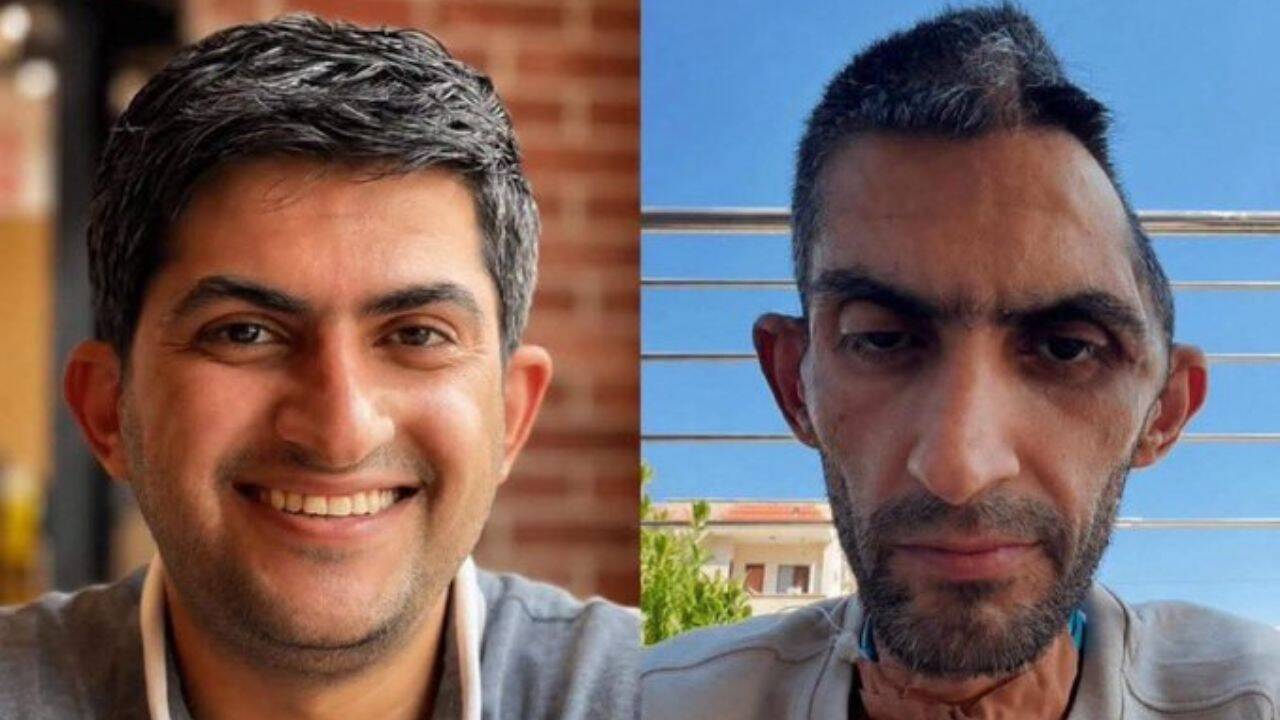
Two Moments in Time
The shutter clicks. It takes a fraction of a second to trap a life in silver halide or digital code. Most of these frozen slices of time are forgotten, buried under the digital avalanche of the modern world. But occasionally, a photograph refuses to dissolve. It sticks to the retina. It demands an accounting.
Consider two images of the same man, captured months apart. Also making headlines in this space: The Mechanics of State Repression and Advocacy Friction in Xinjiang.
In the first, he is whole. There is a weight to his frame, a certain baseline dignity that we take for granted when we walk down a street untouched by conflict. His eyes meet the lens with the steady gaze of someone who occupies his own skin by right, not by permission.
In the second photograph, the man has been hollowed out. The skin stretches like parchment over a ribcage that resembles a ruined hull. His posture is collapsed, a physical manifestation of systematic degradation. The change is so absolute that the brain struggles to connect the two portraits to the same human soul. This is not the natural erosion of time. This is the deliberate, accelerated unmaking of a person. More details on this are explored by Associated Press.
These images did not emerge from a vacuum. They were captured by a Palestinian journalist whose camera became a tool of record against an apparatus designed to keep its operations entirely in the dark. Prisons are, by design, architectural blind spots. They are built with thick walls and heavy gates to keep people in, but also to keep eyes out. When a camera manages to pierce that perimeter, the resulting images do more than document a condition. They disrupt a narrative.
The Architecture of the Unseen
Behind the wire of modern detention facilities, a quiet war is waged against identity. It is easy to look at a photograph of physical emaciation and see only the deprivation of food. That is a grave error. The true starvation is holistic, targeting the mind, the spirit, and the fundamental sense of self.
When a person enters the administrative detention system, they enter a legal twilight. Charges are frequently withheld. Evidence is classified as secret, unavailable to the accused or their legal representation. This is not a trial; it is an indefinite pause button pressed on a human life. Weeks turn into months, and months bleed into years under a system where the release date is a mirage that recedes every time you approach it.
Imagine the psychological toll of that uncertainty. Every morning begins with the exact same question: Is this the day it ends, or is this just day one of another year? The mind cannot anchor itself. Without a fixed horizon, the internal architecture of a person begins to crumble long before the body reflects the damage.
The journalist who captured these photographs understood that the physical deterioration was merely the outward symptom of an inward execution. The sunken cheeks and bruised limbs are the graffiti left behind by an unchecked authority. To look at these images is to realize that the prison is not just a place where bodies are kept; it is a factory where human beings are systematically disassembled.
The Weight of the Witness
Being a journalist in a conflict zone is often romanticized as an exercise in adrenaline and high-stakes truth-telling. The reality is far more grueling, quiet, and haunted. It means carrying the weight of what you see without the luxury of looking away. It means realizing that your camera is both a shield and a target.
For a Palestinian journalist documenting the reality of Israeli detention centers, the camera is an instrument of immense friction. Every frame captured is an act of defiance against a policy of enforced invisibility. The authorities rely on the absence of visual proof to maintain the status quo. If there are no pictures, the arguments remain abstract. They can be debated in the sterile halls of international diplomacy, neutralized by euphemisms like "security measures" and "administrative procedures."
But a photograph destroys abstraction.
When the public is confronted with the stark, unyielding reality of a human being reduced to a skeleton, the language of bureaucracy fails. You cannot policy-brief away a collarbone that threatens to pierce the skin. You cannot issue a press release that explains away the haunted, vacant stare of a man who has forgotten the sound of his own name spoken with kindness.
The photographer becomes the bridge between the hidden cell and the public conscience. It is a lonely position. It requires standing in the space between the victim's agony and the world's indifference, holding up a mirror and refusing to lower it until the viewer blinks.
The Mechanics of Isolation
To understand how a human being changes so drastically between two photographs, one must look at the daily routine of confinement. It is a slow, rhythmic grinding down.
Reports from human rights organizations detailing conditions within these facilities paint a consistent picture. Overcrowding is not a logistics failure; it is a deliberate pressure tactic. Cells designed for four people hold a dozen. The air grows thick, stale, and hot. Sleep becomes a luxury negotiated in shifts.
Then comes the food. Or rather, the lack of it. The rations are calculated not to sustain health, but to prolong survival at the absolute minimum threshold. It is a starvation of increments. The body begins to consume itself, burning through fat reserves, then muscle tissue, until the skeleton stands out in sharp relief.
But the physical hunger is paired with a sensory starvation. The walls are uniform. The clothing is uniform. The faces of the guards are hidden behind visors or distorted by hostility. For months on end, a detainee may see nothing of the natural world—no trees, no open sky, no shifting of the seasons. The world shrinks to the dimensions of a concrete box.
Consider what happens to the human mind when it is denied any positive input. It turns inward, chewing on its own anxieties, replaying the moments of arrest, agonizing over the family left behind without a breadwinner or a protector. The silence of the cell is loud with unanswerable questions.
The Script of Denial
Whenever images like these surface, a predictable choreography unfolds. The institutions responsible for the conditions immediately move to contain the narrative damage.
First comes the blanket denial. The images are dismissed as anomalies, fabrications, or the result of pre-existing conditions. The public is told that the facility operates under the highest standards of international law, that medical care is provided, that rights are respected. The bureaucracy deploys its formidable vocabulary to smooth over the jagged edges of the visual evidence.
When denial fails, justification takes its place. The individual in the photograph is painted not as a victim of systemic abuse, but as a dangerous entity whose treatment, however harsh, is a regrettable necessity for the preservation of public safety. The debate is skillfully shifted from the morality of the treatment to the alleged identity of the treated.
This is the oldest trick in the authoritarian playbook: make the victim unrecognizable as a human being, and the public will acquiesce to their destruction. If you can convince people that the man in the photo is fundamentally different from them—that he does not feel pain the same way, that his family does not mourn him the same way—then the collective conscience remains untroubled.
The journalist’s photographs strike directly at this strategy. By showing the before and the after, they force the viewer to acknowledge the trajectory. They show that this was a man, whole and distinct, before the machine took hold of him. They prevent the easy dismissal of his suffering by showing exactly what was stolen from him.
Beyond the Frame
The danger of consuming these images on a screen is that we treat them as a finite story. We look, we feel a fleeting wave of horror or indignation, and then we swipe to the next piece of content. We treat the photograph as the end of the narrative rather than the beginning of an ongoing reality.
The man in those photos, whether he is currently released or still confined, carries the prison within him. The skin may eventually reclaim its fullness if he is fed, and the bones may retreat beneath the surface, but the internal ledger is never wiped clean. The memory of the cold, the hunger, and the absolute powerlessness leaves a permanent watermark on the psyche.
And outside the frame, the system continues to operate. The cameras are barred from the vast majority of these rooms. For every image that manages to slip through the cracks and ignite a brief firestorm on social media, there are thousands of men and women whose deterioration occurs in absolute privacy, witnessed only by the concrete and the guards.
The true power of the Palestinian journalist's work is not that it captured a singular atrocity. It is that it provided a window into a routine. It invites us to look at the two photographs and realize that the space between them is filled with days of silent, unrecorded agony that happens every hour, every day, just over the horizon of our collective attention.
The lens closes. The image remains. It looks back at us, asking a question that no press release can answer.